Home » Blog » Should I Use CBO or ABO for Print on Demand Ads?
Quick Answer
For print on demand beginners, start with ABO (Ad Set Budget Optimization). ABO gives you control over exactly how much each ad set spends, which is critical when you’re learning to read your data. CBO (Campaign Budget Optimization) lets Facebook decide where to allocate your budget—great for scaling, but risky when you don’t yet understand what’s working and why.
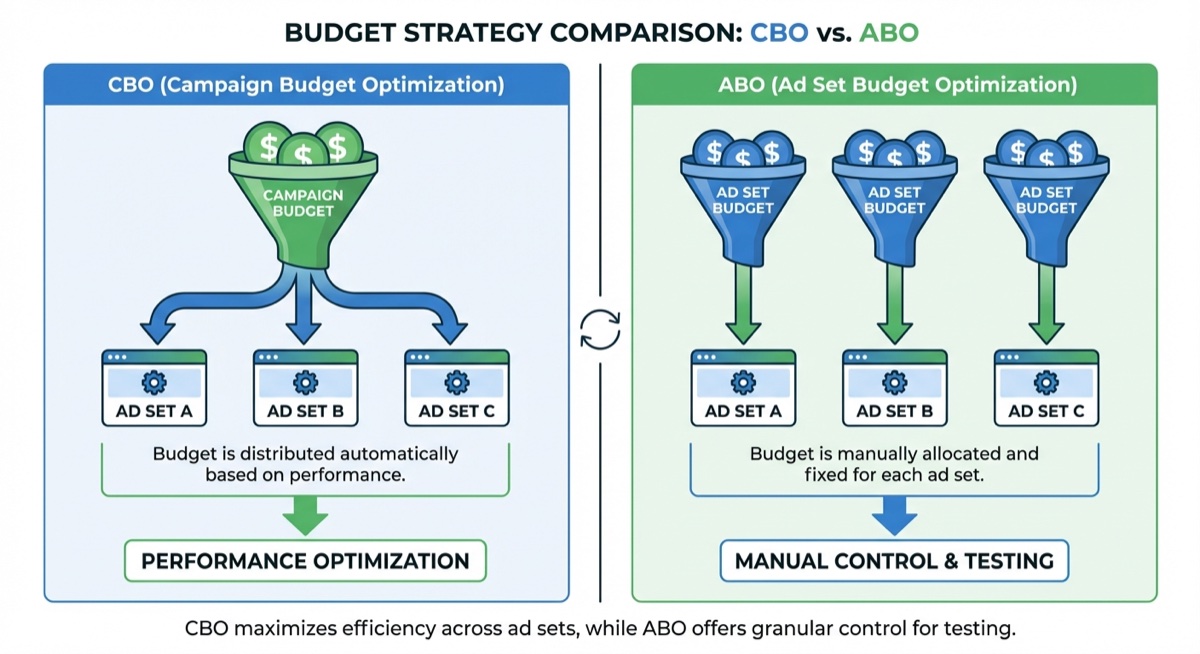
CBO allocates from one pool; ABO gives each ad set its own budget
What’s the Difference Between CBO and ABO?
These two approaches determine how Facebook distributes your advertising budget across ad sets within a campaign.
ABO (Ad Set Budget Optimization): You set a specific budget for each ad set. If you have three ad sets at $10/day each, each one spends exactly $10. You have full control.
CBO (Campaign Budget Optimization): You set one budget at the campaign level, and Facebook’s algorithm decides how to distribute it across your ad sets based on performance. With a $30/day campaign budget, one ad set might get $20 while another gets $5.
According to Meta’s own documentation, CBO is designed to “find the lowest cost opportunities across all your ad sets.” That sounds great on paper. But there’s a catch for beginners.
Why Beginners Should Start With ABO
When you’re just starting out with print on demand ads, your #1 priority is learning what works. You need to understand which audiences respond to your designs, which creatives get clicks, and what patterns lead to sales.
CBO works against this learning process in three ways:
1. It hides what’s actually happening. When Facebook shifts budget around automatically, you can’t tell if an ad set failed because it was a bad audience or because it simply never got enough budget to prove itself.
2. The algorithm optimizes for the wrong thing early on. With limited data (which is where every beginner starts), CBO often chases cheap clicks rather than actual purchases. Matt Schmitt, co-founder of Skup, puts it bluntly: “The algorithm doesn’t know your business yet. You’re training it with every dollar you spend—ABO keeps you in the driver’s seat during that training period.”
3. Small budgets get spread too thin. Most beginners start with $20-50/day total. Split that across 3-4 ad sets with CBO, and Facebook might starve your best performer while feeding one that looks promising but never converts.
When CBO Makes Sense
CBO isn’t bad—it’s just premature for beginners. Here’s when to consider switching:
You have proven winners. After running ABO campaigns, you’ve identified ad sets that consistently generate sales at your target cost per acquisition (CPA).
You’re spending $100+/day. At higher budgets, CBO’s optimization has more room to work effectively without starving any single ad set.
You want to scale horizontally. Testing many similar audiences at once? CBO can efficiently find the best performers within a group.
You’ve established baseline metrics. You know your typical CTR, CPC, and conversion rate. Now you can spot when CBO is making bad decisions.
ABO helps you learn your numbers before letting the algorithm take over
The Skup Approach: ABO First, CBO Later
Inside Skup’s Incubator program, the recommended progression looks like this:
Phase 1 (Testing): Use ABO with $5-10 per ad set. Test one variable at a time—different audiences, different creatives. Run for 3-5 days minimum before making decisions.
Phase 2 (Validation): Winners from Phase 1 get increased ABO budgets ($15-25/day). You’re confirming that early results weren’t flukes.
Phase 3 (Scaling): Now CBO becomes valuable. Take your validated winners, group similar audiences together, and let CBO optimize within proven territory.
This approach has helped Skup students like Adam Schneider hit $179K in 90 days and Simon reach $550K in 3 months. The common thread? They didn’t rush to automation before understanding their fundamentals.
Common Mistakes to Avoid
Switching to CBO too early. Wait until you have at least 3-4 winning ad sets with consistent performance over 7+ days.
Using CBO with wildly different audiences. If one ad set targets dog lovers and another targets political interests, CBO will have trouble optimizing effectively.
Setting CBO budgets too low. If your CPA is $15 and you set a daily budget of $20 across 4 ad sets, most won’t get enough data to work with.
Ignoring the data after switching. CBO doesn’t mean “set and forget.” Monitor daily to catch when the algorithm makes poor choices.
Mixing testing and scaling. Keep ABO for testing new concepts, CBO for scaling proven ones. Don’t combine them in the same campaign.
FAQ
Can I switch from ABO to CBO on an existing campaign?
Yes, but it resets the learning phase. A better approach: create a new CBO campaign with your winning ad sets from the ABO campaign. This preserves your original data and gives you a clean comparison.
What budget should I set for CBO campaigns?
A good rule of thumb: your daily CBO budget should be at least 5x your target CPA multiplied by the number of ad sets. If your target CPA is $12 and you have 4 ad sets, start with at least $240/day ($12 × 5 × 4). This ensures each ad set can potentially get enough budget to generate sales.
Does Facebook prefer CBO or ABO?
Facebook pushes CBO because it gives their algorithm more control (and more opportunity to spend your money). But “preferred by Facebook” doesn’t mean “better for your business.” The platform’s interests and your interests aren’t always aligned, especially when you’re learning.
The Bottom Line
CBO vs ABO isn’t about which one is “better.” It’s about which one fits your current stage. ABO builds your knowledge foundation. CBO scales what you’ve proven works.
Start with ABO. Learn your numbers. Test methodically. Then graduate to CBO when you have winners worth scaling. That’s how you build a real print on demand business instead of gambling on Facebook’s algorithm.
The smartest beginners in print on demand don’t start with the most crowded product. They start where buyers already assign value fast. Caps do that. The category sits inside a market that’s projected to grow to $57.49 billion to $102.99 billion by 2033 to 2034, which means the broader print-on-demand market could multiply 5 to…
You’re at the point where your store is proving the model works. Orders are coming in. A few designs are carrying more than the rest. Your ads are finding buyers. But your fulfillment partner is starting to feel like the ceiling, not the engine. Turnaround slips. Print quality varies. Margin gets thinner every time a…
A lot of people start looking up how to sell print on demand at the same moment in life. Work feels fixed. Income feels capped. You want something you can build after hours that does not require buying piles of inventory, renting a warehouse, or guessing how many units to order. That is why POD…