Home » Blog » When Should I Kill a Facebook Ad? The Print on Demand Decision Framework
When Should I Kill a Facebook Ad? The Print on Demand Decision Framework
You’ve been staring at your Facebook Ads Manager for the last hour, watching your ad spend tick up while sales stay flat. Your gut says kill it, but what if tomorrow brings the breakthrough? This is the daily torture of every print-on-demand seller running paid traffic.
The good news: there’s a data-driven framework that removes the guesswork. Stop making emotional decisions about your ads and start following proven benchmarks.
Quick Answer
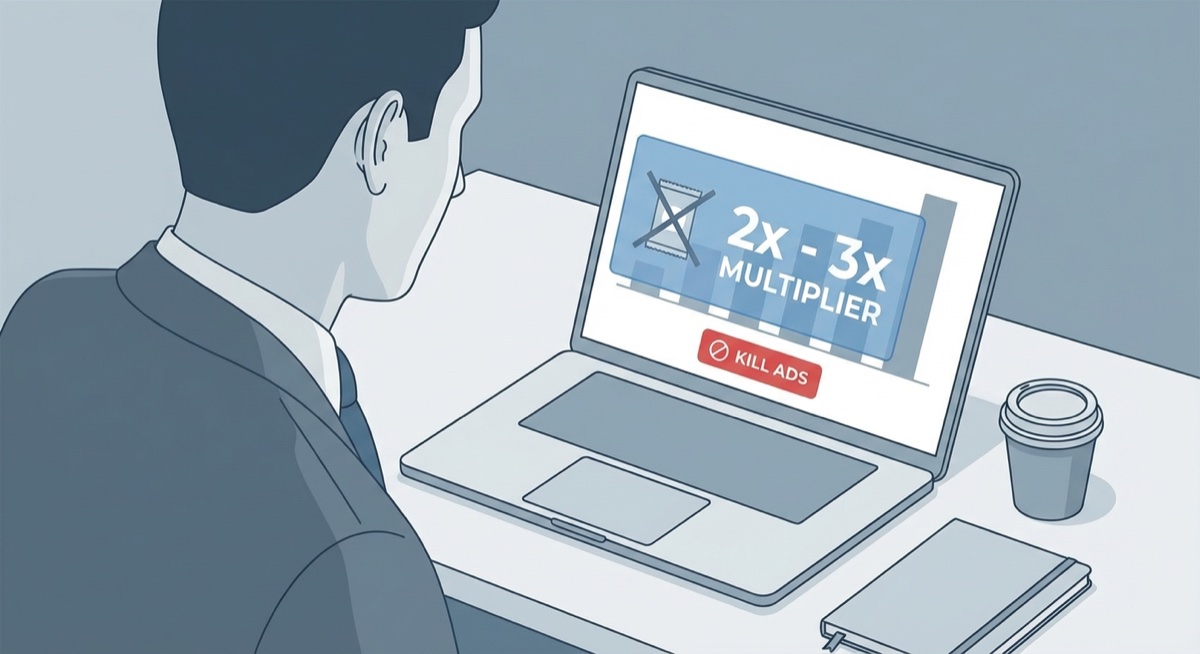
Kill a Facebook ad after it spends 2-3x your product’s price without a sale. If you’re selling a $30 t-shirt, give the ad $60-90 before cutting it. If you’ve spent that amount with zero add-to-carts, the ad isn’t connecting with your audience and won’t suddenly start working.
The 2-3x rule: spend up to 2-3 times your product price before making a kill/scale decision
The 2-3x Rule Explained
This benchmark comes from years of print-on-demand advertising data across thousands of Skup students. Matt Schmitt, who has coached over 5,000 POD sellers, explains the logic:
“If you can’t get a sale within 2-3x your product price, the ad creative or targeting isn’t working. Facebook’s algorithm needs positive signals to optimize, and if you’re not getting them early, you’re just burning money hoping for a miracle.”
Here’s why the math works:
At 1x product price: Too early to judge — sample size too small
At 2x product price: Enough data to see patterns — no sales = warning sign
At 3x product price: Decision time — kill it or scale it
Beyond 3x without results: You’re gambling, not advertising
What to Check Before Killing an Ad
Don’t just look at sales. These metrics tell you if an ad has potential worth saving:
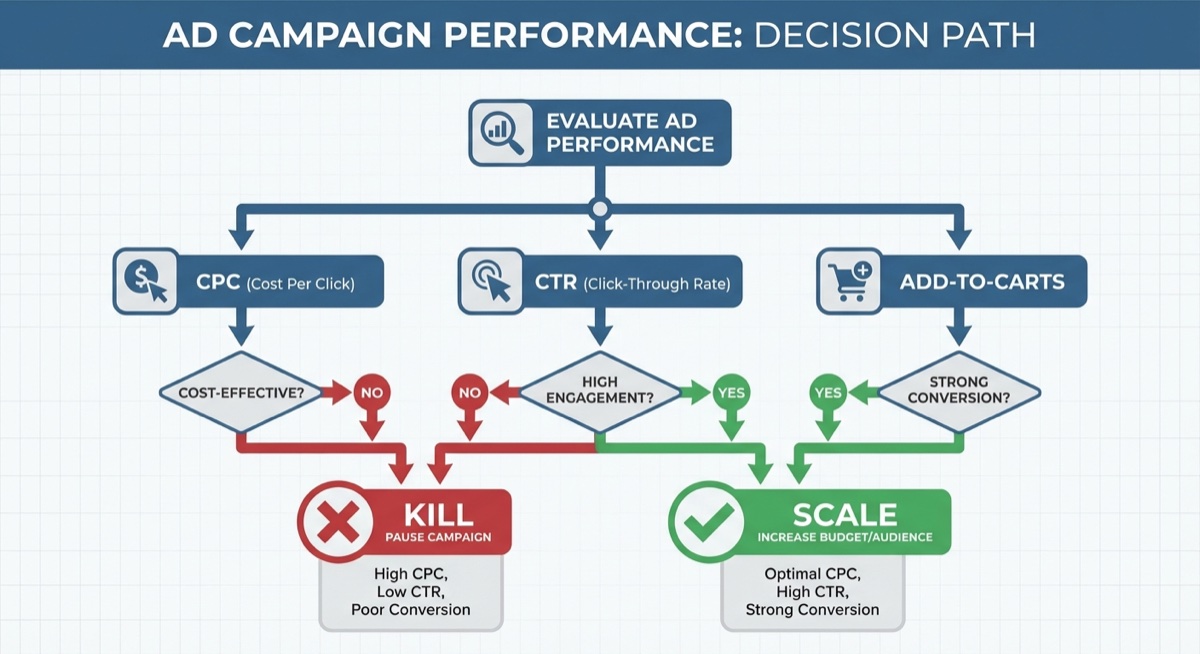
Cost Per Click (CPC)
For print-on-demand, aim for $0.50-$1.50 CPC. If your cost per click is above $2.00, your creative isn’t compelling enough to generate interest. A high CPC means people are scrolling past your ad — the problem is at the ad level, not the landing page.
Add-to-Carts
This is your early signal. If you’re getting clicks but zero add-to-carts after spending 1.5x your product price, something’s wrong with the offer, product page, or price point. An ad with clicks but no add-to-carts is a page problem, not an ad problem.
Click-Through Rate (CTR)
Healthy CTR for POD ads is 1% or higher. Below 0.5%? Your creative isn’t stopping the scroll. Between 0.5-1%? Acceptable but improvable. Above 1.5%? Strong creative that deserves more testing.
The Decision Matrix
Use this framework based on your spend relative to product price:
Spend Level
Results
Action
1x product price
No sales, good CPC, add-to-carts
Keep running
1x product price
No sales, bad CPC, no add-to-carts
Consider killing early
2x product price
No sales, no add-to-carts
Kill the ad
2x product price
No sales, but 2+ add-to-carts
Keep running, check page
3x product price
No sales
Kill the ad
3x product price
1+ sale, profitable ROAS
Keep running, consider scaling
Use this decision matrix to remove emotion from your ad management
Common Mistakes When Killing Ads
After analyzing thousands of POD ad accounts, these are the mistakes that cost sellers the most money:
1. Killing Too Early
Turning off an ad after $15 spent because you’re anxious doesn’t give Facebook’s algorithm enough data. You need at least 500-1,000 impressions before the ad has a fair chance. Patience isn’t optional — it’s strategic.
2. Waiting Too Long
The opposite problem: hoping an ad will “turn around” after spending 5x your product price with no results. Hope is not a marketing strategy. According to Skup data, ads that don’t show positive signals by 2-3x spend almost never become profitable.
3. Looking at the Wrong Timeframe
Judging today’s performance only ignores yesterday’s data. Always look at the cumulative results, not just the last 24 hours. A bad day doesn’t mean kill it; a bad week does.
4. Killing Winners During Learning Phase
Facebook ads go through a “learning phase” where the algorithm optimizes delivery. During this phase (typically 50 conversion events), performance fluctuates. Killing an ad mid-learning can eliminate a future winner.
5. Not Testing Enough Variations
If every ad you run fails at the 2-3x threshold, the problem isn’t the ads — it’s the offer, targeting, or product. Test at least 3-5 creative variations before blaming the platform.
What to Do After Killing an Ad
Killing an ad isn’t failure — it’s data collection. Here’s how to use that information:
Document what didn’t work: Note the creative style, copy angle, and targeting
Analyze the metrics: Was it a creative problem (low CTR/high CPC) or a page problem (clicks but no add-to-carts)?
Test a new angle: Don’t just remake the same ad. Change the hook, image style, or audience
Review your product: If multiple ads fail for the same product, the issue might be the design itself
FAQ
Should I kill an ad that got one sale but isn’t profitable?
Not immediately. One sale proves the product can convert. Optimize by testing new creatives or adjusting targeting. If after another 2x spend you’re still unprofitable, then consider killing it. Sometimes a winning ad is one creative iteration away.
How long should I wait before judging a brand new ad?
Give new ads at least 48-72 hours and the 2-3x product price threshold before making decisions. Facebook’s algorithm needs time to find your audience. Checking hourly and making snap decisions leads to worse outcomes than patient, data-driven choices.
Should I kill an ad with good engagement but no sales?
Engagement (likes, comments, shares) without sales means your ad attracts attention but your offer or page doesn’t convert. Before killing, check your product page, pricing, and checkout process. The ad might be doing its job — the problem is downstream.
The Bottom Line
Killing Facebook ads is part of the game. Even experienced sellers have more losers than winners — the goal is to identify losing ads quickly and scale winners aggressively. The 2-3x rule gives you a clear, emotionless framework: spend up to 2-3x your product price, evaluate the data, and make a decision.
Stop agonizing over every ad and start treating advertising like the numbers game it is. Track your metrics, follow the framework, and remember: every ad you kill teaches you something about your audience.
For step-by-step training on Facebook ads for print-on-demand, including live ad account reviews and proven scaling strategies, check out Skup’s Apparel Cloning System.
The smartest beginners in print on demand don’t start with the most crowded product. They start where buyers already assign value fast. Caps do that. The category sits inside a market that’s projected to grow to $57.49 billion to $102.99 billion by 2033 to 2034, which means the broader print-on-demand market could multiply 5 to…
You’re at the point where your store is proving the model works. Orders are coming in. A few designs are carrying more than the rest. Your ads are finding buyers. But your fulfillment partner is starting to feel like the ceiling, not the engine. Turnaround slips. Print quality varies. Margin gets thinner every time a…
A lot of people start looking up how to sell print on demand at the same moment in life. Work feels fixed. Income feels capped. You want something you can build after hours that does not require buying piles of inventory, renting a warehouse, or guessing how many units to order. That is why POD…