How to Reduce Customer Acquisition Cost in Print-On-Demand
For print-on-demand brands, slashing your customer acquisition cost boils down to two core moves: optimizing your ad spend and maximizing the value of every single visitor. It's an exciting challenge that, once mastered, unlocks incredible growth for your eCommerce business.
Instead of spreading your budget thin and hoping for the best, the real key is to pinpoint your most profitable channels and double down. At the same time, you need to be relentlessly improving your store's conversion rate to turn more of those expensive clicks into actual customers. This is how you build a powerful, profitable brand.
Why Ad Costs Are Skyrocketing (And Your First Big Move)
If you've felt the sting of rising ad costs, you're not imagining it. It's getting more expensive across the board to bring in new customers, and eCommerce brands are feeling the heat. The reasons are simple but powerful: more competition is flooding the ad platforms, and major privacy changes are making it harder to target effectively.
This isn't just a minor annoyance; it’s a direct hit to your profitability. Back in 2013, brands were losing an average of $9 for every new customer they acquired. By 2025, that number is projected to hit $29—a staggering 222% increase.
For print-on-demand entrepreneurs, this trend can feel intimidating, but it's actually a huge opportunity. While others struggle, you have the chance to get strategic and build a smarter, more efficient system. Platforms like Meta and Google are saturated, creating intense bidding wars that drive up costs for those who aren't focused.
But this tough environment also creates a massive opportunity for anyone willing to be strategic. The path to a lower CAC isn't about finding some secret hack; it's about building a smarter, more focused acquisition engine that puts you in control and makes you excited about the possibilities.
Regain Control by Focusing Your Ad Budget
The most effective first step you can take is to stop trying to be everywhere at once.
When you're managing a significant ad spend, spreading your budget across five or six different channels is a classic recipe for diluted data and mediocre results. It leads to a CAC that just keeps climbing.
The goal is to identify the one or two channels that are actually delivering high-quality, profitable customers and go all-in. This means you have to be ruthless in auditing your current efforts. It’s about making cold, hard, data-driven decisions instead of chasing every shiny new platform. This is where the real excitement begins, as you start seeing your budget work smarter for you.
"The fastest way to burn your marketing budget is by treating all channels equally. True scale comes from identifying your top-performing channel and feeding it everything you've got. It’s about depth, not breadth."
This whole process is about moving from a scattered, inefficient ad spend to a focused, profitable one.
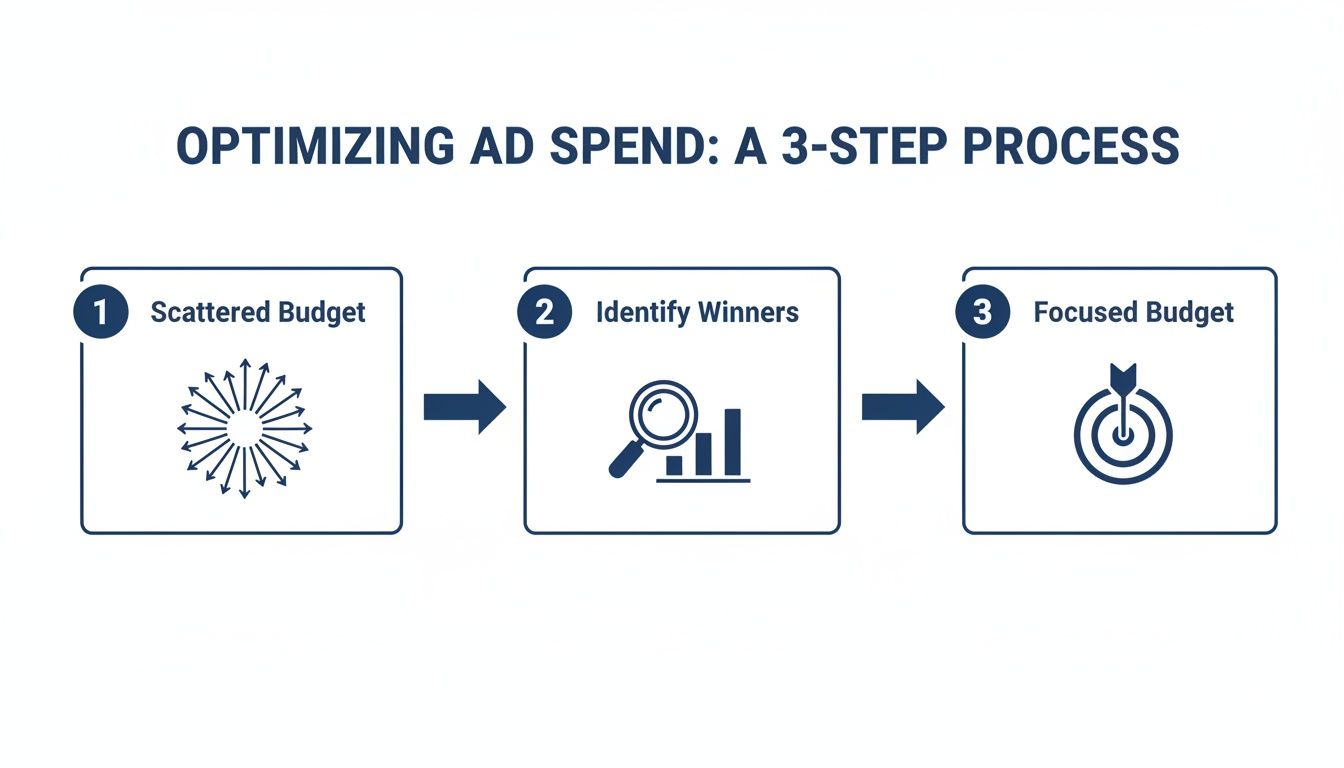
When you funnel your resources into proven winners, you give the platform algorithms more data to work with. This leads to better optimization, sharper targeting, and, ultimately, lower costs over time.
How To Pinpoint Your Winning Channels
So, how do you actually find these "winning" channels? It all starts with tracking the right metrics. You have to look past the surface-level vanity numbers like clicks and impressions and drill down to what really impacts your bottom line. To get a solid grip on your numbers, Mastering Customer Acquisition Cost Calculation is non-negotiable.
Here are the only metrics that truly matter when you're comparing channels:
- Cost Per Acquisition (CAC): How much are you really paying to get one new customer?
- Return On Ad Spend (ROAS): For every dollar you put in, how many dollars in revenue are you getting back out?
- Customer Lifetime Value (LTV): Is the channel bringing you one-time buyers or loyal fans who come back for more?
When you lay these numbers out side-by-side for channels like Meta Ads, Google Ads, and TikTok, the picture becomes crystal clear. You'll almost always find that one channel is dramatically outperforming the others. That's your signal. That's where you focus your budget and your energy.
And if you're struggling to figure out your profit targets, our guide on how to calculate your break-even ROAS gives you a straightforward framework.
Your Channel Performance at a Glance
Use this simple table to diagnose the health of your acquisition channels. It helps you quickly identify which channels are true profit drivers and which are draining your budget, so you can make data-backed decisions.
| Acquisition Channel (e.g., Meta Ads, Google Ads, TikTok) | Monthly Spend | New Customers Acquired | Cost Per Acquisition (CAC) | Return On Ad Spend (ROAS) | Action (Keep, Optimize, or Cut) |
|---|---|---|---|---|---|
| Meta Ads | |||||
| Google Ads | |||||
| TikTok Ads | |||||
| Influencer Marketing | |||||
| Email Marketing |
By filling this out honestly, you'll immediately see where to focus your efforts. The goal isn't to be active everywhere; it's to be profitable where it counts.
Slash Acquisition Costs with Winning Creatives and Offers

Alright, you’ve dug into the data and figured out which of your ad channels are actually making you money. Now for the fun part: the creative itself. This is your chance to shine and connect with customers.
In a world of endless scrolling, your ad is your one and only shot to make an impression. A generic design or a lukewarm offer is the fastest way to get ignored, which means you're just burning cash and watching your customer acquisition cost climb.
Think of your ad creative and offer as the engine of your whole acquisition strategy. A powerful one can get you surprisingly far, even on a shoestring budget. A sputtering engine? It'll just burn through fuel without getting you anywhere. This is doubly true in print-on-demand, where the visual hook is everything.
You can have the most dialed-in, perfect targeting on the planet, but if your ad doesn't resonate, you're just paying to show people something they couldn't care less about. The real goal is to create an ad that stops the scroll cold.
The Apparel Cloning Mindset for Creatives
One of the biggest opportunities for new POD entrepreneurs is to avoid trying to reinvent the wheel with every single design. Spending weeks brainstorming what you think is the next "viral" hit, only to launch it to the sound of crickets, is a slow and expensive way to learn.
Instead, we lean heavily on what we teach in our Apparel Cloning course. Let me be clear: this isn't about ripping off other people's work. It’s about systematically identifying the creative concepts, messaging angles, and visual styles that are already proven winners in the market.
You find what’s hitting a nerve with customers in a niche, then you put your own unique spin on it. Your design, your voice, your brand. This simple shift dramatically cuts your risk because you're building on a foundation of success, not just a blank page and a prayer. It lets you enter the market with a much higher chance of hitting a home run, which is critical for keeping that initial CAC down and getting you excited about your results.
Your Secret Weapon for Rapid Creative Testing
The classic challenge with the Apparel Cloning mindset has always been speed. Finding a great concept is one thing; turning it into a dozen high-quality, unique designs with professional mockups used to be a massive bottleneck. This is the exact problem we built AvatarIQ to solve.
AvatarIQ is our internal AI tool designed to completely demolish that friction. It lets you:
- Generate Unlimited Unique Designs: Give the AI a concept, and it will churn out countless design variations in minutes. Not days, not weeks. Minutes.
- Create Pro-Level Mockups: Instantly slap those new designs onto photorealistic mockups without ever touching a camera or hiring a model. This is key for figuring out how to get the most from your custom product images and making your products look legit.
This speed is your ultimate unfair advantage. It means you can test more ideas, faster than anyone else. Instead of spending a week perfecting one design you think will work, you can launch ten different variations and let the market tell you what it wants. More testing leads to finding winners faster, which directly drives down your acquisition costs.
The key to reducing customer acquisition cost isn't finding one perfect ad. It's building a system that allows you to test creative variations so rapidly that you can't help but find winners.
When you remove the design bottleneck, you unlock the ability to systematically find out what your audience actually wants to buy.
Our 5x5x5 Testing Framework
To pull this all together, we use a simple but incredibly powerful framework for systematically finding winning ad combinations. We call it the 5x5x5 framework, and it’s built to test the three most important levers of any ad campaign.
Here’s the breakdown:
- Five Different Designs: Fire up AvatarIQ and create five distinct design variations based on your core cloned concept. These could have different color palettes, text layouts, or graphic elements.
- Five Different Ad Copy Angles: Write five totally unique hooks for your ad copy. One angle might focus on a discount, another on an emotional trigger, and a third on a specific product feature.
- Five Different Offers: Come up with five compelling offers. Think things like "Free Shipping," "Buy 2, Get 1 Free," "25% Off Today Only," or a special bundle deal.
From there, it’s all about mixing and matching. You don’t have to run all 125 possible combinations at once (please don't). Start small. Find an initial winning design, then test your different copy and offers against it.
This structured approach is what moves you from guessing to knowing. It allows you to consistently find high-performing ads that slash your CAC and fuel profitable growth. This is how you turn eCommerce from a slot machine into a science.
Use AI for Smarter Design and Targeting
Let's be real: "Artificial Intelligence" has been a buzzword for years, but it's finally moved from a trendy topic to a ridiculously powerful tool that's changing the print-on-demand game. If you're not using it, you're missing out on a massive opportunity for growth.
When you get it right, AI becomes your secret weapon for slashing customer acquisition costs. It's your chance to automate the slow, expensive parts of running your business so you can actually focus on growth and get excited about the future.
The two places AI delivers an immediate punch are design creation and ad targeting. By leaning into these tools, you can move faster, make smarter decisions, and turn your ad budget into an efficient customer-acquiring machine. It's the definition of working smarter, not harder.
Automate Design and Mockups to Test Faster
The biggest hurdle in print-on-demand has always been the creative bottleneck. You know the drill: coming up with unique designs, then creating professional, photorealistic mockups. It can be slow and expensive if you’re paying freelancers for every concept. This friction kills your momentum and severely limits how many new ideas you can actually test.
This is exactly why we built AvatarIQ. Instead of staring at a blank screen or waiting days for a designer, you can generate an endless stream of unique apparel designs with a few clicks. It completely removes the guesswork and the waiting, letting you flood your store with fresh ideas to see what truly resonates with your audience.
This speed is a total game-changer for your CAC. The faster you can test, the faster you find a winner. And once you find that winner? You can scale your ad spend with confidence, knowing you're pouring money into a product people actually want to buy.
The old way was spending days to perfect a single design and just hoping it worked. The new way is to create dozens of designs in minutes and let the data tell you which one to bet on. That speed is your new competitive edge.
This shift in workflow means you’re no longer burning your precious ad budget on unproven hunches. You’re making data-backed decisions right from the start.
Use AI to Fine-Tune Your Ad Targeting
Okay, so you have a library of awesome designs. Now what? You have to get them in front of the right people. This is where AI-powered ad platforms like Meta's are incredibly powerful, but they are only as smart as the data you feed them. Your job is to give the algorithm the right signals so it can find your ideal customer without wasting your money.
This all starts with building a detailed customer avatar. I'm talking way beyond basic demographics like age and gender.
- What are their real passions and hobbies?
- What online communities are they obsessed with?
- What specific slang or inside jokes do they use?
- What emotions actually drive them to click "buy"?
The more detailed this avatar is, the better you can guide the ad platform's targeting. You can build out interest-based audiences that are so specific you're practically leading the algorithm to pockets of highly engaged buyers. When the platform’s AI has a crystal-clear picture of who it’s looking for, it stops wasting your budget showing ads to people who will never buy.
The impact here is massive. We're seeing businesses use these strategies to cut their customer acquisition costs by up to 50%. Think about it: in an industry where creating designs and mockups could take hours or cost $50-$100 per project with a freelancer, a tool like our own AvatarIQ software at Skup—for just $97/month—is a no-brainer. This isn't just hype; research shows that advanced personalization through AI drives 10-30% gains in marketing efficiency. You can discover more insights about customer acquisition statistics and see how the top brands are crushing it with this approach.
When you combine AI-generated designs with AI-powered targeting, you create a powerful, self-improving system. You're no longer just throwing ads at the wall. You’re delivering hyper-relevant creative to a finely tuned audience, which is the most direct path to profitable growth and a lower CAC. This is how you build a resilient, scalable eCom business you're actually excited about.
Optimize Your Store to Convert More Visitors
Getting traffic to your store is only half the battle. You can run the best ads in the world, but if your website is clunky, confusing, or just doesn't feel trustworthy, you're basically lighting your ad budget on fire. This is where Conversion Rate Optimization (CRO) becomes your secret weapon for slashing your customer acquisition cost.
Let's break it down. Say you spend $100 to get 100 visitors to your site, and only one person buys. Your CAC is $100. Now, what if you could convince just one more of those 100 visitors to buy? Suddenly, your CAC is cut in half to $50, and you didn't have to spend a single extra cent on ads.
That’s the magic of CRO. It's all about finding and plugging the "leaks" in your store where potential customers lose interest and bail. Even a few small, smart tweaks can have a massive impact on your profitability.
Your Product Page Is Your Sales Pitch
Make no mistake: the product page is where the sale is won or lost. It's not just a spec sheet; it's your 24/7 digital salesperson, and its job is to convince visitors that they need your product. A weak product page is a direct flight to an abandoned cart and a sky-high CAC.
The single biggest lever you can pull here is your product imagery. In the apparel game, people buy with their eyes. Grainy, generic mockups just scream "amateur" and instantly kill trust. This is exactly why a tool like AvatarIQ is so game-changing. It lets you create professional, photorealistic mockups that make your designs look like they belong in a high-end boutique.
When a customer sees a crisp, clear image of a t-shirt on a model who looks like them, it creates an instant connection. They can actually visualize themselves wearing it, and that confidence is what gets them to smash that "Add to Cart" button.
Writing Descriptions That Actually Sell
Once your amazing images grab their attention, your product description has to seal the deal. Don't just list features like "100% cotton" or "unisex fit." You need to tell a story.
- Who is this for? Speak directly to your customer's identity, their passions, their sense of humor.
- What feeling does it spark? Does it make them feel nostalgic, proud, or like they're in on an inside joke?
- Why buy it now? Use a touch of urgency to prompt action without sounding desperate.
Pair that storytelling with clean, scannable bullet points covering the essentials like sizing, materials, and care instructions. This one-two punch of emotion and information is incredibly effective. For a much deeper look, check out our complete guide on how to increase your eCommerce conversion rate for more actionable strategies.
Your product description shouldn't just describe the product. It should describe the customer who is buying it, making them feel seen and understood. That's how you turn a casual browser into a loyal fan.
Build Trust with Social Proof
It's human nature: we are way more likely to buy something if we see that other people have already bought it and loved it. This is social proof, and it's one of the most powerful conversion tools in your arsenal.
- Product Reviews: Actively ask your customers for reviews. A small discount on a future purchase can work wonders here.
- Testimonials: Hand-pick your most glowing reviews and feature them prominently on your product pages.
- User-Generated Content (UGC): Nothing sells apparel like seeing it on real people. Feature photos of your actual customers wearing your gear on your site and social channels.
This kind of proof shows new visitors you’re a legitimate brand with happy customers, which goes a long way in reducing their hesitation to buy.
A high conversion rate is absolutely critical for lowering your customer acquisition cost. For a comprehensive walkthrough, this data-driven playbook for improving your ecommerce conversion rate is an excellent resource. By focusing on these on-site optimizations, you create a fantastic shopping experience that turns more window shoppers into paying customers, giving you more fuel to grow your print-on-demand empire.
Build a Loyal Community to Maximize Lifetime Value
So far, we've been laser-focused on the front end of your business—your ads, your store—and shaving down that initial cost to get someone to buy. That's crucial, but it's not the whole game. The real secret to building a wildly profitable print-on-demand empire isn't just about the constant hunt for new customers; it’s about keeping the ones you already have.
This is where you graduate from short-term tactics to a long-term strategy, building a stable, scalable foundation for your brand. This is the part that makes eCom truly exciting.
If you're only ever chasing that first sale, you're stuck on an expensive treadmill. Each month, the counter resets to zero. But when you build a loyal community, every dollar you pour into ads becomes an investment that pays you back again and again. This is how you flip the script and make the business economics work for you.
Start Building Your Email List from Day One
Your email list is, without a doubt, the single most valuable asset you will ever own in your eCommerce business. It’s a direct line to your biggest fans—people who have already given you their money or explicitly asked to hear from you. Unlike your social media following, you own this channel. No algorithm can take it away.
From the day you launch your store, your number one priority should be capturing email addresses. Don't overthink it. A simple pop-up offering 10% off their first order is all you need to get the ball rolling.
Once they're on your list, the real magic starts. Now you can nurture that relationship without paying an ad platform for the privilege.
- Exclusive Offers: Give your list early access to new drops or subscriber-only deals.
- Behind-the-Scenes Content: Share the story behind a new design or show off happy customers repping your gear.
- Ask for Feedback: Involve them in the creative process. Let them vote on the next t-shirt idea.
This steady communication builds a genuine connection, turning one-time buyers into repeat customers who feel like they're part of your brand's story.
The Golden Ratio: LTV to CAC
To really grasp the power of retention, you need to get intimate with two metrics: Customer Lifetime Value (LTV) and its relationship with your Customer Acquisition Cost (CAC).
Customer Lifetime Value (LTV) is the total profit you expect to make from a customer over their entire relationship with your brand. It’s a forward-looking metric that tells you the true worth of every person you bring into your world.
The north star for any healthy, scalable business is hitting a 3:1 LTV-to-CAC ratio. For every $1 you spend to acquire a customer, you should aim to get at least $3 back in profit over their lifetime.
When you hit that 3:1 ratio, you've officially unlocked a sustainable growth engine. You can now confidently reinvest your profits back into acquiring more customers, knowing that each one will be profitable in the long run. It's the key to predictable scaling.
This simple ratio tells you if your marketing is working and if your business model is actually built to last.
How Retention Makes Every Ad Dollar Work Harder
Focusing on keeping customers is the most direct path to lowering your effective CAC over the long haul. Research consistently shows that it is far more cost-effective to retain a customer than to acquire a new one. The data is clear: retention strategies can turn one-time buyers into lifetime fans for 5-7x cheaper than acquiring new ones.
In the print-on-demand world, where we've driven over $50M in sales at Skup since 2015, this concept is pure gold. You can explore the latest customer acquisition cost trends to see just how critical this is across the board.
Think of it this way: you pay your CAC once to get a customer through the door. If they buy from you three more times over the next year thanks to your email list, you've effectively quartered the acquisition cost for those four sales. Your initial investment gets spread out, or amortized, across multiple purchases.
This is especially powerful in apparel, where profit margins can hit 30-50%. Every one of those repeat purchases is almost pure profit, completely free of any new ad spend. By building a community and maximizing your LTV, you create a business that isn't just surviving—it's thriving. This is your ticket off the daily ad-spend grind and onto building something with real, lasting value.
Your Questions, Answered
Let's tackle some of the most common questions we hear from print-on-demand founders trying to get a handle on their acquisition costs.
What Is a Good Customer Acquisition Cost for a New Print-On-Demand Store?
This is the big one, but there's no magic number here. A "good" CAC is completely relative to your product's price and, more importantly, your profit margins. Instead of obsessing over a specific dollar amount, you need to be laser-focused on your LTV-to-CAC ratio. That's your true north.
For a business that's ready to scale, a 3:1 ratio is the gold standard. For every dollar you put into acquiring a customer, you're getting three dollars back over their lifetime. When you're just starting out, you might be closer to 1:1, and that’s okay. As you dial in your retention with things like email marketing, you'll see that LTV climb, building a much healthier, more profitable business.
The most successful print-on-demand brands don't just focus on the first sale. They obsess over the second, third, and fourth, because that's where the real profit is made, making the initial CAC a smart investment rather than just a cost.
This shift in perspective—from a single transaction to a long-term customer relationship—is what separates the stores that struggle from the ones that thrive.
How Long Should I Test an Ad Before Deciding If It Is Working?
I get it. It's incredibly tempting to pull the plug on an ad after a day or two if the sales aren't rolling in. But nine times out of ten, that's a huge mistake. Ad platforms like Meta need time and data to work their magic and find your ideal audience. This "learning phase" isn't just a suggestion; it's critical.
As a rule of thumb, we recommend letting a new ad run for at least 3-5 days to gather enough data to make an informed decision. In those early days, don't just stare at the purchase numbers. Look at your leading indicators: what's your click-through rate (CTR)? Your cost per click (CPC)? If those metrics are strong, it's a great sign your creative is hitting the mark. It's often worth giving the ad a little more time to see if the conversions catch up. A little patience goes a long way here.
Can I Really Lower My CAC Without Spending More on Tools?
Absolutely. While powerful tools like AvatarIQ are designed to give you a massive shortcut in your creative workflow and testing, many of the most impactful strategies for lowering CAC cost you nothing but time and effort.
- Sharpen your product descriptions. Telling a compelling story doesn't cost a dime, but it can have a huge impact on your conversion rate.
- Optimize your mobile experience. This is non-negotiable. A clunky mobile site is a guaranteed sale-killer. Making it smooth has a direct impact on your bottom line.
- Build your email list from day one. Capturing an email gives you a free channel to market to interested people forever. It's an asset you own.
- Go deep, not wide. Instead of spreading your budget thin across five different ad channels, pick one or two and truly master them. This focus saves money and almost always yields better results.
At its core, lowering your CAC is about working smarter, not just spending more. It’s about fine-tuning every step of the customer journey, from the first ad they see to the unboxing experience and the follow-up email. That entire journey is your chance to build a brand people actually care about.
Ready to stop guessing and start building a profitable print-on-demand business you're excited about? At Skup, we provide the training, tools, and coaching to help you scale. Learn more about our proven systems at https://skup.net.