How to Increase Average Order Value and Boost Your Profits
Ready to crank up your store's profits without pouring more money into ads? The secret is getting a handle on how to increase average order value (AOV). It's all about encouraging the customers you already have to add just one more item to their cart. This is your chance to unlock some serious growth, and honestly, it's one of the most exciting parts of running an eCommerce business.
This single metric is the most powerful lever you can pull to scale your print-on-demand store. It’s what turns good months into record-breaking ones. You're about to discover how simple, yet powerful, these strategies can be.
The Untapped Goldmine in Your eCommerce Store
So many entrepreneurs get stuck on the customer acquisition treadmill, constantly chasing new buyers. I get it. But the real opportunity for explosive growth often lies with the people who are already on your site, wallet in hand. The potential here is absolutely massive, and you're in the perfect position to seize it.
Average Order Value is just the average amount a customer spends every time they check out. Even a small bump here can have a massive impact on your bottom line.
Think about it: you’ve already done the hard work. You got them to your store. They trust you enough to make a purchase. By showing them the right offers at the right time, you can seriously increase that transaction size, which directly boosts your profitability and your return on ad spend (ROAS). This is where the real fun begins!
Why AOV Is a Game-Changer for Print-on-Demand
The print-on-demand world is blowing up, and that creates a perfect storm of opportunity for anyone who masters AOV. Shoppers are actively looking for unique, personalized stuff, and they're willing to pay for it.
The global POD market was valued at around $13 billion in 2025 and is projected to skyrocket to nearly $103 billion by 2034. That tells you one thing: customers aren't just buying; they're ready to spend more on products that really connect with them.
This is your chance to work smarter, not harder.
Every customer visit isn't just a single sale. It's an opportunity for a much bigger, more profitable transaction. To really make this work, it helps to have solid omnichannel e-commerce solutions in place that give customers a smooth experience no matter where they find you.
By focusing on increasing your Average Order Value, you are maximizing the revenue from every single customer you acquire. This is the core strategy that separates struggling stores from 8-figure print-on-demand empires.
The strategies we're about to dive into are simple, actionable, and incredibly effective. Let's get into the specifics.
Key AOV Strategies at a Glance
Before we break down the step-by-step plays, here's a quick look at the core tactics we'll be covering. Think of this as your cheat sheet for boosting your store's AOV.
| Strategy | What It Is | Best For |
|---|---|---|
| Product Bundling | Selling multiple related items together as a single package, often at a slight discount. | Increasing perceived value and moving complementary products. |
| Upselling | Offering a customer a more premium or upgraded version of the product they're considering. | Stores with tiered product lines (e.g., standard vs. deluxe). |
| Cross-selling | Suggesting related or complementary items to the one a customer has already added to their cart. | Selling accessories or items that naturally go together. |
| Order Minimums | Setting a spending threshold to unlock a reward, like free shipping or a free gift. | Encouraging customers to add small "filler" items to their cart. |
| Subscriptions | Offering a recurring order for consumable products, usually at a discounted price. | Stores selling replenishable goods like coffee, supplements, or apparel basics. |
These are the fundamental building blocks. You'll learn how to turn every transaction into a chance to delight your customers while growing your business sustainably. Get excited, because you’re about to unlock a powerful new way to scale.
Crafting Product Bundles Customers Cannot Resist
If you're looking for the fastest way to bump up your average order value, product bundling is your ticket. It’s a straightforward play: package a few products together and sell them as a single unit, usually for a bit less than if someone bought them all separately.
But the real magic isn't just the discount. It's the psychology behind it. A killer bundle makes the customer feel like they've stumbled upon an incredible deal that was put together just for them. It cuts through the decision fatigue and instantly jacks up the perceived value of their cart.
We're not talking about basic "buy one, get one" stuff here. This is about building strategic packages that just make sense to the customer—packages so good they feel like they’ve found a clever shortcut to getting more of what they already love.
The Power of Perceived Value
A great bundle never feels like a random pile of products. It should tell a story or solve a complete problem. Your job is to think about how your products can be grouped together to create a cohesive, must-have experience.
This strategy is an absolute beast in the print-on-demand world. You have the flexibility to mix and match designs and products without ever touching physical inventory. You're not just selling a t-shirt anymore; you're selling a whole vibe.
Here are a few bundle ideas that consistently crush it:
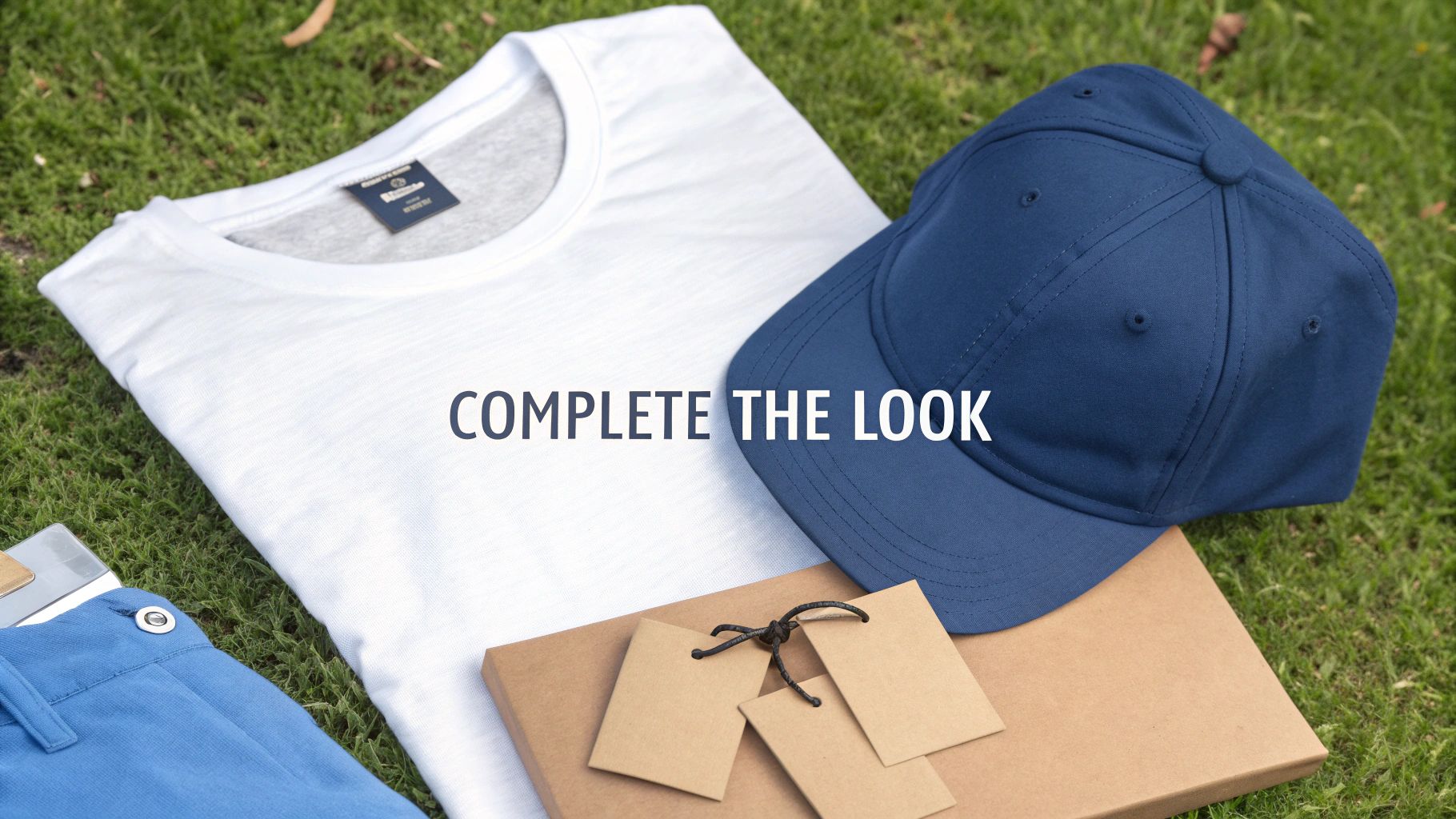
- The 'Complete the Look' Bundle: This is a classic for a reason, especially in apparel. Think a t-shirt with a matching hat, a hoodie with joggers that share a design element, or a tank top with a tote bag from the same collection.
- The 'Starter Kit' Bundle: Absolutely perfect for reeling in new customers. Combine your best-selling t-shirt with a popular mug and a few stickers. It’s an awesome introduction to your brand's world.
- The Themed Collection Bundle: Go all-in on a specific niche or interest. If your brand is for hikers, you could bundle a "Mountain Explorer" t-shirt, a branded water bottle, and a beanie.
The goal is to make the bundle so logical and tempting that the customer thinks, "Well, I was going to buy the shirt anyway, but getting the matching hat for just a few bucks more? It's a no-brainer."
Designing Your Bundle Offers
How you present your bundle is just as crucial as what's in it. You need to make it look like a premium, hand-picked collection, not a bargain bin deal. This is where creating killer mockups becomes non-negotiable.
Tools like AvatarIQ are a game-changer here, letting you quickly spin up professional, high-quality images of your bundled products. Picture this: a lifestyle mockup of a person actually wearing your t-shirt and the matching hat. That kind of visual storytelling makes the offer ten times more compelling and helps the customer instantly see themselves with the whole set.
Without strong visuals, a bundle can look cheap. With great mockups, it looks like a high-value collection they can't pass up.
Pro Tip: Ditch the plain white backgrounds. Use a tool like AvatarIQ to generate dynamic lifestyle mockups that place your bundles in real-world situations. This immediately elevates the perceived value and makes your offer far more desirable.
One of the surest ways to open up more bundling opportunities is to simply expand your product catalog. We've seen it time and time again: successful print-on-demand stores draw a direct line between a wider product range and a higher AOV. In fact, the most successful merchants add an average of seven new products per month. Stores offering diverse items like hoodies, mugs, and phone cases consistently blow single-product stores out of the water. You can see more data on this in the full POD industry report.
Pricing Your Bundles for Profit
Okay, let's talk numbers. The discount is what grabs their attention, but you have to be smart about it to protect your profit margins. A discount between 10% and 20% off the combined individual prices is usually the sweet spot.
Here’s a quick breakdown of what that looks like:
| Bundle Type | Individual Prices | Total Price | Bundle Price (15% Off) | Customer Savings |
|---|---|---|---|---|
| T-Shirt + Hat | Shirt: $28, Hat: $22 | $50.00 | $42.50 | $7.50 |
| Hoodie + Joggers | Hoodie: $45, Joggers: $40 | $85.00 | $72.25 | $12.75 |
| T-Shirt + Mug | Shirt: $28, Mug: $18 | $46.00 | $39.10 | $6.90 |
Remember, the goal isn’t just a bigger sale—it's to increase your total profit from that one customer. Even with a discount, selling more items at once is often more profitable because your customer acquisition cost gets spread across a larger order. For a deeper dive into offer creation, check out our comprehensive guides on product bundles.
By building thoughtful, visually stunning, and smartly priced bundles, you're giving customers an offer that feels too good to refuse. This is one of the most effective levers you can pull to watch your AOV—and your bottom line—start climbing.
Mastering the Art of Upsells and Cross-Sells
Once a customer decides to buy something, a powerful window of opportunity swings open. They've already committed, which means they trust your brand. This is the absolute best time to present an upsell or cross-sell, turning a good order into a great one.
These two tactics are fundamental if you're serious about increasing your average order value, but they work in slightly different ways. An upsell nudges a customer toward a more premium version of the item they already want. A cross-sell, on the other hand, suggests a related or complementary product.
Both are incredibly effective because they tap into a customer's existing buying momentum. The real trick is to make these offers feel like genuinely helpful suggestions, not just a pushy sales pitch.
Upselling The Smart Way
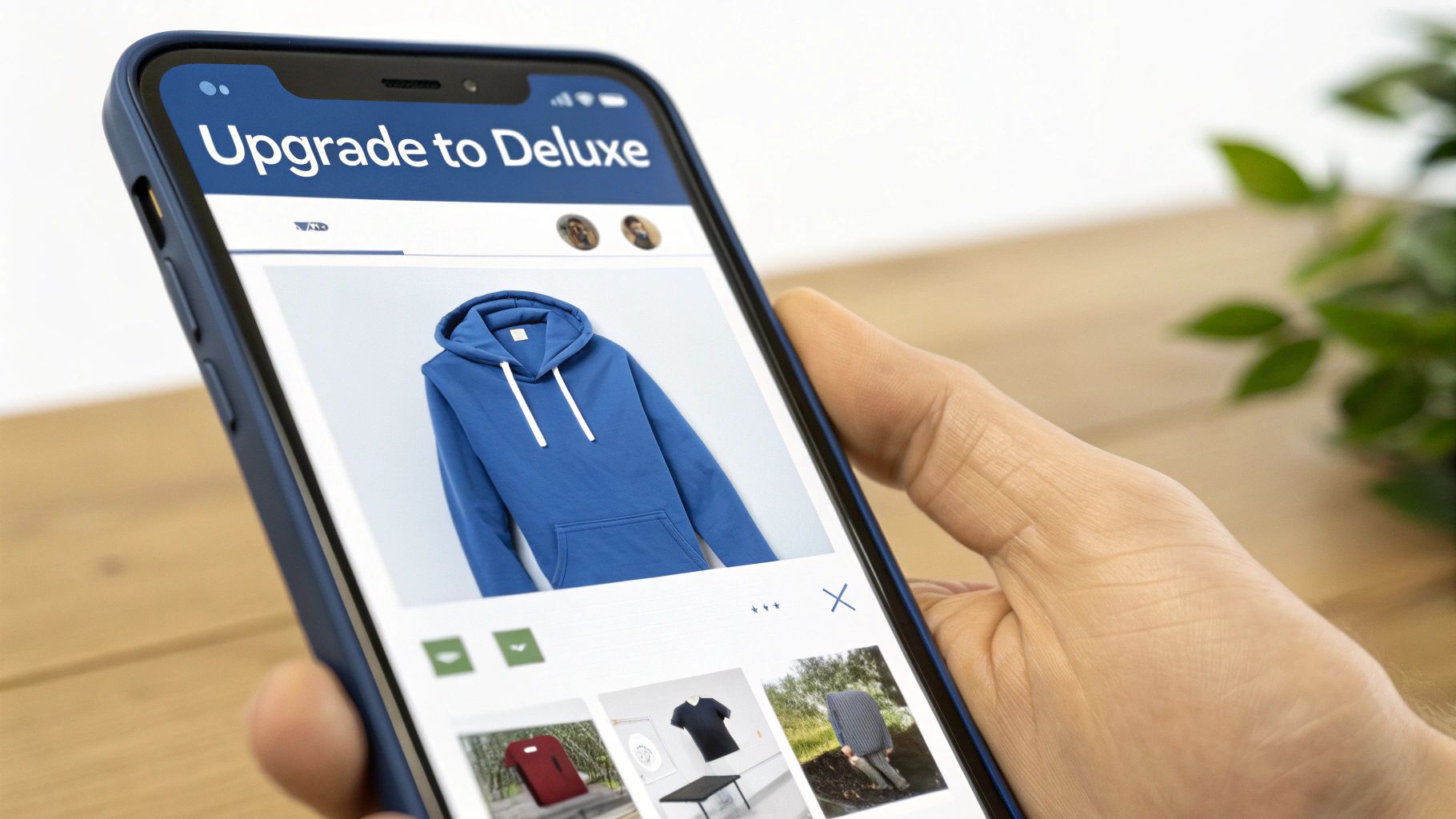
An upsell is all about upgrading a customer's choice. Think of it as convincing them to move from a standard t-shirt to a premium, heavyweight version. The customer was already planning to spend money on that particular design; you’re just showing them a better experience for a small extra cost.
The real beauty of upselling in print-on-demand is the profit margin. Premium products—like a deluxe hoodie versus a basic tee—often carry much healthier margins. This means you increase not only the order value but the total profit from that single transaction.
Here’s a simple script you could use for a product page upsell:
Love This Design? Upgrade to Our Premium Hoodie!
Get this same incredible design on our ultra-soft, heavyweight hoodie for just $20 more. It's warmer, more durable, and perfect for making a statement.
This copy works because it immediately highlights the value—softness, durability, impact—which makes the extra cost feel completely justified. The best upsells always present a clear and immediate benefit.
Cross-Selling With Precision
Cross-selling is about offering the perfect companion piece. If a customer adds a t-shirt with a cool graphic to their cart, what else might they love? This is where you can get creative and boost your AOV with smaller, often high-margin, items.
To cross-sell effectively, you have to think like your customer. What items just logically go together?
- Matching Accessories: If they buy a t-shirt, offer a phone case or tote bag with the same design.
- Completing an Outfit: If they choose a hoodie, suggest a pair of matching joggers.
- Low-Cost Impulse Buys: Stickers or enamel pins related to the design are perfect, low-friction additions to almost any cart.
A great cross-sell should feel like you're reading their mind. You're aiming for that "Oh, I didn't even think of that!" moment. To get even sharper with your recommendations, exploring tools that use artificial intelligence can be a huge help. You can learn more by reading about the benefits of AI in eCommerce to boost sales.
When and Where to Present Your Offers
Timing is everything. Throwing an offer up at the wrong moment can create friction and might even lead to an abandoned cart. The goal is a seamless experience that feels helpful, not disruptive.
Here’s a breakdown of the three key moments to make your pitch:
| Offer Placement | Strategy | Best For |
|---|---|---|
| Product Page | Presenting the upsell directly below the "Add to Cart" button. | Upsells. Showcasing a premium version before the customer makes their final decision. |
| In-Cart | Displaying complementary items after something has been added to the cart. | Cross-sells. Suggesting low-cost, relevant add-ons like stickers or hats. |
| Post-Purchase | Offering a one-click deal after the initial payment is complete. | Both. This is the ultimate low-friction opportunity for a significant AOV boost. |
The Power of Post-Purchase One-Click Upsells
The post-purchase upsell is a true game-changer. Why? Because it introduces zero friction to the original checkout process. The customer has already entered their payment information and hit "buy."
At this point, you can present them with a special, one-time offer. With a single click, they can add it to their order without having to re-enter any details. This is where you can be a bit more aggressive with your deals, like offering a "buy one, get one 50% off" on another t-shirt.
This technique is incredibly powerful and serves as a cornerstone for many successful eCommerce strategies. For a more detailed look, you can explore the core advantages of upselling and see how to apply them directly to your store.
By strategically placing upsells and cross-sells throughout the buying journey, you guide customers toward higher-value purchases naturally. You're not just selling more products; you're curating a better experience for them while significantly boosting your store's bottom line. This is one of the most exciting and direct ways to fuel your brand's growth.
Using Smart Shipping Thresholds to Encourage Spending
"Free shipping on orders over $75."
It might be one of the most powerful phrases in all of eCommerce. It’s a classic for a reason—it works. The psychology here is simple but incredibly effective: customers will gladly spend more on products just to avoid spending less on shipping. It’s a bit irrational, but it’s human nature.
This isn’t about just picking a random number, though. Done right, this is a data-driven strategy that works around the clock to bump up your AOV. It creates a powerful little incentive for a shopper to add just one more thing to their cart, turning a pretty good sale into a great one.
The real magic happens when you set the bar just right. It needs to feel like an attainable goal, a small challenge that unlocks a valuable reward. Often, that simple nudge is all it takes to see a serious lift in your revenue. Best of all, it's a true set-it-and-forget-it tactic.
Calculating Your Shipping Sweet Spot
The key to unlocking this is to base your free shipping threshold on your store's actual data. If the number is too high, it'll feel unreachable and might even kill the sale. Too low, and you're just eating into your margins without actually getting customers to spend more.
You want to set the threshold just a little bit above what your customers typically spend. This makes the offer feel like a smart, easy upgrade. The industry standard is to set your free shipping minimum about 15% to 20% higher than your current Average Order Value.
Here’s the simple math to find your number:
- Find Your Current AOV: Jump into your Shopify Analytics and pull your Average Order Value over the last 30-60 days. This gives you a solid, recent baseline.
- Calculate the Target Increase: Multiply your AOV by 1.15 (for a 15% bump) or 1.20 (for a 20% bump). The result is your target threshold.
- Round It Off: Round that number to something clean and marketable. Think $50, $75, or $100.
Let's say your AOV is currently $65. A 15% increase brings you to $74.75. The perfect threshold here would be $75. It's a clean, psychologically appealing number that practically begs customers to find one last item.
Finding Your Free Shipping Sweet Spot
Use this simple calculation to determine the optimal free shipping threshold for your store.
| Current AOV | Target Increase | New Shipping Threshold | Example Item to Add |
|---|---|---|---|
| $42.50 | 18% | $50.00 | A pair of socks, a sticker pack |
| $65.00 | 15% | $75.00 | A coffee mug, a small accessory |
| $88.00 | 14% | $100.00 | A t-shirt, a premium candle |
This exercise isn't just about math; it's about understanding what low-cost, high-margin items you can suggest to help customers reach that goal.
Implementing Your Threshold in Shopify
Setting this up in Shopify is a breeze. You’ll just create a new shipping rate that only becomes available once a customer's cart value hits your calculated threshold.
This creates a seamless experience. The free shipping option magically appears as soon as they qualify, reinforcing their smart shopping decision. It's a fully automated system that works 24/7 to boost your AOV.
Your free shipping threshold shouldn't be a guess. It should be a strategic number based on your actual sales data, designed to motivate the majority of your customers to spend just a little bit more.
Using Dynamic Banners to Drive Action
Once your threshold is set, you have to shout it from the rooftops. This is where dynamic banners are an absolute game-changer. Plenty of Shopify apps let you display a smart banner that updates in real-time as a customer adds items to their cart.
Imagine a banner at the top of your site that says, "You're only $12 away from unlocking FREE shipping!"
This one little message does two things brilliantly:
- It gamifies the experience, turning shopping into a mini-challenge.
- It removes the mental math, showing the customer the exact dollar amount they need to add.
This small psychological nudge is incredibly persuasive. It reframes the decision from "Do I want to pay for shipping?" to "What cool thing can I get for just $12 more?" This is how you convince shoppers to add that extra sticker pack, phone case, or lip balm, pushing their order value right where you want it.
Keep Them Coming Back: Building Loyalty and Driving Repeat Purchases
The customer’s journey doesn't end when they hit "complete purchase." Honestly, that's just where the real work begins. That post-purchase window is your golden opportunity to turn a one-time buyer into a loyal fan who spends more with you over time.
This isn’t about a cheap trick for a one-off AOV bump. We're playing the long game here. The goal is to build a genuine connection that pays off for years. When you create a community and reward people for being a part of it, you build a base of customers who are actually excited for your next drop, which means higher lifetime value and bigger future orders.
Two of the heaviest hitters in your toolbox for this are loyalty programs and a killer post-purchase email sequence. Let's break down how to use them to make every customer feel like a VIP.
Launch a Simple (But Effective) Loyalty Program
A loyalty program is one of the best ways to keep customers shopping with you. Think about it: why would they buy a t-shirt from a competitor when they’re just a few points away from a sweet reward at your store? It gamifies the experience and makes every dollar they spend feel like an investment.
You don't need some ridiculously complex system, either. A simple points-based program is often the perfect place to start.
- Reward Every Dollar: The foundation is straightforward—customers earn points for what they spend. A common starting point is 1 point for every $1 spent.
- Create Attainable Tiers: Map out clear rewards that feel both valuable and reachable. This gives customers something to actually work toward.
- Offer Bonus Points: Get people more involved by offering extra points for simple actions like following you on social media, leaving a product review, or on their birthday.
The key is making the rewards feel exclusive and worth the effort. A customer who feels like you value their business is way more likely to return and spend more on their next order. That's a direct, long-term impact on your AOV.
A well-designed loyalty program does more than just hand out discounts. It fosters a sense of belonging, turning casual shoppers into true brand fans who are eager to spend a little more to unlock that next perk.
Craft a High-Impact Post-Purchase Email Flow
The moment after a customer buys something is when they are most engaged with your brand. Their inbox is the perfect place to keep that conversation going and nudge them toward their next purchase. A smart post-purchase email sequence isn't just nice to have; it's non-negotiable.
This is about more than just sending a receipt. It's about delivering value, building anticipation, and then making a strategic offer that boosts their lifetime value. For a deeper dive, check out these expert guides on customer retention and loyalty.
Here’s a simple but powerful three-email flow to get you started:
Email 1: The "Thank You & Here's What's Next" (Send Immediately)
- The Goal: Reassure them and get them excited. Thank them personally and confirm their order was received.
- The Content: Let them know their order is confirmed and give them a shipping timeline. This is your chance to reinforce that they made a great decision. Don't sell anything here. Just provide pure value and peace of mind.
Email 2: The "Here's How to Get More Out Of It" (Send 3-5 Days Later)
- The Goal: Deepen the connection and give them value that goes beyond the product itself.
- The Content: Share tips on how to care for their new apparel, or show off lifestyle photos of other customers enjoying the same item. You could also subtly share the story behind the design or your brand's mission.
Email 3: The "Exclusive Offer Just For You" (Send 7-14 Days Later)
- The Goal: Drive that crucial second sale and increase their lifetime value.
- The Content: Now's the time for a compelling offer. Send an exclusive, time-sensitive discount like "15% off your next order" as a thank you for their first purchase. This is also a perfect spot to cross-sell by recommending products that pair well with what they just bought.
By nurturing this relationship after the initial sale, you create a powerful cycle of repeat business. You stop chasing one-time AOV bumps and start building a sustainable growth engine, fueled by loyal customers who consistently come back to place larger, more profitable orders.
Got Questions About AOV? We've Got Answers.
As you start putting these AOV strategies into action, you're going to have some questions. It's totally normal. In fact, some of the sharpest entrepreneurs in our Apparel Cloning course ask these exact same things when they're on the brink of scaling up.
Let's cut through the noise and tackle the most common questions we hear. These are the clear, no-fluff answers you need to move forward and start seeing those numbers climb.
How Do I Actually Calculate My Average Order Value?
This one is refreshingly simple, so don't overthink it. You just need two key metrics: your store's total revenue over a set period (say, the last 30 days) and the total number of orders you processed in that same timeframe.
The formula is just: Total Revenue / Total Number of Orders = Average Order Value.
So, if your store pulled in $10,000 in revenue from 200 orders last month, your AOV would be $50 ($10,000 ÷ 200). Most platforms, including Shopify, track this for you right in the analytics dashboard, which makes keeping an eye on it a breeze.
Will Offering Bundle Discounts Kill My Profit Margins?
Fantastic question, and it's a concern that trips a lot of people up. The short answer? No—not if you're smart about how you structure your bundles. While the profit margin on each individual item in the bundle might dip slightly, the real goal is to jack up the total profit per transaction.
Think of it like this: you're selling more stuff in one go. That means your customer acquisition cost for that single transaction gets spread across a much larger purchase, making the entire order more profitable.
The trick is to always run the numbers before you launch a bundle. Make sure that even with a 10-20% discount, the final price still lands you a healthy profit. You're trading a tiny slice of margin for a much bigger overall sale.
What's the Real Difference Between an Upsell and a Cross-Sell?
It’s super easy to get these two mixed up, but knowing the difference is key to building a solid AOV strategy. Both are killer tactics for getting customers to spend more, they just work at different points in the buying process.
- Upsell: This is where you convince a customer to buy a better, pricier version of the item they're already considering. A classic move is offering a premium, heavyweight fleece hoodie when they're looking at a standard t-shirt with the same design.
- Cross-Sell: This is all about suggesting a related product that complements what's already in their cart. For example, if they just added a t-shirt, a cross-sell would be offering a matching phone case or a tote bag with the same artwork.
Both are incredibly powerful. Upsells beef up the value of the core item, while cross-sells simply add more items to the cart.
How Often Should I Be Testing New AOV Strategies?
The urge to try everything at once is real, but a steady, methodical approach will give you way clearer results. Our rule of thumb is to implement one new strategy at a time and let it run for at least 30 days.
That gives you enough runway to collect real data and see what impact it's actually having. For instance, roll out your free shipping threshold and measure its effect for a full month before you even think about launching new product bundles.
This is the secret sauce to long-term success: disciplined, constant testing. Test one thing, analyze the data, learn from it, and then roll out the next idea. This is how you build a powerful, optimized system that actually grows your business.
Feeling ready to build your own wildly successful print-on-demand brand? At Skup, we skip the theory and give you the exact systems, software, and coaching that have built 8-figure businesses. It’s time to stop guessing and start building with a proven plan.
Discover how our Apparel Cloning System can help you launch and scale your dream business today!