How to Do Print on Demand on Etsy From Start to Finish
Ready to turn your creative spark into a real business? The game plan for launching a print-on-demand shop on Etsy is incredibly exciting and boils down to a few core moves: getting your Etsy shop live, syncing it with a print-on-demand partner, cooking up some killer product designs, and then dialing in your listings so buyers can actually find you.
It’s a truly amazing setup. You get to build a legit business with almost no cash upfront, transforming your ideas into paychecks without ever having to wrestle with a tape gun or stare at boxes of unsold t-shirts. This is your chance to build something incredible.
Your Blueprint for a Profitable Etsy POD Business
Think of this guide as your personal launchpad. We're not just throwing a list of tasks at you; this is the proven blueprint we've seen work time and again for building a successful print-on-demand business from scratch, right on Etsy. We'll show you exactly how to take those designs floating around in your head and turn them into a steady income stream.
The POD model on Etsy is one of the lowest-risk, highest-reward opportunities out there for anyone wanting to start their own thing. You get to focus on the fun part—creating awesome designs—while your production partner sweats the details of printing, packing, and shipping every single order. The opportunity here is massive!
This simple workflow means:
- No inventory headaches: You’ll never buy products in bulk or get stuck with designs that don’t sell.
- Minimal startup costs: Your main investment is your own time and creative energy.
- Massive potential: You can tap into Etsy's millions of built-in shoppers who are already looking for unique stuff.
The Core Etsy POD Workflow
The entire business model is beautifully simple. At its heart, it's just three activities: coming up with an idea, creating a design, and making the sale. This visual breaks it down perfectly.
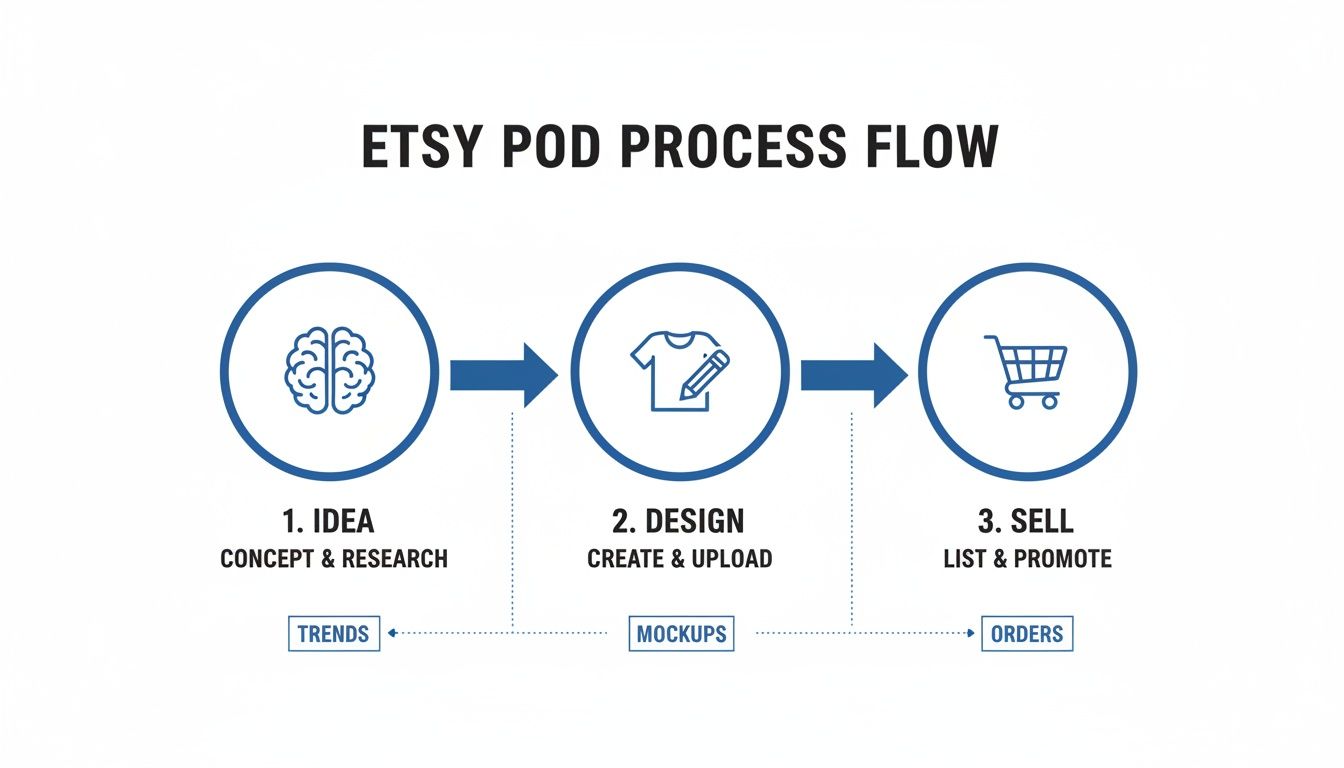
This flow really drives home that your job is to be the creative director. You leave all the complicated logistics of manufacturing and fulfillment to your POD partner.
The print-on-demand market is absolutely exploding, with some projections showing the industry will hit $58 billion by 2033. This isn't just hype; it reflects a huge shift in how people shop, moving toward more personalized, made-to-order goods.
Here's the kicker for Etsy sellers: roughly 33% of all transactions on the platform are for personalized or custom items. That single stat shows exactly why POD is such a perfect fit for Etsy—buyers are already there hunting for the unique products you can create.
To get the full picture, you can dig into more details on the print on demand market growth.
Before we dive in, here’s a quick-glance checklist to keep you on track. Think of it as your roadmap to launch day.
Your Etsy POD Launch Checklist
| Milestone | Key Action | Why It Matters |
|---|---|---|
| Shop Creation | Set up your Etsy shop, complete your bio, and fill out all policies. | Builds trust with buyers from day one and handles legal basics. |
| Niche Selection | Research and choose a specific target audience or theme for your store. | Prevents you from being a tiny fish in a huge ocean; helps you stand out. |
| Partner Integration | Select and connect a POD provider (like Printful or Printify) to your Etsy account. | This is the engine of your business that automates production and shipping. |
| Design Phase | Create your first batch of 5-10 unique product designs. | You need actual products to sell! A small batch lets you test the waters. |
| Listing & SEO | Create product listings with compelling mockups, titles, tags, and descriptions. | This is how customers will find your products through Etsy search. |
This checklist covers the foundational pieces you'll need in place. We'll break down each of these steps in detail as we go.
This is your chance to build a business that works for you. We're going to cover everything—setting up a shop that gets noticed, finding profitable niches, designing with AI, and scaling up your sales. Let's get started.
If you're totally new to this, you might want to check out our deep dive on what is print on demand to get a solid foundation. Otherwise, let's jump right into the first step.
Setting Up Your Etsy Shop for Success
Alright, this is where the rubber meets the road. Setting up your Etsy shop is way more than just filling out a few forms—it's the first real step in carving out your brand's corner of the internet. You're building your digital storefront, and every little detail, from your shop name to your banner, helps turn a casual browser into a repeat customer.
Think of it like building a house. You wouldn't just start throwing up walls without a solid foundation. Getting your shop settings dialed in from day one makes everything else run smoother. This is your chance to make a killer first impression. Let's get it right.
Naming Your Shop and Crafting Your Story
Your shop name is your handshake. It's the first thing people see, and it needs to be memorable, easy to spell, and ideally, hint at what you're all about. Don’t just pick the first thing that comes to mind. A good name sticks in someone's head, making it a no-brainer for them to find you again.
Once you’ve landed on a name, it's time to write your shop bio. This is your chance to connect on a human level. Seriously, don't just say, "I sell cool t-shirts." Tell people why. Share the spark behind your designs, what gets you excited to create. Shoppers on Etsy want to buy from real people, not faceless corporations. A good story builds trust in a way a big-box store never could.
Make sure you nail these key sections to look legit from the get-go:
- Shop Policies: Be crystal clear about your processing times, shipping, and returns. Even though your POD partner handles the grunt work, solid policies show you're a serious, professional seller.
- About Section: This is the perfect spot to put a face to the name. Add photos of yourself, your workspace, or even sketches of your designs. It makes your story feel real and adds a huge dose of authenticity.
- Shop Icon & Banner: These are your billboards. Keep them clean, professional, and consistent with the vibe of your products.
Connecting Your POD Partner Seamlessly
Now for the magic that makes this whole business model work: linking your print-on-demand provider. This integration is the engine of your entire operation. It's what turns an Etsy order into a freshly printed product on your customer's doorstep, all without you ever touching a roll of shipping tape.
The process itself is usually pretty straightforward. You’ll authorize the connection between Etsy and your POD partner (like Printify or Printful), letting their systems talk to each other. When a sale comes in, the order details get zapped over to your provider automatically. They print it, pack it, and ship it directly to your customer—often with your own branding on the package.
Key Takeaway: This integration isn't optional; it's the core of an efficient POD business. A proper sync ensures every order is fulfilled correctly and on autopilot. This frees you up to focus on what actually grows your income: creating new designs and marketing your shop.
To make it official, you'll need to add your provider as a “production partner” in your Etsy settings. This is a must-do for transparency and staying compliant with Etsy's handmade policy. You're basically just telling Etsy, "Hey, I'm the designer, and this company helps me bring my creations to life."
This automated workflow is the beauty of print-on-demand. It lets you build an e-commerce business from your laptop that can scale without being limited by the number of hours in your day. With this foundation in place, you're ready for the fun part: filling your new shop with awesome products.
Finding Your Niche and Creating Winning Designs
This is where the real work—and the real fun—begins. What separates a shop that makes a few bucks here and there from one that generates life-changing income? It’s all about finding a hungry audience and creating designs they can't live without.
Guessing what might sell is not the path to success. The secret to learning how to do print on demand on Etsy the right way is to ditch the guesswork.
Instead of just throwing designs at the wall and hoping something sticks, you need a repeatable system. We call our method Apparel Cloning. It’s a simple process: find products that are already best-sellers, identify the passionate communities buying them, and then create your own unique, better versions. You're confirming demand before you ever spend a minute on design.
The Power of Untapped Niches
The classic rookie mistake is trying to be everything to everyone. New sellers launch shops with generic designs for massive categories like "funny shirts" or "dog lover tees." That's a losing battle. You’re immediately up against thousands of established sellers with more reviews and bigger ad budgets.
You have to go deeper. Get hyper-specific.
Forget "dog lovers." Think "owners of retired racing greyhounds." Instead of a generic "nurse" shirt, design one for "pediatric oncology nurses who love coffee." These are tight-knit communities actively looking for products that reflect their unique identity. When you tap into these groups, you build a loyal following that feels like you truly get them.
Focusing on a specific niche doesn't limit your potential—it multiplies it. You become the go-to shop for a dedicated audience, building a brand that actually stands out.
Not sure where to start looking? Try these research goldmines:
- Hobby & Interest Groups: Dive into forums and social media groups for things like vintage car restoration, urban gardening, or complex board games.
- Passionate Professions: Look past the obvious jobs. Think about specialized careers with strong identities, like arborists, marine biologists, or audiobook narrators.
- Life Events & Milestones: Consider unique celebrations like finishing a marathon, adopting a rescue pet, or graduating as a first-generation college student.
Uncovering these opportunities is the crucial first step. If you want to go deeper on this, check out our complete guide on https://skup.net/blog/how-to-find-niches-for-print-on-demand/.
Revolutionize Your Design Process with AI
Once you’ve locked in on a promising niche, the next step is often the most exciting: creating amazing designs. Many would-be sellers get stuck here, thinking they need to be a design pro or have a big budget for freelancers. That’s the old way of thinking.
This is exactly why we built AvatarIQ. It’s our proprietary AI tool designed to completely solve this problem. You can generate totally unique, professional-quality apparel designs in just a few minutes, even with zero design skills. Just describe your idea, and our AI brings it to life.
Forget the frustration of complex software or the high costs and slow turnaround of hiring designers. With AvatarIQ, you can create an entire collection of killer designs in a single afternoon. This speed is your unfair advantage, letting you test ideas and launch new products faster than anyone else.
Creating Mockups That Actually Sell
A world-class design is useless if it’s presented poorly. Your customers need to see themselves wearing your apparel, which is why high-quality product mockups are an absolute must. They are your digital window display, and they have a huge impact on whether a browser becomes a buyer.
AvatarIQ doesn't just make designs; it also generates stunning, photorealistic mockups. You can create entire lifestyle photoshoots without ever picking up a camera or hiring a model. This is a massive leap forward, eliminating one of the biggest costs and time sinks for new sellers.
In minutes, you can produce images of diverse models wearing your shirts in a coffee shop, a park, or a cozy living room—whatever matches your brand’s vibe. This is how you create an emotional connection and turn a simple t-shirt into something your customer has to own. It's how you build a brand that looks and feels premium from day one.
Optimizing Your Etsy Listings to Get Found

Look, creating a killer design is only half the battle. If shoppers can't find your products, all that creativity might as well not exist. This is where mastering Etsy SEO—Search Engine Optimization—becomes the single most important skill in your toolkit.
Think of Etsy as a giant search engine, but just for unique, handcrafted, and vintage-style goods. Your job is to feed its algorithm all the right signals so it knows exactly what you're selling. Get this right, and Etsy will put your products directly in front of people who are actively searching for them. This is how you build a consistent stream of sales.
Crafting Titles and Tags That Convert
Your product title is the first—and most critical—signal you send to Etsy. It needs to be jam-packed with descriptive keywords that a real person would actually type into that search bar. This is not the place for clever, artsy titles. You have to be painfully clear and direct.
For instance, a title like "Forest Spirit Tee" sounds nice, but it's totally vague. No one is searching for that. A much, much stronger title would be: "Whimsical Forest Spirit T-Shirt, Cottagecore Mushroom Graphic Tee, Nature Lover Gift, Boho Fairycore Apparel." See the difference? That single title can now show up for a half-dozen different searches.
After your title, you get 13 tags. These are your next best shot at getting discovered. You absolutely must use all 13 of them. Every single tag is another potential doorway for a customer to find your shop.
Essential Tagging Strategies
- Be Specific: Don't just tag "t-shirt." Think deeper. Use tags like "graphic t-shirt," "vintage style tee," or "oversized comfort colors shirt."
- Think Like a Buyer: What problem are they solving? What event are they shopping for? Tags like "gift for hiker" or "bachelorette party shirt" are pure gold.
- Mix It Up: Use a cocktail of broad terms (like "graphic tee") and super-specific, long-tail keywords (like "dark academia moth shirt").
The goal here is to cast a wide net. By using a variety of relevant, descriptive keywords across your titles and tags, you maximize the number of search queries your listing can appear in. Don't leave any opportunity on the table.
Writing Descriptions That Sell
While your title and tags are mostly for the Etsy algorithm, your description is for the human on the other side of the screen. This is where you make a personal connection. It's your chance to answer their questions before they even think to ask and build the kind of excitement that makes them smash that "Add to Cart" button.
Start by painting a picture. Describe the feel of the shirt, the quality of the print, and who it’s absolutely perfect for. Make your description easy to scan by using short paragraphs and bullet points for key details like materials, sizing charts, and care instructions. It also helps to weave your main keywords into the first couple of sentences for a nice little SEO boost.
The Unbeatable Power of High-Quality Mockups
Words can only do so much. The single most powerful part of your entire listing is your photography. In the print-on-demand world, that means your mockups. Grainy, flat images of a t-shirt floating on a white background just won't cut it anymore. The market is way too competitive for that.
This is where a tool like AvatarIQ becomes an absolute game-changer. It lets you generate professional, hyper-realistic mockups that literally stop people from scrolling. Instead of a boring, lifeless product photo, you can create a whole lifestyle scene showing someone just like your ideal customer wearing your shirt and loving it.
Imagine your "hiking club" t-shirt not just on a blank background, but on a model who looks like they're actually standing on a mountain trail. This is powerful stuff. It helps customers visualize themselves wearing your product in their own lives, creating an emotional connection that is absolutely crucial for driving sales. If you want to know how to do print on demand on Etsy successfully, this step is non-negotiable. Your mockups are your best salesperson; make sure they're incredible.
Pricing, Shipping, and Mastering Your Financials
Let's talk about the part that really matters: making money. A beautiful Etsy shop is one thing, but a profitable Etsy shop is what buys you freedom. This is where we’ll get into the weeds of the numbers, so you can price your products with confidence and shoot for those healthy 30-50% profit margins.
Honestly, understanding your financials isn’t just about math—it's about knowing you’re in control. When you have a solid grasp of your numbers, you can make smart, strategic decisions that actually grow your business. We’ll keep it simple and actionable.
Calculating Your True Costs
To set a price that actually pays you, you have to know exactly what it costs to get one single item out the door. It's so much more than the cost of a blank t-shirt. Your real cost is what your POD provider charges you, plus all the little fees Etsy skims off the top.
Here’s the full breakdown of what to account for:
- POD Provider Cost: The base price for the product and the printing. Let's say it's $12 for a t-shirt.
- POD Shipping Cost: What your provider charges to ship the item to your customer (e.g., $4.50).
- Etsy Listing Fee: Etsy takes $0.20 every time you list or renew an item.
- Etsy Transaction Fee: This is a 6.5% cut of the entire sale amount, shipping included.
- Etsy Payment Processing Fee: This varies, but in the US, it's typically 3% + $0.25 of the total sale price.
- Offsite Ads Fee: This one’s a biggie. If your shop makes over $10,000 a year, Etsy’s 12-15% fee on sales driven by their offsite ads becomes mandatory.
Key Takeaway: You have to add up all of these costs before you land on a final price. Forgetting just one of these fees can silently drain your profit margin until there’s nothing left.
A Simple Pricing Formula for Profit
Once you've got your total costs nailed down, pricing for profit is pretty straightforward. A good rule of thumb is to aim for a 30-50% profit margin. That gives you a solid cushion for marketing, covering returns, and actually paying yourself.
Let's walk through a quick example. If your total cost for a shirt (product + shipping + all those fees) adds up to $19, pricing it at $29.99 leaves you with a profit of over $10 per sale. That's a fantastic 33% profit margin.
Feeling good about your pricing is a huge part of running a successful Etsy POD business. If you want to dive even deeper into different pricing models, we have an in-depth guide on how to price print on demand products.
Smart Shipping Strategies
Shipping can make or break a sale. While your POD provider is handling the actual packing and posting, you control the shipping strategy your customers see in your Etsy shop. Before you set anything in stone, it helps to understand the differences between major carriers like UPS and USPS, as this will affect both your costs and your customer's delivery times.
In Etsy, you can create different "shipping profiles" to manage your approach. A really popular strategy is to roll the shipping cost directly into your product’s price and then offer "free shipping." Psychologically, this is a massive incentive for buyers—even if the total they pay is identical.
Don't underestimate the potential here. Real-world data from Etsy POD sellers shows how big this can get. One seller's income report revealed a massive seasonal swing, with revenue rocketing to $28,000 in December alone. While things cool off in January, it just shows the incredible opportunity during the Q4 holiday rush. More importantly, the data proves that successful sellers can consistently hit 25-50% profit margins.
Marketing Your Shop and Scaling Your Business
Alright, your shop is live. Your listings are polished and optimized. Now, the real fun begins. It's time to put on your marketer hat and shift from building your store to building an audience.
Let's be real: a great shop with no visitors is basically a digital storage unit for your designs. A great shop with consistent, targeted traffic? That's a business. This is the part where you turn that side hustle energy into a legitimate income stream.
The goal isn't just to snag a few sales here and there. We're talking about building a real brand with momentum—one that people remember, follow, and buy from again and again. Let's break down the proven ways to get eyes on your products, both organically and with a little ad spend.
Building Your Brand with Organic Marketing
Organic marketing is all about playing the long game. You're not just shouting "buy my stuff!" into the void; you're building a community and attracting customers without paying directly for ads. Done right, this creates a loyal fanbase that becomes your best marketing asset.
For this, social media is your best friend, especially platforms where visuals are king.
You need to figure out where your ideal customers are scrolling. For most apparel brands, that's going to be places like Pinterest and Instagram.
- Pinterest: Think of this less like a social network and more like a visual search engine. People go here looking for ideas and inspiration. Your job is to show up when they search. Create stunning pins using your mockups from AvatarIQ and make sure every single one links directly back to an Etsy listing. Don't skimp on the descriptions—pack them with relevant keywords.
- Instagram: This is where you bring your brand to life. Use it to tell your story. Share behind-the-scenes glimpses, feature photos from happy customers (with their permission, of course!), and use Reels to show off your apparel in a fun, dynamic way. Building a genuine connection here can turn casual followers into die-hard fans.
Here's the secret to making organic marketing work: consistency. Post regularly. Talk to people in the comments. Provide value beyond just pitching your products. This is how you build trust and stay top-of-mind.
Scaling Your Winners with Paid Ads
Once you've got some sales data rolling in, it's time to pour some fuel on the fire. This is where paid advertising comes in, and Etsy Ads is the perfect place to start. It lets you promote your listings right inside Etsy's search results, putting your designs in front of motivated buyers at the exact moment they're ready to pull out their wallets.
Don't just take my word for it. Etsy's own performance data shows that a growing chunk of their revenue comes from seller tools like Etsy Ads. The trend is clear: the most successful sellers are learning how to use the tools Etsy gives them. You can dig deeper into the numbers in this in-depth analysis of Etsy statistics.
The strategy here is beautifully simple, but it works.
- Start Small. Kick things off with a modest daily budget. Seriously, $5-$10 per day is plenty to start gathering data.
- Test Broadly. Don't put all your eggs in one basket. Spread that small budget across several of your best-looking designs.
- Find Your Winners. Let the ads run for a week or two. Then, dive into the stats. Etsy will tell you exactly which listings are getting the clicks and, more importantly, the sales.
- Scale Up. Now you can get surgical. Turn off the ads for the duds and funnel that budget directly into the products that are already proven to sell.
This methodical approach takes all the guesswork out of spending money on ads. You’re not gambling; you’re making data-driven investments in your own bestsellers. This is how you confidently scale your shop from a few sales into predictable, lasting income.
Etsy POD: Your Questions Answered
Jumping into the world of Etsy print on demand is an exciting move, but let's be real—it's natural to have a few questions swirling around. Let's tackle some of the most common ones I hear from sellers who are just getting their feet wet.
Do I Need to Be an Artist to Succeed on Etsy?
Absolutely not. This is probably the biggest myth that holds people back from even starting. You don't need a fancy art degree or years of design experience under your belt. What you really need is a killer idea and the right tools to bring it to life.
This is exactly why we built AvatarIQ. Our AI-powered tool lets you generate professional, totally unique designs in minutes, even if you can't draw a stick figure to save your life. You just describe what you're imagining, and the AI handles the heavy lifting. Your real value comes from understanding your niche and knowing what they actually want to buy, not from being a master illustrator.
Your job isn't to be the artist; it's to be the creative director. Spot the trends, know your audience, and use smart tools. That's how you create winning products without ever picking up a pencil.
How Much Money Do I Need to Start?
Here's the best part about the print-on-demand model: the startup costs are ridiculously low compared to almost any other kind of business. Since you aren't buying a mountain of t-shirts upfront, you completely sidestep the single biggest financial risk.
Your main costs are pocket change, really:
- Etsy Listing Fees: A measly $0.20 per product you list.
- Design Tools: Your main investment is getting access to a powerful tool like AvatarIQ that lets you churn out high-quality designs.
Forget needing thousands of dollars for inventory. You can launch a legitimate business for less than the cost of a couple of pizzas. This makes it one of the most accessible opportunities out there right now. The door to e-commerce is wide open, and the barrier to entry has never been lower.
Ready to stop wondering and start building? At Skup, we've helped thousands of entrepreneurs just like you launch and scale their dream businesses. Our Apparel Cloning system gives you the exact blueprint, and AvatarIQ provides the design power you need to win.