Print On Demand Vs Do It Yourself Which Path Builds a Real Brand
So, you’re at a crossroads, staring down two very different paths to building an apparel brand. This is a big decision. It’s the one that will shape pretty much everything about your business, from your daily grind to how you make money.
On one side, you have Print on Demand (POD), the model that lets you jump in with almost zero financial risk. It’s all about creativity and marketing, giving you incredible flexibility. On the other side is the Do It Yourself (DIY) route—total hands-on control over your products, but it comes with serious upfront investment and a whole lot of logistics.
Your choice here defines your entire entrepreneurial journey. Are you building a flexible side hustle or a full-blown empire that lets you quit your 9-to-5? Let’s break down what really matters—startup costs, profit margins, day-to-day operations, and scaling potential—so you can pick the right path for you.
Key Operational Differences
Let's get real about what your day-to-day will actually look like with each model. They couldn't be more different.
Print on Demand: Your job is to dream up killer designs with our incredible tool, AvatarIQ, and get them in front of the right people. When an order comes in, your POD partner handles the printing, packing, and shipping. You literally never touch the inventory. Your focus stays on the creative and marketing side of the business, which is an absolutely thrilling place to be.
Do It Yourself: Your day is physical. You're ordering blank apparel, tinkering with your printing equipment, managing ink levels, printing each order, checking for quality, and then packing and shipping every single item yourself.
This split has huge implications for where your time and energy go.
The real question isn't just about printing shirts; it's about what kind of business owner you want to be. Do you want to be a creative director and marketer, or a hands-on production manager? Your answer will lead you to the right model.
Quick Look: Print On Demand vs. DIY
Before we dive deep, here’s a high-level summary of the core differences between the two models. This will give you a fast, clear overview of what you're getting into.
| Factor | Print on Demand (POD) | Do It Yourself (DIY) |
|---|---|---|
| Startup Cost | Extremely low (minimal software/store fees) | High (equipment, bulk inventory, supplies) |
| Inventory Risk | Zero—products are made only after a sale | High—risk of unsold stock and wasted capital |
| Daily Focus | Design, marketing, and brand growth | Production, quality control, and shipping |
| Scalability | Effortless—handles high order volumes easily | Difficult and expensive—requires more staff/equipment |
| Product Variety | Huge—test hundreds of designs with no cost | Limited by your equipment and inventory budget |
For those leaning toward the DIY model and wanting to create a truly memorable brand experience, exploring custom packaging solutions is a great way to make your packages stand out from the moment they arrive.
The print-on-demand market has absolutely exploded for a reason—it’s projected to hit $57.49 billion by 2033 because it solves the single biggest nightmare for apparel startups: inventory.
By printing products only after a sale is made, entrepreneurs are slashing their upfront costs by up to 90% compared to buying inventory in bulk. This shift has opened the doors for creators to build incredible brands faster and more efficiently than ever before.
The Financial Reality of Startup Costs and Profit Margins
Let's get straight to the numbers—the fuel for your business. The financial paths of print on demand (POD) and do it yourself (DIY) printing couldn't be more different, especially right at the start. This initial choice will shape everything from how much risk you take on to your long-term profit potential.
Going the DIY route means opening your wallet wide before you even think about your first sale. This isn't just about buying a single printer; it’s a whole ecosystem of equipment that adds up fast. You’re looking at commercial-grade heat presses, screen printing setups, bulk orders of blank apparel, and all the inks and chemicals that go with them. That initial bill can easily hit thousands, sometimes even tens of thousands, of dollars.
On the flip side, the print on demand model is built for an incredibly low-risk start. Your main startup cost is usually just your e-commerce store subscription. There’s no equipment to buy and no inventory to warehouse. That means you can get your brand off the ground without a massive financial weight on your shoulders.
Unpacking the True Startup Investment
The difference in upfront cash is stark. For a new entrepreneur, tying up thousands of dollars in equipment and unsold inventory before making a dime can be a paralyzing risk. This is exactly why the POD model feels so liberating for so many aspiring brand owners.
It’s one thing to talk about it, and another to see it.
This chart makes it crystal clear: while DIY demands a heavy financial commitment for gear and materials, POD lets you start lean. You can pour your resources into what actually grows your business—killer designs and smart marketing.
The Real Story on Profit Margins
It’s easy to assume that printing a shirt yourself would lead to fatter profits. But once you account for all the hidden costs of DIY, the numbers often tell a different story. The per-item cost you calculate for DIY doesn't include wasted materials from print errors, unsold inventory that becomes dead weight, or the value of your own time spent printing and packing.
Let’s be real: profit margins are the true measure of your business's health. A DIY screen printer might see a low production cost on paper. But after you factor in equipment depreciation (from an initial $10,000+ investment) and an average inventory spoilage rate of 25-35% from printing mistakes and unsold stock, those margins often shrink to a slim 10-20%.
POD completely flips this script. With zero inventory risk, sellers consistently bank 30-50% margins on every single sale. This is the financial edge that allows top sellers to build sustainable, high-growth brands.
The magic of POD isn't just in avoiding startup costs; it's in protecting your profit margins on every order. You'll never lose money on a design that didn't sell, which creates a stable and predictable path to profitability.
To put this into perspective, let's look at a hypothetical scenario for a new t-shirt brand over its first six months.
Cost and Margin Scenario for a New T-Shirt Business
This table breaks down the potential costs and profits for a small t-shirt business using both models. It assumes a modest sales volume to illustrate how the numbers play out in the early stages.
| Financial Metric | Print on Demand Model | DIY Model (In-House Printing) |
|---|---|---|
| Initial Investment | $100 (Store subscription) | $7,500 (Printer, heat press, blanks) |
| Total Units Sold (6 Mos) | 300 | 300 |
| Revenue (@ $30/shirt) | $9,000 | $9,000 |
| Cost of Goods Sold | $4,500 ($15/unit) | $2,400 ($8/unit) |
| Gross Profit | $4,500 | $6,600 |
| Additional Costs | $600 (Marketing) | $3,100 (Marketing, wasted inventory) |
| Net Profit (Before Investment) | $3,900 | $3,500 |
| Return on Initial Investment | 3900% | -53.3% (Still in the red) |
As you can see, even though the DIY model has a higher gross profit per shirt, the massive initial investment and hidden costs mean it takes much longer to actually become profitable. The POD model, in contrast, is profitable almost immediately, allowing you to reinvest your earnings back into growth.
For a deeper dive, check out our guide on how to calculate and optimize your print on demand profit margins. It's packed with strategies to maximize your earnings from day one.
Comparing Your Daily Business Operations
Let's get real for a moment and talk about what your day-to-day life actually looks like. Forget the spreadsheets and margin calculators. The choice between DIY and Print On Demand isn't just a business decision; it’s a lifestyle one that determines how you spend your most valuable asset: your time.
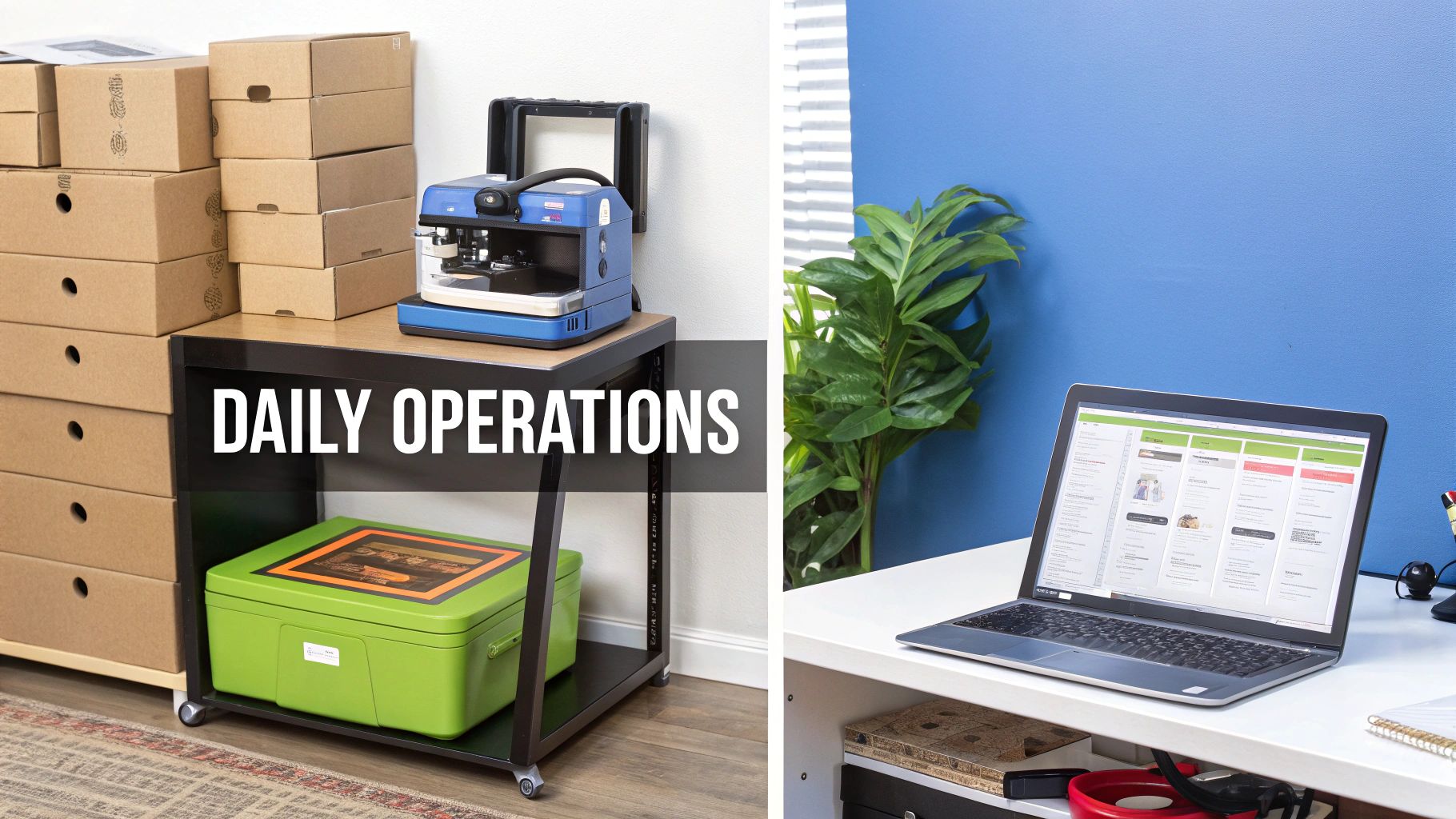
With a DIY setup, your life quickly becomes all about physical logistics. You are the operator, the quality control manager, and the shipping department all rolled into one. Your day is a whirlwind of tangible, often repetitive, tasks that demand your constant, hands-on attention.
A Day in the Life of a DIY Operator
Picture this: your morning doesn't start with creative brainstorming. It starts with checking if you have enough small-sized t-shirts or if your ink is running low. Your to-do list is a cycle of physical production that can easily swallow your entire day.
Here’s a quick snapshot of what you'll be doing:
- Managing Supplies: You're constantly ordering blank products, monitoring ink levels, and making sure you have enough shipping boxes and labels. If you run out of one key item, your whole operation grinds to a halt.
- Production and Printing: Every single order means firing up the equipment, carefully printing the design, and curing it just right. It's a time-suck, and one small mistake can be costly.
- Quality Control: After printing, you have to inspect every single piece. A slightly off-center print or a tiny smudge means you're starting over, wasting both time and materials.
- Packing and Shipping: Once an item finally passes inspection, you have to fold it, bag it, box it up, and slap a label on it. Then it's off to the post office or time to schedule a carrier pickup.
This hands-on process can be incredibly satisfying if you love the craft. But make no mistake, it anchors you to a physical location and shifts your focus inward on production, not outward on growth.
A Day in the Life of a POD Entrepreneur
Now, let's flip the script. With Print On Demand, the difference is night and day. You're effectively outsourcing the entire physical side of the business, freeing you up to focus on what actually moves the needle: growing your brand.
Your daily tasks transform from manual labor into creative and strategic work. Instead of managing boxes, you're managing ideas. Your time is spent on high-impact activities that fuel sales and build your brand.
With Print on Demand, you stop working in your business and start working on your business. You’re no longer a technician tied to a machine; you’re the CEO steering the ship, focused entirely on growth.
This freedom from the daily grind gives you incredible speed. An idea for a new t-shirt can go from a concept in your head to a live product in your store in minutes, not days. This is where POD has a massive competitive advantage.
Think about it: a POD entrepreneur can dream up, design, and launch five new products in the time it takes a DIY operator to print, check, and pack a single batch of shirts. This agility lets you test new designs constantly, find winners faster, and stay ahead of the curve.
This mindset of outsourcing non-core tasks is central to the POD model’s power. It applies beyond production, too. Many smart entrepreneurs realize it's wiser to Ditch the DIY for accounting services to stay focused on growth. It’s all about building a business that serves your life, not one that consumes it.
Unlocking Your Creativity with AI Design Tools
Let's be honest. The biggest thing that stops most new entrepreneurs cold isn't the business plan or the marketing strategy—it's creating designs that people actually want to buy. This is a huge fork in the road when you're weighing print on demand vs. doing it yourself.
If you go the DIY route, you're looking at a steep learning curve. You either sink countless hours into mastering complex design software or you shell out hefty fees to professional designers. All of that happens before you even know if an idea has legs. It’s a slow, expensive, and frustrating process that kills a lot of great concepts before they ever get a chance.
But the print on demand model flips the script entirely, especially when you bring in modern tech. It's completely opened up the design process, putting professional-level creativity in the hands of anyone, regardless of their artistic background. This shift is a total game-changer for building a standout eCommerce brand.
From Blank Screen to Bestseller with AvatarIQ
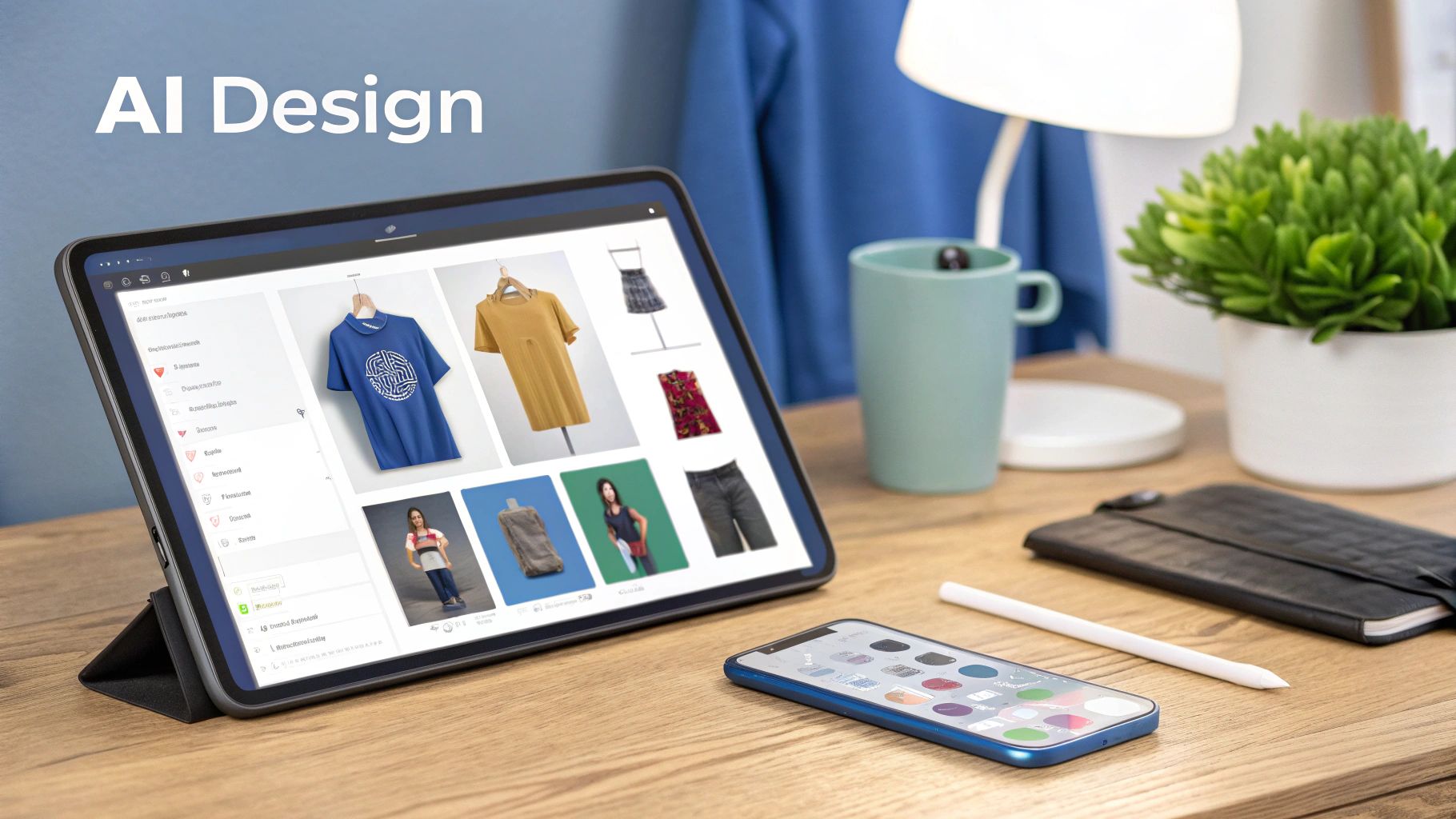
Forget staring at a blank canvas, paralyzed by indecision. We built our own AI software, AvatarIQ, to crush this exact problem. It lets you generate completely unique, high-quality apparel designs in minutes, not days. You can take a simple idea rattling around in your head and turn it into a stunning graphic that's ready to sell.
And it's not just about making graphics. AvatarIQ takes it a massive step further by letting you create photorealistic mockups and full-blown product photoshoots without a camera, models, or an expensive studio. This instantly gives your store a premium, professional vibe from day one, which builds customer trust and makes your products look incredible. That's an edge a typical DIY setup just can't compete with unless you're ready to make a serious investment.
The real power of AI in the POD model isn't just about speed; it's about getting a massive competitive advantage. You can test dozens of design ideas with virtually zero cost or risk, letting you figure out what your audience loves and get winning products to market faster than anyone else.
Gaining a Competitive Edge Through Rapid Testing
That ability to test ideas on the fly is what separates the brands that thrive from the ones that stagnate. In a DIY model, every new design is a commitment. You’re spending real money on blank apparel and supplies for a concept that might flop. With POD powered by a tool like AvatarIQ, you can experiment without fear.
- Launch seasonal designs instantly to jump on trends without getting stuck with inventory that might not sell.
- Test niche-specific graphics to see what clicks with different customer groups before you go all-in.
- Create dozens of variations of a popular design to see how you can maximize its appeal and sales potential.
This agile approach shifts your business from one based on guesswork to one driven by hard data. If you want to get those creative gears turning, check out our article on unleashing your creativity with print-on-demand design ideas. By leaning into these tools, you're not just making designs—you're building an exciting, adaptable brand that's primed for explosive growth.
Scaling Your Brand from Side Hustle to Empire
What happens when your brand suddenly blows up? That one design goes viral, and the orders start pouring in. This is the exact moment that separates a fun side hustle from a life-changing eCommerce empire, and your ability to handle that surge is determined entirely by the business model you chose from the start.
For a do-it-yourself (DIY) operation, sudden success can feel more like a crisis than a celebration. A massive spike in orders becomes a huge logistical and financial nightmare. The machine that was perfectly fine handling 10 orders a day just can't keep up with 100, forcing you into an immediate, high-stakes decision.
The DIY Scaling Wall
Growth for a DIY business is never a smooth, upward curve. It's more like a painful staircase of expensive problems. Each new level of success demands another round of significant capital investment that can quickly drain your momentum—and your bank account.
- More Equipment: You’ll need to buy more printers or heat presses just to increase your output, easily costing thousands of dollars.
- More Staff: You can't do it all yourself anymore. Hiring employees introduces payroll, training, and management headaches.
- More Space: Your garage or spare room is suddenly way too small. Now you need to lease a commercial workspace, adding another major monthly expense to your books.
Each one of these steps forces you to stop focusing on growing the brand and instead focus on managing an increasingly complex physical operation. The business starts to run you, not the other way around.
When a DIY brand gets 100 orders overnight, the owner panics about how they'll print and ship everything. When a Print on Demand brand gets 100 orders, the owner celebrates and starts planning their next big marketing push. The difference is freedom.
The Effortless Growth of Print On Demand
This is where the true power of the print on demand model becomes crystal clear. With POD, scaling isn't a problem you have to solve—it’s built into the business from day one. Your workflow stays exactly the same, whether you sell 10 products a month or 10,000.
When a tidal wave of orders hits your store, you don't have to lift a finger. Your POD partner already has the industrial-scale infrastructure to handle the volume without breaking a sweat. No bottlenecks, no emergency equipment purchases, and no sleepless nights spent packing boxes.
This hands-off fulfillment is the ultimate competitive advantage. It lets you grow your brand infinitely without ever touching a roll of shipping tape or worrying about production capacity. Your energy stays locked on the high-impact activities that created the growth in the first place.
Focusing on What Truly Matters
From our experience building multiple 8-figure POD businesses, we can tell you this operational freedom is the secret to rapid, sustainable growth. Instead of getting bogged down in the weeds of production, you can dedicate your time to the real money-makers.
This means you finally have the bandwidth to:
- Expand Your Product Line: Launch new designs and products instantly to capitalize on trends.
- Double Down on Marketing: Pour your energy into the ad campaigns and social media strategies that are actually working.
- Build a Community: Engage with your customers and turn them into loyal, repeat buyers.
- Optimize Your Store: Continuously improve your website for better conversion rates and higher average order values.
This is what building a real brand looks like. It’s about being the visionary, the strategist, and the marketer—not the person stuck running the printer. The POD model is intentionally designed for stress-free growth, giving you a clear path from a small startup to a scalable empire. For more powerful insights, explore our top eCommerce growth strategies to take your brand to the next level.
The Final Verdict: Print On Demand vs. DIY
So, after breaking down the costs, the day-to-day operations, and the potential for real growth, the choice between print on demand vs. doing it yourself becomes much clearer. The right path really boils down to one simple question: What kind of business are you actually trying to build?
If you're a hands-on crafter, someone who genuinely loves the physical process of printing and wants total, granular control over every single item, then the DIY route has its appeal. It’s a model built for artisans who find joy in the production itself.
For the Growth-Focused Entrepreneur
But let's be honest. If your goal is to build a scalable, profitable eCommerce brand that gives you financial freedom without tying you to a print shop, Print on Demand is the undisputed champion. This isn't just a different fulfillment method; it's a fundamentally smarter business model for today's world. POD was literally designed to dismantle the biggest barriers new entrepreneurs face.
The real genius of Print on Demand is how it vaporizes the two biggest business killers: dead inventory and the need for massive upfront cash. This frees you up to pour 100% of your focus and funds into the only two things that actually scale a brand—great designs and smart marketing.
With POD, you're not trapped in the daily grind of printing, packing, and shipping. You can launch new designs in minutes, risk-free. You can find winning products with a proven system like our Apparel Cloning course, and when you find that viral hit, you can scale to the moon without breaking a sweat. There's no ceiling because the entire model is built for explosive growth.
The Clear Path to Your Goals
The entire Skup ecosystem is built on the power of Print on Demand for one simple reason: we've been in the trenches and built multiple 8-figure brands with it. We know firsthand it’s the most direct and efficient path to hitting your goals as an entrepreneur.
It's the model that lets you be the CEO, not the machine operator. You get to focus on the fun stuff, like unleashing your creativity with tools like AvatarIQ, building a loyal audience, and crafting a brand people genuinely connect with. When the orders start flooding in, you can kick back and know that the fulfillment is completely handled, letting you focus on your next big idea. That's how you build an exciting, modern apparel brand that serves your life—not the other way around.
Frequently Asked Questions
When you're weighing print on demand against doing it all yourself, a few key questions always come up. Here are the straight answers from our experience to help you decide with total confidence.
Are the Profit Margins Really Better with Print On Demand?
Yes, for the vast majority of online sellers, your actual net profit is much better and more predictable with POD. It's easy to look at the per-item cost of a DIY shirt and think you're winning, but that number is misleading. It completely ignores huge factors like unsold inventory, your time, and the slow depreciation of your expensive equipment.
It's not uncommon for 20-30% of a DIY print run to end up as dead stock or get wasted from printing mistakes. With POD, your inventory risk is zero. Every single sale you make with a POD product typically locks in a 30-50% profit margin. That's real, predictable cash in your pocket, making it a much more stable foundation for building a brand. This is the exact model we teach in our Apparel Cloning system.
Can I Get the Same Quality with POD as DIY Printing?
Absolutely. In fact, you can often get better quality. Top-tier print on demand companies are running industrial-grade machines that are simply out of reach for most small, in-house setups. The trick is to find a reputable partner who cares about quality garments and uses modern printing tech.
The non-negotiable step is ordering samples for yourself before you list anything for sale. This is your chance to touch and feel the final product. Doing this one simple check guarantees your customers get a premium item that builds your brand's reputation—and you don't have to become a printing expert to make it happen.
Is It Hard to Start with Print On Demand with No Experience?
Not at all—and that’s the whole point. There's a reason POD is the most beginner-friendly model in eCommerce. Modern platforms plug right into your store, automating everything from the moment a customer clicks "buy."
The biggest hurdles for beginners—creating compelling designs and effectively marketing them—are precisely what we focus on solving. You don't need to be an artist or a marketing guru to succeed.
Tools like our AvatarIQ software put professional-grade design into anyone's hands, even if you can't draw a stick figure. You can crank out incredible visuals and mockups in minutes. Then, our training programs, like the Apparel Cloning System, give you a step-by-step roadmap to find winning products and market them effectively. You really can get a professional-looking POD store up and running in just a few days, ready to start building the business you've been dreaming of.
Ready to build a profitable, scalable apparel brand without the risk and hassle of DIY printing? At Skup, we provide the training, tools, and coaching to help you succeed. Discover how our systems can help you build the eCommerce business you've always dreamed of. Learn more at Skup.net.