Do I Need a Course for Print on Demand? Honest Answer (2026)
Quick Answer
No, you don’t technically need a course to start print on demand. Free YouTube videos and blog posts cover the basics. However, students who invest in structured training typically see results 3-6 months faster than those who piece together free content—and avoid expensive trial-and-error mistakes that often cost more than the course itself.
The Real Question Behind This Question
When people ask “do I need a course,” they’re really asking: Can I figure this out myself, or will I waste months (or years) spinning my wheels?
Here’s the honest truth: Print on demand isn’t complicated. The mechanics—setting up a Shopify store, connecting to Gelato, uploading designs—can be learned from free resources in a weekend.
But there’s a massive difference between knowing how to do something and knowing what actually works.
What Free Content Gets Wrong
Most free POD content is created by people who:
- Made money once and want to sell you something
- Teach outdated strategies from 2019-2021
- Give generic advice that sounds good but doesn’t convert to sales
- Focus on getting views, not getting you results
The information isn’t wrong—it’s just incomplete. You’ll learn how to set up a store, but not which products actually sell. You’ll learn about Facebook ads, but not the specific metrics that separate winners from money pits.
The Hidden Cost of “Free”
Students who try the free route typically spend:
- $500-2,000 on ads testing designs that were never going to work
- 6-12 months learning lessons that could be taught in weeks
- Countless hours watching contradictory YouTube videos
- Motivation and belief when nothing seems to work
A $500 course that gets you profitable in 90 days is infinitely cheaper than $2,000 in wasted ad spend and a year of frustration.
Real Results From Structured Training
These are actual Skup Incubator students who invested in coaching:
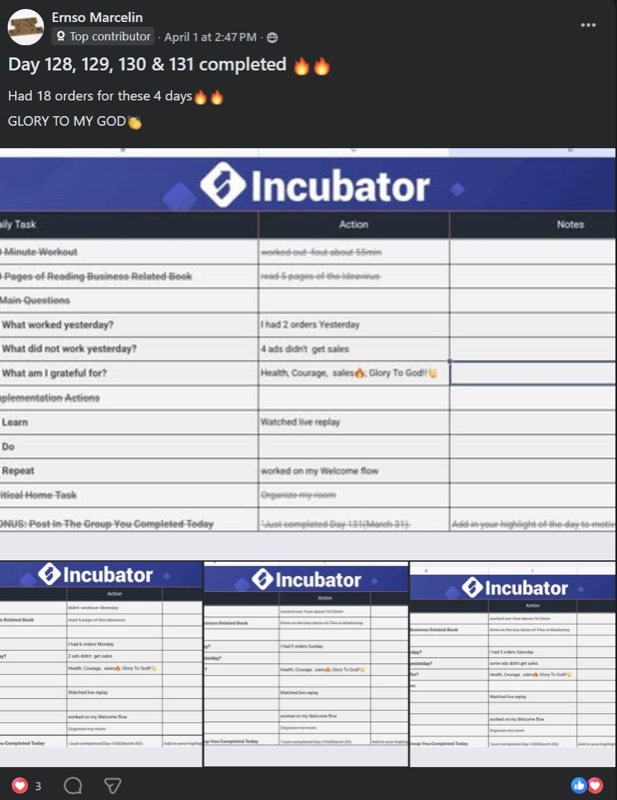
Ernso Marcelin hit 13 sales in 4 days and then 18 orders in another 4-day stretch (April 2026). He went from zero to consistent daily orders by following a proven system instead of guessing.
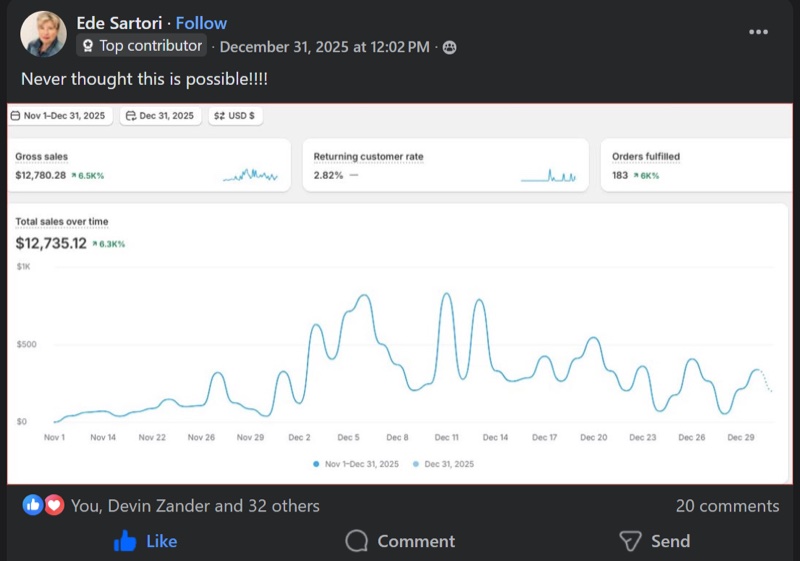
Ede Sartori made 55 sales in just a couple weeks (December 2025) after struggling for months trying free methods. The difference? A clear framework for finding designs people actually want to buy.
Adam Schneider scaled to $179K in 90 days and hit a $5K+ single day—not by watching YouTube tutorials, but by implementing specific strategies from live coaching calls.
What a Good Course Actually Provides
Beyond just “how to” information, quality POD training gives you:
- Design research systems that identify winning products before you spend money
- Ad testing frameworks so you know exactly when to kill or scale
- Real-time feedback on your specific store and ads
- Community support from people at your level and ahead of you
- Accountability that keeps you from giving up after week 3
Skup’s Apparel Cloning System teaches a specific methodology for finding proven designs and making them your own legally. Students also get access to AvatarIQ ($97/month value) for AI-powered design generation—eliminating the “I can’t design” excuse entirely.
When You DON’T Need a Course
Be honest with yourself. Skip the course if:
- You have 12+ months to experiment and learn through failure
- You’ve already built a profitable ecommerce business before
- You’re comfortable losing $1,000-3,000 on ad testing mistakes
- You learn well from scattered, contradictory information
- You’re not actually serious about making this work
Some people genuinely prefer the DIY path. That’s valid. Just understand what you’re signing up for.
When You SHOULD Invest in Training
A structured program makes sense if:
- Your time is valuable (you have a job, family, other commitments)
- You want to minimize expensive trial-and-error
- You’re starting from zero with no ecommerce experience
- You’ve tried free methods and gotten nowhere
- You learn faster with guidance than figuring it out alone
How to Spot a Scam Course
Not all POD courses are created equal. Red flags include:
- Promises of “overnight” or “guaranteed” income
- No verifiable student results with real names
- Instructors who haven’t run successful stores themselves
- One-time recordings with no ongoing support
- Refusing to show what’s inside before purchase
Any legitimate program should have documented student success stories, active community support, and instructors with real track records.
The Bottom Line
You don’t need a course—but the right one pays for itself many times over in time saved and mistakes avoided. The students seeing results fastest aren’t the ones with the most raw talent. They’re the ones who invested in a proven system and followed it.
If you’re serious about building a real print on demand business, explore the Apparel Cloning System to see if structured training makes sense for your situation.
FAQ
Can I learn print on demand for free?
Yes, the basic mechanics (store setup, connecting suppliers, uploading designs) are free to learn. What’s harder to find is reliable information on what actually sells, how to test ads profitably, and how to avoid common mistakes that cost more than any course.
How much does a good POD course cost?
Quality programs range from $500-2,000 for self-paced courses to $5,000+ for coaching programs with live support. Compare this to the typical $1,000-3,000 most beginners waste on failed ad campaigns before they learn what works.
What if I buy a course and it doesn’t work?
Any reputable program offers a refund policy (Skup’s Apparel Cloning System has a 30-day guarantee). More importantly, look for programs where “not working” isn’t really possible if you follow the system—structured frameworks remove most of the guesswork.