Home » Blog » Ecommerce Growth Strategies to Scale Your Online Brand
Stop looking for a single magic bullet to grow your store. Real, effective ecommerce growth isn’t about finding one secret trick; it’s about building a high-performance engine.
Success comes from a unified framework where every part of your business—your product, your marketing, your customer experience—works together to create unstoppable momentum. This is about shifting your focus from chasing isolated tactics to building an integrated system for sustainable, long-term growth.
Building Your Ecommerce Growth Engine
Thriving in today’s market means you have to move beyond a simple checklist of marketing activities. What you really need is a cohesive system where each component makes the others stronger.
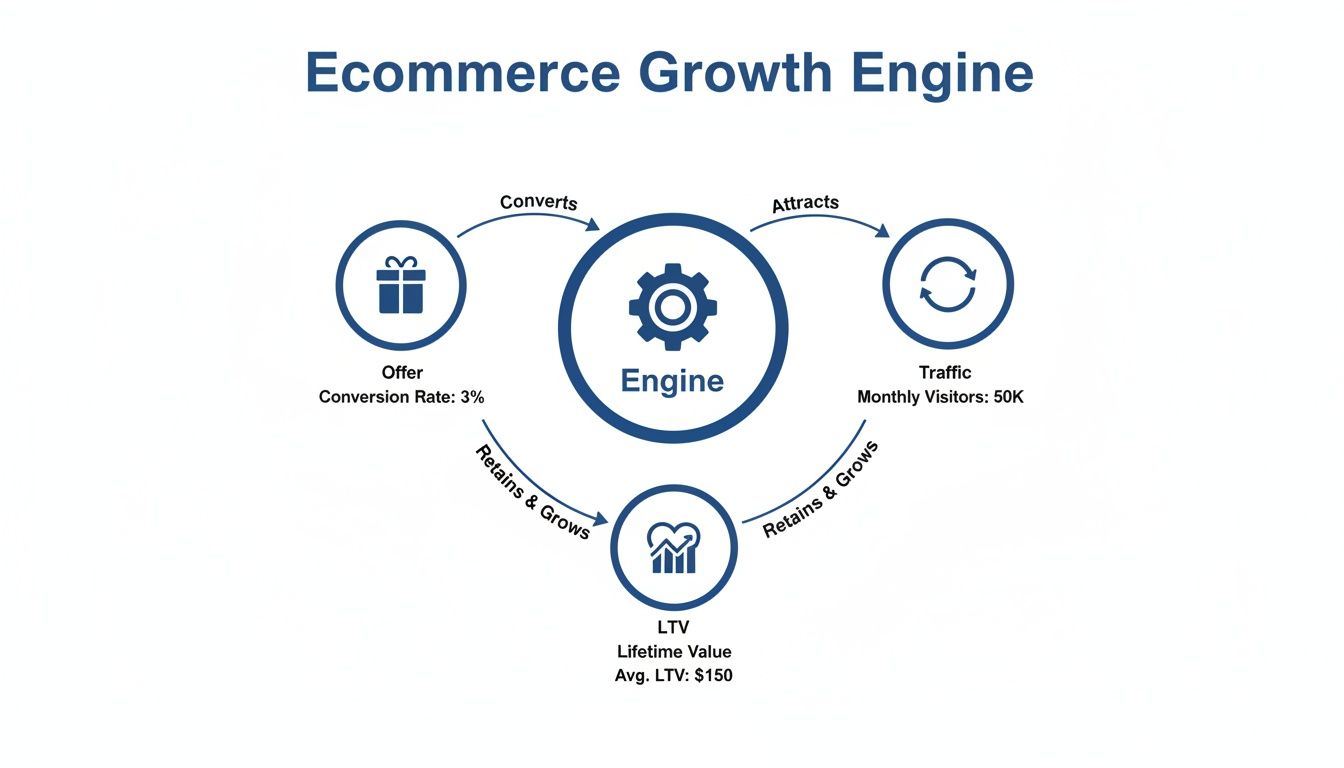
Think of your business like a powerful engine. A great product (premium fuel) is useless without traffic (the ignition) or customer retention (the cooling system). For the engine to run, every single part has to work in sync.
Of course, the foundation of this entire operation is your tech stack. It all starts with choosing the right ecommerce platform, because that decision directly impacts your ability to scale and actually implement the strategies we’re about to cover.
The Three Pillars of Sustainable Growth
At its core, a powerful ecommerce growth engine is built on three interconnected pillars. If you neglect any one of them, the whole system will stall out, no matter how much money you pour into the others.
Think about it: a brand with incredible ads but a confusing website will just burn cash. A store with a fantastic, life-changing product but zero traffic will never make a sale. They all have to work together.
The Irresistible Offer: This is the fuel for your engine. It’s so much more than just your product; it’s the story you tell, the problem you solve, and the value you deliver. A truly compelling offer makes the customer’s decision to buy feel easy and obvious.
Targeted Traffic: This is the spark that gets the engine started. It’s all about driving the right people to your store through smart channels like paid ads and organic search. The goal isn’t just clicks; it’s attracting visitors who are genuinely fired up about your offer.
Customer Lifetime Value (LTV): This is what keeps your engine running smoothly for the long haul. This pillar is focused on turning one-time buyers into repeat customers and loyal fans, maximizing the total revenue you get from every person you bring to your store.
This flywheel shows exactly how these three core components—the offer, traffic, and LTV—lock together to form a complete, self-sustaining growth engine.
As you can see, these aren’t just separate tactics you can pick and choose from. They are deeply interconnected systems that feed into one another, creating exponential results. This guide is your blueprint for building and tuning each part of this engine, giving you a clear roadmap to scalable success.
Crafting an Irresistible Product and Offer
Your product and the way you frame it are the absolute fuel for your growth engine. Before you even think about driving traffic or obsessing over customer retention, you need an offer so compelling that shoppers feel like they’d be crazy to say no. This is one of the most foundational growth levers, but it’s amazing how often it gets pushed aside for flashy marketing funnels.
A truly powerful offer is way more than just a product with a price tag. It’s the whole package—it solves a real problem, screams value, and carves out its own space in a ridiculously crowded market. Just slapping a 10% discount on a mediocre product and calling it a day? That’s not going to move the needle.
Understanding What Your Market Really Wants
The secret to a killer offer always starts with getting inside your customer’s head. You need to understand their pains, their secret desires, and what truly motivates them to pull out their wallets. This means ditching the guesswork and committing to some smart, focused research.
Start by sizing up your direct competitors. What are they selling, and how are they pitching it? Pay close attention to their bestsellers, and then dive deep into their customer reviews—the good, the bad, and the ugly. You’re looking for gaps, for angles they’ve missed that your brand can own. This isn’t about copying; it’s about finding an opening. For a much deeper playbook on this, check out our guide on how to find winning products to sell online.
This initial intel is gold because it shapes every single decision that comes next, from your product design all the way to your ad copy.
Defining Your Unique Selling Proposition
Once you’ve got the lay of the land, you have to figure out what makes you different. Your Unique Selling Proposition (USP) is the one clear, punchy reason a customer should buy from you and not the dozen other guys selling something similar. It’s the heart of your offer and the bedrock of your brand.
A strong USP could be built on things like:
Superior Quality: You use better materials or a more advanced manufacturing process. Simple as that.
Unique Design: Your products just look different, with a distinct vibe they can’t get anywhere else.
Unmatched Convenience: Your offer makes a customer’s life easier, saving them time or simplifying something complex.
A Powerful Mission: Your brand stands for something that your target audience genuinely cares about.
Your USP isn’t some fluffy marketing slogan; it’s a promise. And that promise needs to be obvious in your product, on your website, and in every ad you run. It has to scream, “We’re the best choice for you.”
Structuring Offers That Boost Perceived Value
How you package your offer can radically increase its appeal without you ever touching the core product. The goal here is to jack up the perceived value, making the customer feel like they’re getting an absolute steal—a deal that’s just too good to ignore.
One of the most powerful ways to do this is through bundling. Instead of just selling one t-shirt, you could create a “Summer Style Kit” that bundles the shirt with a matching hat and sunglasses for one price. Not only does this pump up your Average Order Value (AOV), but it makes the purchase feel more complete and valuable to the customer.
Other killer tactics include tossing in exclusive bonuses, like a free digital guide or a limited-edition accessory that goes with the main product. These little extras often cost you next to nothing but can massively lift how much your offer feels worth.
The Critical Role of Visuals in Your Offer
Let’s be real: in ecommerce, your product photos are your product. Customers can’t touch it, feel it, or try it on. Your images and mockups have to do all the heavy lifting. Low-quality, generic, or boring visuals will kill even the most perfectly structured offer. Dead on arrival.
This is a huge bottleneck for so many brands. Creating high-quality, on-brand creative is expensive and eats up a ton of time. But this is where tools built to solve this specific problem can completely change the game. For apparel brands, AvatarIQ was designed for this exact challenge, letting you generate countless conversion-focused, on-brand creative assets in seconds.
By instantly creating professional mockups and photoshoots, AvatarIQ rips away the creative barrier. It ensures your offer is always presented in its absolute best light, which is the final, crucial piece of crafting an offer that doesn’t just look good—it sells.
Scaling Your Customer Acquisition Machine
Once you’ve dialed in an irresistible offer, it’s time to open the floodgates. This is where we build your customer acquisition machine—a reliable, predictable system that turns ad spend into new customers. Think of it as the engine for your brand.
Without this engine, even the world’s greatest offer will just sit on the shelf gathering dust. We’re moving beyond just boosting posts and into a structured, strategic approach to paid ads on platforms like Facebook, Instagram, and Google.
Building Your Ad Campaign Framework
One of the biggest mistakes brands make is launching campaigns without a clear structure. A solid framework lets you test variables methodically, so you know exactly what’s working and what’s not.
The foundation is simple: separate your campaigns by their objective. Are you prospecting for new customers who’ve never heard of you (cold traffic)? Or are you retargeting people who’ve already visited your site (warm traffic)? These are two completely different ballgames and need their own campaigns.
Inside each campaign, you can then test different ad sets, each targeting a specific audience. You might have one ad set for a broad, interest-based audience and another for a high-powered lookalike audience. Seriously, learning how to create video ads that actually convert is a total game-changer for finding new buyers who look just like your best existing ones.
This structured approach stops you from making emotional, gut-feeling decisions based on one ad’s performance. Instead, you let the data drive your budget.
The Power of AI in Creative Testing
The single biggest lever you can pull in any ad campaign is the creative—the image or video that actually stops someone from scrolling. In a crowded feed, you have maybe three seconds to grab their attention. That means you need to be testing constantly.
This is where a lot of brands get stuck. Creating dozens of ad variations by hand is painfully slow and expensive. But this is also where AI-powered tools give you a massive advantage. Mastering how to create video ads that actually convert is the key to turning casual viewers into paying customers.
The modern advertising game is won by speed and volume. The brand that can test 50 creative variations while a competitor tests five will find winning ads faster, lower their Customer Acquisition Cost (CAC), and scale their budget with confidence.
An AI design tool like AvatarIQ is your secret weapon here. It lets you generate countless on-brand ad creatives and professional mockups in minutes, not weeks. This rapid testing cycle is how you outmaneuver the competition and discover what truly connects with your audience, turning your ad account into a money-printing machine.
Data Driven Personalization and Scaling
At the end of the day, scaling your ad spend is all about the data. AI-powered marketing and data-driven personalization aren’t just buzzwords; they’re measurable strategies that directly impact your revenue.
By 2025, analysts expect retailers using AI for customer segmentation and automated creatives to see huge jumps in conversion rates and ROAS. In fact, some industry reports show personalized product recommendations can already drive 10–30% of an ecommerce store’s total revenue. That’s the power of showing the right message to the right person.
When you combine precise audience targeting with relentless creative testing, you create a powerful feedback loop. The more data you get on which ads and audiences are winners, the more confidently you can pour budget into them and cut the losers. This is how you systematically lower your CAC, increase your profit, and build an acquisition engine that fuels real, sustainable growth.
Optimizing Your Store for Maximum Conversions
Getting clicks is one thing. Turning those clicks into paying customers? That’s what separates the brands that scale from the ones that stall out. Once you have your ads driving traffic, the real work begins. It’s time to shift your focus to Conversion Rate Optimization, or CRO. This is where we fine-tune your store to turn as many visitors as possible into buyers.
Think of your online store like a brick-and-mortar shop. If the layout is confusing, the products are hard to find, and there’s a massive line at the register, people are just going to walk out. CRO is all about making sure your digital storefront is clean, convincing, and completely frictionless.
Deconstructing the High-Converting Product Page
Your product page is your digital salesperson. It’s the final pitch before a visitor decides to click “Add to Cart” or bounce forever. Every single element on this page has to work in harmony to build desire, answer questions before they’re asked, and crush any last-minute doubts.
An effective product page isn’t just a random collection of images and specs; it’s an engineered experience. It has to do the heavy lifting of guiding a customer to a confident “yes.”
Persuasive Copywriting: Don’t just list features—sell the outcome. How does this product make your customer’s life better, easier, or more enjoyable? Use benefit-driven headlines and bullet points they can scan in seconds.
High-Quality Visuals: Your customers can’t touch or hold your product, so your images and videos have to do all the work. We’re talking high-resolution photos from every angle, lifestyle shots showing the product in action, and maybe even a quick demo video. This is a massive bottleneck for many brands, which is why a tool like AvatarIQ can be a game-changer. It lets you generate endless pro-level mockups and creative assets, so your product always looks its best.
Trust-Building Social Proof: People trust other people more than they trust brands. Make sure your customer reviews, star ratings, and any user-generated content are front and center. This social proof validates your product’s quality and helps new buyers feel confident hitting that purchase button.
Engineering a Frictionless Shopping Journey
Every extra click, every confusing step, every surprise fee is a reason for a customer to abandon their cart. One of the most powerful ecommerce growth strategies is to ruthlessly hunt down and eliminate friction in the buying process, especially at checkout.
The perfect checkout process is so smooth, so intuitive, that the customer barely even thinks about it. Your goal is to make giving you money as easy as humanly possible.
A great starting point is offering a guest checkout option. Forcing someone to create an account is a surefire way to lose sales. Also, be upfront about shipping costs and delivery times. Nobody likes a nasty surprise right before they enter their credit card details—it’s the number one reason for abandoned carts.
Prioritizing a Mobile-First Design
Let’s be clear: modern ecommerce is mobile commerce. A clunky, slow, or hard-to-navigate mobile site isn’t just a minor annoyance; it’s a hole in your pocket, leaking revenue every single day. Designing for mobile first isn’t optional anymore. It’s essential for survival.
Mobile commerce is a beast, with sales projected to hit around $2.5 trillion in 2025. That’s expected to be roughly 59% of all online retail sales. This trend underscores why brands have to nail mobile optimization and one-click checkouts to cut down cart abandonment. You can see how these trends are shaping the future by checking out these key ecommerce statistics and insights from Sellers Commerce.
On mobile, your buttons need to be big enough for a thumb to tap easily. Your text needs to be readable without pinching and zooming. And your pages have to load fast.
To help you prioritize, here’s a quick checklist of the most impactful mobile optimizations.
Mobile CRO Checklist
This table breaks down the key areas to focus on for a better mobile experience that actually converts.
Optimization Area
Action Item
Expected Impact
Page Speed
Compress images and leverage browser caching.
Faster load times, lower bounce rates, improved SEO.
Navigation
Use a simple, clear menu (like a hamburger menu).
Users can find what they want quickly without frustration.
Checkout Flow
Enable guest checkout and mobile wallets (Apple/Google Pay).
Drastically reduces friction and cart abandonment.
Forms & Fields
Minimize the number of required fields. Use larger fonts.
Easier and faster for users to complete on a small screen.
CTAs & Buttons
Make buttons large, with contrasting colors.
Higher click-through rates on key actions like “Add to Cart.”
Focusing on these areas will make a measurable difference. A seamless mobile experience is the final piece of the CRO puzzle, ensuring you capitalize on every single visitor, no matter what device they’re using.
Turning First-Time Buyers into Lifelong Fans
Look, chasing down new customers is a grind. It’s expensive and exhausting. The real secret to building an ecommerce brand that lasts isn’t just getting that first sale; it’s maximizing the value of the customers you already have. This is where retention marketing becomes your most powerful growth lever.
Turning a one-time buyer into a repeat purchaser—and eventually a true fan of your brand—is how you jack up your Customer Lifetime Value (LTV). Here’s a number that should get your attention: acquiring a new customer can cost five times more than keeping an existing one. That fact alone makes a solid retention plan an absolute economic necessity, not just a “nice-to-have.”
Building Relationships on Autopilot
Modern retention runs on automated email and SMS marketing. But don’t think of these as tools for just blasting out discounts. They are powerful systems for building genuine, one-on-one relationships with your customers, at scale.
When you set up automated flows, you deliver the perfect message at the perfect time. It makes each customer feel seen and valued, which builds trust and keeps your brand top-of-mind long after that first package arrives.
Every single ecommerce brand should have these core automated flows running 24/7:
Welcome Series: This is your first impression. It’s where you greet new subscribers, share your brand story, and maybe offer a little something to nudge them toward that first purchase. It sets the entire tone for the relationship.
Abandoned Cart Recovery: A wild 70% of online shopping carts are abandoned. It happens. A simple, automated email or text reminding customers what they left behind can claw back a huge chunk of that lost revenue.
Post-Purchase Follow-Up: This is your victory lap. It’s your chance to say thank you, provide shipping updates, and ask for a review. It reassures them they made a great decision and opens the door for the next purchase.
The Power of Not Treating Everyone the Same
If you want to take your retention to the next level, you have to kill the generic, one-size-fits-all messaging. This is where audience segmentation comes into play. By grouping customers based on their actual behavior, you can send them stuff they actually care about.
A personalized email isn’t just a nice touch anymore—it’s the bare minimum expectation. Segmented and personalized campaigns drive massively higher engagement and revenue because they speak directly to an individual’s needs and interests.
Here are some of the most common segmentation strategies to start with:
Purchase History: Group customers by what they’ve bought. Someone who bought a dog collar might be interested in a leash, right?
Purchase Frequency: Your VIPs who buy every month deserve a different conversation than someone who bought once a year ago. Create exclusive offers for your biggest fans.
Engagement Level: Got a group of customers who haven’t opened an email in 90 days? Hit them with a special “we miss you” campaign to win them back.
Creating an Unbreakable Competitive Moat
While email and SMS are your workhorses, the ultimate retention strategy is having a product so good, so unique, that your customers can’t even imagine buying from someone else. This creates an unbreakable bond and a powerful competitive moat around your brand.
For brands in the apparel space, this means dialing in designs that truly connect with a specific niche or community. Our apparel cloning course is built entirely on this idea. We teach you how to systematically find proven product concepts and create unique, winning designs that build an army of die-hard fans who come back again and again.
Expanding Your Brand with an Omnichannel Strategy
To really grow, your brand can’t just live in one place. Relying only on your direct-to-consumer (DTC) store is like setting up a single, amazing lemonade stand on a quiet street. Sure, you might have the best lemonade in town, but you’re missing out on the massive crowds at the downtown market.
This is exactly where an omnichannel strategy comes in.
Think of it this way: your Shopify store is your flagship. It’s your home base where you control every pixel of the brand experience. But marketplaces like Amazon are bustling shopping malls filled with millions of customers who are already looking to buy something.
Being on these platforms isn’t about ditching your DTC store. It’s about strategically meeting customers wherever they already are. An omnichannel approach is one of the most powerful ecommerce growth strategies because it creates multiple front doors to your brand, blowing the ceiling off your reach and customer acquisition potential.
Tapping into High-Intent Marketplace Traffic
The single biggest win from selling on a major marketplace? Instant access to a massive, built-in audience of buyers.
These aren’t just casual browsers, either. They are customers with their credit cards out, actively searching for products just like yours. This lets you supercharge customer acquisition far beyond what you could ever hope to achieve with paid ads alone.
The numbers don’t lie. Marketplaces drive a huge slice of all ecommerce sales and are a proven path for accelerating both customer acquisition and international expansion. In the U.S., Amazon alone accounted for roughly 37% of all online sales in 2024. Globally, you’re talking about hundreds of billions in sales every year. You can discover more insights about marketplace dominance from Capital One Shopping.
By listing your products where millions are already shopping, you place your brand directly in the path of high-intent traffic, turning search queries into sales. Simple as that.
A Framework for Integrating Sales Channels
Jumping into marketplaces without a plan is a recipe for chaos. The key is to build a unified system where your DTC store and marketplace channels work together, not against each other. A successful integration boils down to getting a few core areas right.
Unified Inventory Management: Avoid the nightmare of overselling by using a system that syncs inventory levels across all your channels in real-time. When a product sells on Amazon, the stock count should instantly update on Shopify, and vice versa. No excuses.
Streamlined Fulfillment: You need to decide how you’ll handle orders from different channels. You can use Fulfillment by Amazon (FBA) for your marketplace orders or bring on a third-party logistics (3PL) provider to manage fulfillment for both DTC and marketplace sales from one spot.
Consistent Brand Experience: You have less control on a marketplace, but you can still maintain brand consistency. Use high-quality visuals and well-written copy that sound like you. For apparel brands, this means ensuring your mockups and product photos look just as professional there as they do on your own site. A tool like AvatarIQ is a lifesaver here, letting you generate consistent, top-tier creative for all your channels from a single platform.
Omnichannel isn’t just about selling in more places. It’s about creating a single, seamless brand experience for your customers, no matter where they find you. This unified approach transforms separate sales channels into a powerful, scalable, and cohesive sales ecosystem that fuels long-term, sustainable growth.
Common Questions About Ecommerce Growth
As you start putting all these pieces together, you’re bound to run into some practical questions. Let’s tackle a few of the most common hurdles brands face when trying to scale up.
What Is the Most Important Growth Strategy for a New Store?
For a brand-new store, forget everything else and focus on one thing: product-market fit. You have to prove you have a product people actually want before you can worry about scaling traffic or nailing down retention.
All your early energy should go into dialing in your product, building an offer that converts, and soaking up every bit of customer feedback. Those first 100 sales aren’t about getting rich; they’re about learning. Once you have a proven offer that converts visitors into customers at a decent rate, then you can start pouring gasoline on the fire with paid ads and other traffic strategies.
How Do I Choose the Right Tools for My Growth Stack?
The right tool depends entirely on your current stage and your biggest bottleneck. Don’t just collect subscriptions because they look cool. First, figure out what’s actually holding you back.
Is your team struggling to produce enough quality creative for your ad campaigns? A purpose-built tool like AvatarIQ is designed to solve that exact problem, and nothing else. Is your LTV flatlining? Then it’s time to get serious about a real email and SMS platform.
The goal is to avoid “shiny object syndrome.” Instead of bogging your business down with a dozen different apps, find one or two powerful tools that solve your most painful problem right now.
The best tech stack isn’t the biggest one—it’s the one that solves your most critical problems with the least complexity. Start with the core pillars: email, customer reviews, and creative generation. These almost always deliver the biggest impact right out of the gate.
How Long Does It Take to See Results from These Strategies?
This is the big “it depends” question. Some levers you pull will give you feedback almost instantly, while others are a long game that requires patience.
Quick Wins (Days to Weeks): On-site CRO tweaks are the fastest. Changing your product page layout or smoothing out the mobile checkout can show a measurable lift in just a few days or weeks with a simple A/B test.
Medium-Term (Weeks to Months): Paid ad campaigns start spitting out data within 24-48 hours, but don’t be fooled. It usually takes a solid one to two weeks of testing and tweaking to really find a profitable groove.
Long-Term (Months): The foundational stuff takes time. Building sophisticated email flows or spinning up an apparel cloning product cycle can take anywhere from three to six months to really see the massive impact on your bottom line.
The key isn’t a magic bullet; it’s consistent work and letting the data guide your next move.
Ready to stop guessing and start building? Skup gives you the training, tools, and coaching to actually implement these strategies. From our AI-powered design tool AvatarIQ to our deep-dive coaching programs, we’ve built the entire ecosystem to help you scale your brand. Start your journey with Skup today.
Quick Answer Matt Schmitt is the co-founder of Skup, a print-on-demand ecommerce training company. With over $30 million in personal ecommerce sales and a decade of experience building and scaling POD stores, Matt oversees Skup’s coaching program and teaches the systems that helped him exit multiple 7-figure businesses. His students have collectively generated tens of…
Ready to turn your creativity into cash? The fastest way to make money selling t-shirts is to find designs that are already crushing it, create even better versions with your own unique spin, and sell them to passionate audiences. The exciting world of print-on-demand allows you to start with virtually zero risk and build a…
Quick Answer Most successful print-on-demand beginners spend 10-15 hours per week to see real results. That breaks down to about 1.5-2 hours per day. You don’t need to quit your job or sacrifice all your free time—but you do need to be consistent. Random weekend sprints won’t cut it. The Real Time Investment for POD…