Home » Blog » How to Start a Print on Demand Business on Etsy Your Ultimate Guide
So, you're ready to build a life-changing print on demand (POD) business on Etsy. Fantastic. You've picked the perfect time to jump in, and this guide is the only blueprint you'll need to get from idea to your first sale.
The old way of starting an apparel business meant buying tons of inventory upfront. You'd sink thousands into boxes of t-shirts, hoping you picked the right sizes, colors, and designs. Print on demand completely flips that model on its head.
With POD, you can launch a full-blown apparel brand without ever touching a single t-shirt. The core idea is simple: you create the designs, and a partner company prints, packs, and ships the product directly to your customer after they place an order. No inventory, no risk, all reward.
This guide is built on real-world experience, walking you through every critical stage of launching a profitable Etsy POD store.
Why The Opportunity Is Massive Right Now
Let's be clear: this isn't just a fun side project. This is a serious business opportunity. The demand for unique, personalized products is absolutely exploding.
The global custom printing market is projected to grow at over 20% annually through 2030. Why? Because shoppers are tired of generic, mass-produced junk. They crave products that reflect their personality, hobbies, and sense of humor. In fact, 36% of consumers now see personalization as a standard offering, and a staggering 48% are willing to wait longer for a custom item.
Etsy is ground zero for this movement. It's a marketplace filled with millions of buyers actively searching for the exact kind of unique products you're about to create.
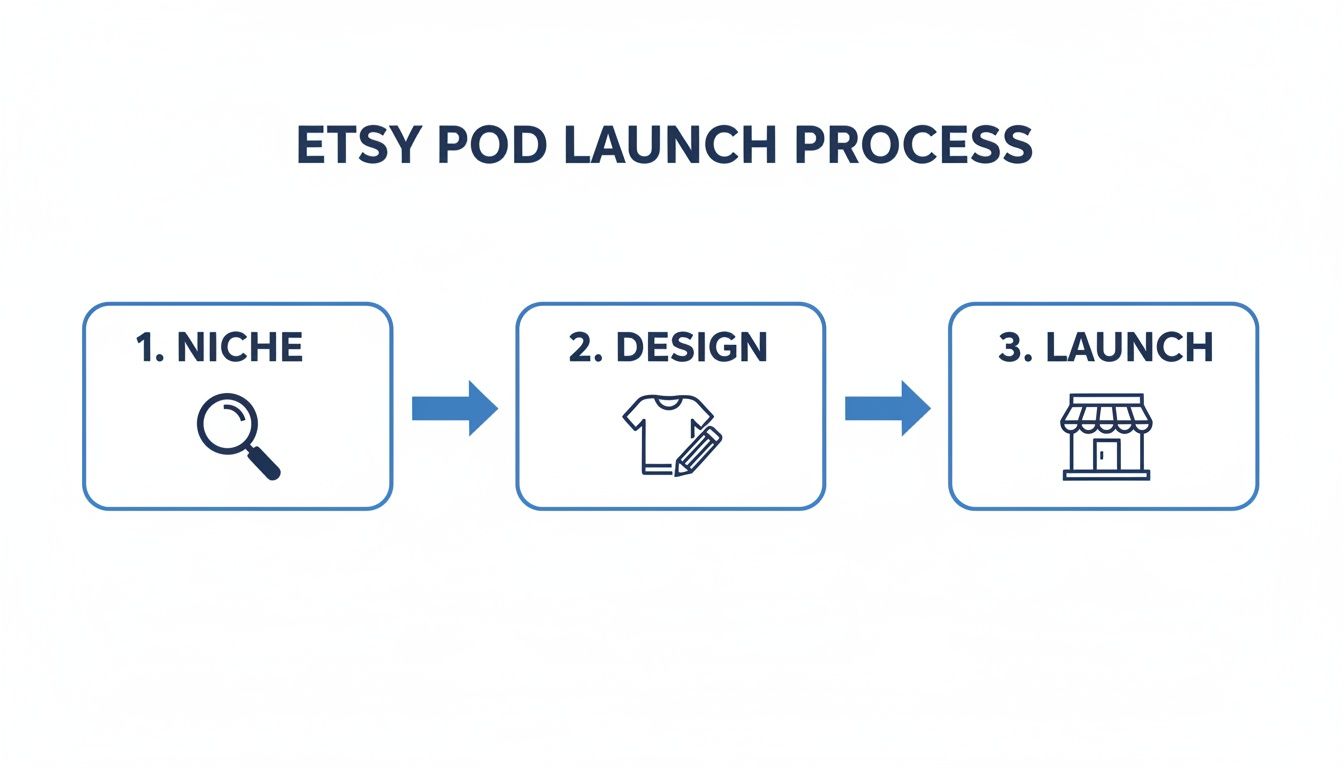
This simple flow—Niche, Design, Launch—is the engine behind every successful Etsy POD shop. It proves you don't need a hundred-page business plan to get started. You just need to follow the process.
Building Your Foundation From The Ground Up
Our goal here isn't just to help you make a few bucks. It's to help you build a sustainable, high-margin business that gives you genuine financial freedom.
To get there, we’ll cover everything, starting with the fundamentals. I'm going to show you exactly how to:
Find profitable niches packed with passionate, ready-to-buy customers.
Create incredible designs in minutes (even if you're not an artist) using our powerful tool, AvatarIQ.
Connect a reliable POD supplier to your Etsy shop seamlessly.
Write product listings that get seen by shoppers and convince them to buy.
Price your products for healthy, sustainable profit margins from day one.
This is about more than just selling t-shirts. It's about building an asset. You're creating a system that generates sales for you, freeing up your time and giving you control over your financial future. That feeling of excitement you have right now? Hold onto it. That's the first step.
To get you started on the right foot, here's a quick checklist of the major components we're about to build together.
Your Etsy POD Launch Checklist
This table breaks down the essential pieces of your new business. Think of it as our roadmap for the rest of this guide.
Component
Key Action
Why It Matters
Niche Selection
Identify a passionate audience with clear buying habits.
A great niche makes marketing easier and helps your designs stand out from the crowd.
Design Creation
Develop unique designs that resonate with your chosen niche.
Your designs are your product. They need to connect emotionally to drive sales.
POD Provider
Choose and integrate a reliable partner for printing and fulfillment.
A good partner ensures high-quality products and happy customers.
Etsy Store Setup
Create and optimize your shop, listings, and SEO.
This is how customers find you. Getting it right is crucial for organic traffic.
Launch & Marketing
Publish your listings and start driving initial traffic.
A strong launch builds momentum that can carry your business for months.
This checklist covers the core of what it takes to get your doors open and your first sales rolling in.
As you start to see success, you'll naturally think about the next steps. For some, especially those in Canada, this might mean thinking about your business structure. It's worth looking into when and should I incorporate my business to handle the legal and financial side of things as you scale.
But for now, let's focus on step one. Let's start building.
Finding Your Niche and First Winning Products
Every successful print-on-demand shop on Etsy starts long before the first design is ever made. It begins with a deceptively simple idea: find a specific group of passionate people and make something they’ll fall in love with. This is where the magic happens, and trust me, it’s a lot more straightforward than it sounds.
Your goal isn't to sell to everyone. It's to sell something special to a specific someone.
The most common trap for new sellers is jumping into gigantic, oversaturated markets like "funny dog shirts." Sure, they're popular, but they're also a battleground with tens of thousands of competitors. The secret to getting those first crucial sales and building real momentum is to niche down.
Instead of "dog shirts," get specific. How about "t-shirts for Corgi owners who love to hike"? Or "sweatshirts for retired nurses who are now full-time grandmas"? See the difference?
This strategy of drilling down into a sub-niche is your unfair advantage. You stop selling just a piece of clothing and start selling an identity, an inside joke, or a badge of honor for a tight-knit community. These are the customers who don't just buy a product—they feel seen by it.
Uncovering Profitable Niche Ideas
Finding these little goldmines isn't about some stroke of genius; it's about paying attention. Your future best-sellers are hiding in plain sight.
Just look at your own life and the people in it.
Hobbies and Passions: What are you or your friends obsessed with? Woodworking, book clubs, urban gardening, fantasy football—every single one is a potential niche.
Professions and Careers: People are incredibly proud of what they do for a living. Think about niches like "ER Technicians," "Librarians," or "Long-Haul Truckers."
Life Events and Roles: Big life moments create passionate buyers. Consider niches like "new parents," "first-time homeowners," or "newly engaged couples."
Once you’ve got a few broad ideas, use Etsy itself as a research tool. Type your idea into the search bar and watch the auto-suggestions. That's Etsy literally telling you what real shoppers are searching for. This is how you confirm people actually want what you're thinking of selling, before you spend a single minute designing. For a deeper dive, check out our complete guide on how to find niches for print on demand for more advanced tactics.
Choosing Your First Products
With a solid niche in mind, it’s time to pick the actual products you’ll sell. The options can feel endless, but you want to start with proven winners that sell all year long. This is about building a foundation of evergreen items that will bring in consistent cash.
The undisputed champions for beginners are:
T-Shirts: The backbone of any POD apparel business. They’re universally popular, available in countless styles, and offer healthy profit margins.
Sweatshirts and Hoodies: These are gold, especially in the colder months. As higher-ticket items, they can seriously boost your average order value and feel like a premium, cozy purchase.
Mugs: A perfect gift and an easy impulse buy. Mugs with clever, niche-specific designs are absolute top-sellers on Etsy, day in and day out.
The key is to start small and focused. Don't try to launch with 50 different product types. Master the t-shirt. Perfect your sweatshirt listings. Then you can start expanding your catalog. This focused approach makes your shop look way more professional and makes your marketing infinitely more effective.
Validating Your Product Ideas
Before you fire up your design software, do one last check to make sure you're not just guessing. Head back to Etsy and search for your specific combination, like "book lover sweatshirt."
Take a hard look at the top results. Are other sellers making consistent sales? Do the reviews show that customers are genuinely happy with what they received? This isn't about copying them. It's about confirming that a hungry market exists for what you're about to create.
Seeing successful competitors is a fantastic sign. It's proof that people are already spending money in this niche. Your job now is to step into that market with a fresher design, a unique perspective, or a message that connects even more deeply with that target customer. This simple research phase is what separates the shops that struggle for months from the ones that thrive from day one.
Bringing Your Designs to Life (The Easy Way)
Alright, you've locked in a niche that's full of passionate buyers. Now for the fun part: creating the actual designs people will be excited to wear.
For years, this was the biggest hurdle for anyone wanting to get into the apparel game. If you weren't a graphic design pro, your options were limited. You could either shell out a ton of cash for freelancers or spend countless frustrating hours trying to cobble something together yourself.
Thankfully, those days are long gone. This is where you get a serious, almost unfair, advantage.
Imagine having an entire design team on call, ready to turn any of your ideas into a finished product in seconds. That's exactly what you get with AvatarIQ, our in-house AI design tool we built from the ground up for apparel sellers like you. It’s made to completely smash that design roadblock and let your creativity run wild, no matter your skill level.
From a Simple Idea to a Killer Design in Seconds
Let's go back to our niche: "t-shirts for Corgi owners who love to hike." Instead of hunting for generic clipart, you just tell AvatarIQ what you want.
A simple prompt like, "A cute Corgi wearing a backpack, sitting on a mountain top, vintage art style," can spit out dozens of unique, professional-quality designs for you in a matter of moments.
This completely flips the script for starting a print-on-demand business on Etsy. The speed alone is a game-changer.
Test Ideas at Lightning Speed: Have ten different design ideas for your niche? You can generate all of them in a few minutes, not a few weeks. This lets you quickly see what your audience actually connects with, without sinking a ton of time into duds.
Scale Up Your Listings: A huge key to success on Etsy is consistency and volume. With AvatarIQ, you can pump out a high volume of quality listings, which tells the Etsy algorithm that your shop is active, relevant, and worth showing to more people.
Create Genuinely Unique Products: You’re no longer stuck using the same templates and graphics as everyone else. You can create truly one-of-a-kind designs that give you a massive edge over the competition.
Generating Mockups That Actually Sell
A great design is only half the battle. How you show it off is just as critical. Shoppers on Etsy need to be able to picture themselves wearing your stuff.
AvatarIQ does more than just create the design; it also generates hyper-realistic mockups that look like they came from a professional photoshoot.
This means you can display your t-shirt or sweatshirt on a diverse range of AI-generated models in all kinds of settings—from a cozy living room to a mountain trail. You get the quality of a high-end shoot without dropping thousands of dollars on photographers, models, and locations.
This is your secret weapon: the ability to generate incredible designs and photorealistic mockups in one seamless workflow. You can go from a simple concept to a complete, ready-to-sell product listing faster than ever before. This isn't just a tool; it's a system for building your brand efficiently and at scale.
To really get the most out of AI, it helps to play around with different tools. You can explore some of the best free AI image generators out there to see what kind of unique assets you can create for your Etsy shop.
Your New Super-Efficient Design Workflow
Your whole process just got way more efficient. You can go from a brainstorming session to a live Etsy listing in a fraction of the time it used to take. We have a more detailed guide on how to use Canva for print on demand, but the core AI workflow is incredibly simple:
Ideate: Think up a design concept based on your niche research.
Generate: Pop a simple text prompt into AvatarIQ to create the design.
Refine: Pick the best option and make any small tweaks you see fit.
Mockup: Apply your finished design to a set of photorealistic mockups.
This powerful, streamlined workflow is exactly how our students in the Apparel Cloning program are able to build huge product catalogs and scale their businesses so quickly. It's all about working smarter, not harder, and using the right tech to stay miles ahead of the competition. The path to building a successful eCom business is right here, and with tools like this, the biggest hurdles have been cleared for you.
Setting Up Your Etsy Shop for Maximum Sales
Alright, you’ve got your killer niche and a folder full of amazing designs. Now it's time to build your storefront. This is the fun part—where your ideas finally become a real, shoppable brand on one of the biggest marketplaces for unique goods. Getting this next stage right is what separates a fun hobby from a seriously profitable e-commerce business.
First up is creating your Etsy seller account. It’s a pretty straightforward process, but it’s the foundation for everything else. You'll dial in your shop preferences, pick a memorable name that speaks to your niche, and link up your bank account so you can get paid.
With your shop live, the next move is to connect a reliable print-on-demand partner. Think of them as your behind-the-scenes operations team. They’re the ones who will be printing your designs, packaging them up, and shipping them out to your customers. Your reputation is in their hands, so look for a provider known for quality products, dependable shipping times, and a smooth Etsy integration.
Crafting the Perfect Etsy Listing
An Etsy listing is way more than just a product page; it’s your virtual salesperson working around the clock. Your job is to make someone stop scrolling, feel an instant connection with your product, and hit "add to cart" without thinking twice. It’s a mix of art and science.
Your product mockups are the first hook. They have to be good. This is where a tool like AvatarIQ is a game-changer. By creating photorealistic mockups, you’re not just selling a t-shirt; you’re selling a vibe, a lifestyle. The customer sees themselves in your product, making the purchase feel personal.
Next up is the science: your Etsy SEO. This is how people find you in the first place.
Titles: Your title needs to be stuffed with keywords that a real person would actually type into the search bar. Get inside your customer's head. Instead of something generic like "Funny Shirt," go for long-tail gold like "Retro Corgi Hiking T-Shirt, Gift for Dog Mom, Mountain Adventure Tee."
Tags: Etsy gives you 13 tags. Use every single one of them. These are your direct lines to the search algorithm. Mix broader terms ("dog lover gift") with super-specific ones ("corgi owner apparel") to cast the widest net possible.
Descriptions: Tell a story. Talk about the soft feel of the cotton, the high-quality print, and paint a picture of who this product is perfect for. Weave your keywords in naturally here, too—it helps both shoppers and the Etsy algorithm figure out exactly what you're selling.
Keep this in mind: you’re setting up shop on a platform with 90 million active buyers. That’s a massive audience you can reach with zero upfront inventory costs. Even better, 33% of all Etsy sales are for personalized or custom items, so a huge chunk of buyers are already looking for the exact kind of unique products you’re making.
Pricing for Healthy Profit Margins
Pricing can feel tricky, but there’s a simple formula to get it right. Your goal isn't just to cover your costs; it's to build a profitable business right out of the gate. A 30-50% profit margin is a healthy target that gives you room to grow.
To figure out your price, just add up three numbers:
Product Cost: What your POD partner charges you to make the item.
Shipping Cost: The fee your provider charges to ship it.
Etsy Fees: Etsy takes a cut for transaction, listing, and payment processing fees.
Once you have your total cost, you can calculate your retail price. For a 40% margin, a quick way to do this is to multiply your total cost by 1.67. This ensures that after all the expenses, you’re walking away with a solid profit. For a full step-by-step, check out our guide on how to set up a print on demand Etsy store.
Don't fall into the trap of trying to be the cheapest. That's a race to the bottom. Instead, compete on the quality of your designs, the appeal of your mockups, and how well you connect with your niche. A well-built shop that’s optimized for sales and priced for profit is the engine that will power your entire business.
Going Live: Launching and Scaling Your POD Empire
Flipping the switch on your Etsy shop is a rush, but that's the starting pistol, not the finish line. Now the real excitement begins. We're about to turn this new store into an automated income stream, shifting from setup mode into pure growth mode.
The single biggest key to getting early traction isn't some secret marketing hack. It's consistency. Plain and simple. The Etsy algorithm is hungry for activity, and it seriously rewards shops that are always adding new, relevant products.
Think of every new listing as another hook in the water. Each one is a new chance for a customer to bite.
So many sellers give up way too soon. They'll upload a few dozen designs, see only a handful of sales, and just assume it isn’t working. But the people who win in this game know that volume and consistency are what unlock the algorithm and build a real, profitable business.
Your Launch Plan: The Consistency Engine
Right after you launch, your main mission is to build out your product catalog. Forget about making a few "perfect" listings. Your goal should be a steady, consistent flow of good ones. This constant activity tells Etsy your shop is alive, fresh, and a place its customers should be checking out.
This isn't just a hunch; it’s a proven strategy for insane growth. I've seen a real Etsy POD shop go from just 35 sales in its first month to around $65,000 in revenue over the next three months. The only thing they changed? They massively ramped up their listing volume.
This shows just how much of a game-changer consistency is. Most people quit after listing 50-100 products with no sales. The winners push past that wall, knowing that momentum builds over time. You can actually see the real-world results of this aggressive listing strategy to understand its power.
This is exactly why having a fast design process with a tool like AvatarIQ is so vital. It lets you maintain that crucial momentum without burning yourself out, turning fresh ideas into live Etsy listings in just minutes.
Your launch isn't a single event. It's a 30-to-90-day sprint of consistent action. Every design you list is another lottery ticket—another chance to get discovered, make a sale, and give the Etsy algorithm exactly what it wants to see.
Handling Your First Orders and Nailing Customer Service
Hearing that first "cha-ching" notification on your phone is a feeling you'll never forget. And while your POD partner handles all the printing and shipping, your job is far from over. This is your first real shot at creating a customer for life.
Your best marketing tool, especially early on, is top-notch customer service. Responding to questions quickly and professionally isn't optional. Happy customers are the ones who leave those precious five-star reviews, and those reviews are the social proof that convinces other shoppers you're a safe bet.
A few simple tips to create an awesome customer experience:
Be Fast: Try to answer every customer message within a couple of hours. Speed impresses people.
Be Proactive: If you get a notification about a potential shipping delay, let the customer know before they have to ask you. They'll appreciate the heads-up.
Go Above and Beyond: A simple, personalized "thank you" message after their order ships can make a surprisingly huge impact.
Using Data to Make Smarter Moves
Once the sales start trickling in, your Etsy Stats dashboard becomes your new best friend. Don't just get hypnotized by the revenue number. You need to dig into the data to see the story it's telling you.
Start looking for patterns in your analytics:
Which listings get the most views? This tells you which designs and keywords are catching people's eyes in the search results.
Which products are turning those views into sales? This is even more important. It shows what's actually compelling people to pull out their wallets.
What search terms are bringing people to your shop? This is a goldmine for SEO tweaks and ideas for your next batch of designs.
When you pay close attention to this data, you can finally stop guessing and start making informed decisions. Double down on the niches, design styles, and keywords that are already working. This creates a powerful feedback loop that fuels smart, sustainable growth. It's how you go from your first $100 month to your first $10,000 month and beyond.
Got Questions? We’ve Got Answers.
As you start piecing this all together, a few questions are bound to bubble up. That’s a good thing—it means you're already thinking like a business owner. We’ve been there, so let’s tackle some of the most common hurdles new sellers face to get you moving with confidence.
Seriously, What’s This Going to Cost Me?
One of the best things about jumping into print-on-demand on Etsy is how little cash you need to get started. It’s not like opening a brick-and-mortar store with thousands in overhead. Your main costs are tiny.
Etsy Listing Fee: It's just $0.20 to list an item. That's it.
Transaction Fees: When you make a sale—and only when you make a sale—Etsy takes a small cut for processing the transaction.
There are zero upfront inventory costs. You don't pay your POD partner for the t-shirt until after a customer has already bought it from you and the money is in your account. This is a super low-risk way to get your business off the ground for less than the price of a fancy coffee.
Do I Actually Need to Be a Designer?
Nope. Absolutely not. This is probably the biggest myth that stops people dead in their tracks. While you obviously need good designs, you don’t need to be a classically trained artist to make them.
The sellers who crush it aren’t necessarily professional graphic designers. They’re entrepreneurs who really get their niche. They know the inside jokes, the popular sayings, and the imagery that will make their audience stop scrolling.
Your real superpower is your knowledge of your niche. Your ability to come up with a clever phrase or a cool concept is far more important than struggling with complicated software. With a tool like AvatarIQ, you can type a simple idea and get back a professional-grade design in seconds. It was built for people just like you.
How Many Listings Do I Need to Start Making Sales?
There’s no magic number here, but the real answer is probably "more than you think." Consistency trumps everything else. Some people get lucky and strike gold with their first few designs, but real, sustainable success is built by creating a solid catalog of products.
Your goal, especially in the first 90 days, should be to add new designs consistently. This activity sends a strong signal to Etsy’s algorithm that your shop is alive and kicking, which helps you get seen. If you list ten products and the sales don’t immediately roll in, don't get discouraged. Keep creating, keep listing, and let that momentum build.
At Skup, we’re all about turning these questions into clear, actionable game plans. Our entire system, from the Apparel Cloning program to our AI design tool AvatarIQ, is designed to give you a straight shot to profitability without all the guesswork. Ready to start building for real? Learn more about how Skup works.
Imagine launching a full-blown apparel brand without ever touching a single t-shirt or hoodie. That’s the magic of print on demand, and if you’ve been waiting for the right moment to jump in, this is it. This is your complete roadmap to getting your first sale and building a real, high-margin brand from the ground…
Quick Answer Matt Schmitt is the co-founder of Skup, a print-on-demand ecommerce training company. With over $30 million in personal ecommerce sales and a decade of experience building and scaling POD stores, Matt oversees Skup’s coaching program and teaches the systems that helped him exit multiple 7-figure businesses. His students have collectively generated tens of…
Ready to turn your creativity into cash? The fastest way to make money selling t-shirts is to find designs that are already crushing it, create even better versions with your own unique spin, and sell them to passionate audiences. The exciting world of print-on-demand allows you to start with virtually zero risk and build a…