Home » Blog » Proven Marketing Strategies for Startups to Fuel Fast Growth
Great marketing isn't about having a million-dollar budget or a massive team. It's about knowing who you're talking to, making them an offer they can't ignore, and then showing up in the right places to connect the two. This journey is one of the most exciting opportunities available to entrepreneurs today.
For a startup, this means a smart blend of data-driven experimentation and patience. You need the quick wins that paid ads can deliver, but you also need the long-term, brand-building power of organic growth. Nail this balance, and you’re building something truly special.
Your Blueprint for Startup Marketing Success
Welcome to your no-fluff playbook for building a real-deal eCommerce business. We’re cutting through the noise to give you a step-by-step framework that actually works—one built on what we've seen win in the trenches, not just in theory. For ambitious founders, especially in the print-on-demand space, the right marketing strategies are your launchpad to success.
Our job here is to give you a clear path from a cool idea to predictable, repeatable sales.
Forget burning through your cash on pure guesswork. Instead, you'll learn a system to find your ideal customers, figure out exactly what they want to buy, and build a marketing engine that keeps the sales coming in. The opportunity in eCommerce right now is massive, and with the right strategy, you can absolutely claim your piece of it.
The Core Pillars of Startup Marketing
Success in eCommerce, especially in the fast-moving world of print-on-demand, really boils down to a few fundamental pillars. If you get these right from the start, you build a foundation that makes everything else—scaling, hiring, new product launches—so much easier.
These aren't just buzzwords; they're the non-negotiables for a brand built to last.
Here's a quick look at the core marketing pillars every founder needs to master. This table breaks down what matters most and why, giving you a clear starting point for your growth plan.
Core Marketing Pillars for Your Startup
A quick overview of the essential marketing areas every new eCommerce and POD founder must focus on for sustainable growth.
Marketing Pillar
Why It's Critical for Startups
Key Action
Customer & Offer Discovery
All great marketing starts here. Without knowing who you're selling to and what they desperately want, your ads are just noise.
Conduct surveys, interviews, and competitor analysis to build a detailed customer persona.
Smart Channel Selection
You can't be everywhere at once. Focusing your limited budget and time on the right channels is how you win against bigger players.
Identify where your target audience spends their time online and focus on 1-2 key channels first.
Conversion & Retention
Getting traffic is easy; getting sales is hard. Turning that first sale into a second, third, and fourth is where the real profit is.
Optimize your website for a smooth checkout and implement an email marketing strategy to bring customers back.
By focusing on these three areas, you're not just chasing fleeting trends. You're building a solid, repeatable system for growth.
The goal is to move beyond short-term tactics and build a robust system. By mastering these fundamentals, you create a business that doesn't just survive but thrives, giving you the financial freedom you're working toward.
Laying the Groundwork for Growth
Before you can build a house, you need to learn how to read a blueprint. The same goes for marketing. To set yourself up for success, it helps to get a solid handle on the promotional tools that are working right now.
Think of this guide as your roadmap. By the time you’re done, you won't just have a plan; you'll have the confidence to execute it and turn your startup vision into a profitable reality.
Let's dive in.
Discovering Your First Customers and Winning Offers
Before you spend a single dollar on ads, you have to nail two things: Who are you selling to? And what do they actually want? This is the invisible line that separates stores that barely hang on from brands that take off. It's about swapping your gut feelings for genuine customer insight.
Many founders get excited and rush to build a product they think will be a hit, only to launch to the sound of crickets. It's an understandable mistake, but one you can easily avoid. Data shows that 14% of failed startups point to poor marketing, and another 14% admit to ignoring their customers—which is just another way of saying "bad marketing."
That means almost 3 out of 10 startup failures are tied directly to not understanding their customer. If you want to dive deeper, you can check out more research on why startups succeed or fail, but the lesson is clear.
This is exactly why mastering customer and offer discovery is one of the most powerful marketing strategies for startups. It's the foundation for everything that comes next.
Adopting the Apparel Cloning Mindset
The smartest print-on-demand sellers I know don't try to invent demand out of thin air. They find it. This is the whole idea behind the "Apparel Cloning" mindset—a systematic way to figure out what's already selling and, more importantly, why people are buying it.
This isn't about ripping off designs. It's about playing detective and deconstructing what makes a product successful so you can spot repeatable patterns.
Your job is to sift through online communities, watch social media trends, and peek at what your competitors are doing. The goal is to pinpoint hungry audiences and untapped niches, which takes all the risk out of launching. You'll be creating something people are already itching to buy. The Apparel Cloning course is our signature program designed to walk you through this exact process, step-by-step.
Building Your Ideal Customer Avatar
A customer avatar (or persona) is a super-detailed profile of your ideal buyer. And I don't just mean demographics like age and location. We need to go deeper into their psychology.
To build an avatar that’s actually useful, you need to answer these questions:
Passions and Hobbies: What do they geek out on? Are they part of communities like dog lovers, vintage car collectors, or book clubs?
Pain Points and Frustrations: What keeps them up at night? What are the little annoyances your product could connect with or solve?
Values and Beliefs: What do they stand for? What's their sense of humor like—sarcastic, goofy, dark?
Online Behavior: Where do they hang out online? Which influencers do they trust? What slang or inside jokes do they use?
Doing this work transforms a vague "target audience" into a real person you can talk to. Suddenly, your marketing messages get sharper, your designs hit differently, and your products feel like they were made just for them.
An avatar isn't just a marketing exercise; it's your north star for every decision. When you know exactly who you're selling to, crafting compelling offers becomes ten times easier.
Engineering an Irresistible Offer
Once you have that crystal-clear customer avatar, you can start engineering an offer that feels like an absolute no-brainer. A winning offer is more than just a t-shirt; it’s the whole package—the product, the message, and how you present it.
Start by validating your ideas before you create a single thing. You can use a tool like AvatarIQ to spin up some quick mockups of your design concepts. Next, take those mockups and share them in relevant online groups. Ask for honest feedback. Do people love it? Would they actually pull out their credit card for it?
This one validation step can save you an insane amount of time and money.
After you've got a validated design, your offer becomes the entire experience that makes it a must-have. Nail this stage, and every marketing dollar you spend later on will have the biggest possible impact.
Choosing Your Paid and Organic Marketing Channels
You’ve done the hard work. You’ve dug deep, found your ideal customer, and crafted an offer that feels like it was made just for them. Now for the next giant leap: getting that offer in front of them. This is all about choosing your marketing channels—the roads you'll use to connect your products with the people who actually want them. For a new eCommerce or print-on-demand brand, this is an incredibly exciting decision.
The best marketing playbooks don't just bet on one horse. They build a powerful tag team between paid advertising and organic marketing.
Here’s an easy way to think about it: paid ads are like lighter fluid. They get the fire going fast. Organic content, on the other hand, is the slow-burning logs that keep the fire roaring long after the initial spark. You get instant sales and feedback from ads while building a sustainable, free traffic source with content. That balanced approach is your ticket to smart, efficient growth.
The Immediate Power of Paid Advertising
Paid ads, especially on a powerhouse like Meta (Facebook and Instagram), are your shortcut to real-world data. Forget guessing games. You can put your offer in front of thousands of potential buyers almost overnight and see what sticks. You're literally buying information on which messages connect, which designs sell, and who your real best customers are.
For a startup, that speed is everything. Instead of waiting months to see if your SEO is working, you can get results—and learn critical lessons—in a matter of days.
Here’s why kicking things off with paid ads is so powerful:
Rapid Feedback: You'll know almost immediately which products and ad creatives are winners. This lets you double down on what’s working and kill what isn't, saving you a ton of time and money.
Precise Targeting: Platforms like Meta allow you to zero in on people based on their interests, online behavior, and demographics. Your budget goes directly toward reaching the most relevant audience.
Scalability: The moment you find a profitable ad campaign, you can start turning up the dial. Systematically increasing your budget can drive predictable sales and grow your business on your terms.
For a fresh take on ads, it's worth looking into how AI User-Generated Content (UGC) Ads can build authenticity and grab attention. Your first campaigns don't need to be complex, but you do need to know the basics. Dive into our guide on how to build profitable FB ads to get started on the right foot.
The Enduring Value of Organic Marketing
While paid ads give you that initial burst of speed, organic marketing is what builds the foundation of your brand. Think of it as the engine that will eventually drive free, high-intent traffic to your store for years. This covers everything from Search Engine Optimization (SEO) and social media content on TikTok or Instagram to building a killer email list.
The amazing thing is that the eCommerce landscape is more accessible than ever. The cost to get results from ads has risen in recent years, which is exactly why an overwhelming 98% of high-growth companies now say that building relevant organic traffic is a non-negotiable part of their strategy. It’s an opportunity, not a barrier.
Building an organic presence isn't just a "nice-to-have" anymore; it's a strategic necessity. It's your business's insurance policy against rising ad costs and your ticket to creating a loyal community that money can't buy.
You don't need a huge content team to get started. Just start simple.
Niche Blog Posts: Write helpful articles that answer the exact questions your ideal customer is tapping into Google.
Engaging Social Content: Create short-form videos for TikTok or Instagram Reels. Show off your designs, tell a quick story, or jump on a trend that fits your niche.
Over time, this content builds trust and positions you as an authority. It pulls in customers who are already looking for what you sell, meaning they show up ready to buy. When you combine the instant feedback from paid ads with the long-term asset of organic content, you create a resilient marketing machine that's ready for anything.
Turning Visitors into Loyal Customers
Driving traffic to your store is a huge win, but honestly, it’s only the first half of the game. The real magic—and where the real money is made—happens when you turn those curious visitors into paying customers and then, eventually, into loyal fans who buy again and again.
This is where your startup’s marketing strategy shifts gears from just getting eyeballs to actually building a profitable business. It's all about maximizing the value you get from every single person who lands on your site. By dialing in your store experience and nurturing your audience, you can seriously boost sales without spending another dime on ads.
Optimizing Your Store for Conversions
Conversion Rate Optimization (CRO) sounds super technical, but the core idea is simple: make it as easy and appealing as possible for someone to buy from you. Your product page is basically your digital salesperson. If it’s confusing, slow, or doesn't feel trustworthy, people are going to walk.
Even tiny tweaks here can lead to massive gains. You've already done the hard work of getting them to your site; CRO is how you make sure that effort pays off. It's the art of turning a "maybe" into a "hell yes."
Here are the high-impact areas you should tackle first:
High-Quality Product Images: Your visuals do the heavy lifting. Ditch the blurry photos and use professional-looking mockups that show your designs clearly and in the best light.
Compelling Product Descriptions: Don't just list features. Tell a story that clicks with your customer avatar. Use their language, speak to their passions, and paint a picture of how awesome they'll feel wearing your stuff.
Clear Calls-to-Action (CTAs): Your "Add to Cart" and "Buy Now" buttons should be impossible to miss. Think contrasting colors and direct, punchy text that tells people exactly what to do.
Social Proof and Trust Signals: Plaster your site with customer reviews, ratings, and secure payment badges. These little things build confidence and crush that last-second hesitation that kills so many sales.
The Power of Automated Email Marketing
So, what happens after someone visits but doesn't buy? Or after they make that first purchase? This is where email marketing becomes your secret weapon for building a brand that lasts. It’s your direct line to your audience, and it works for you around the clock.
The data doesn't lie. Globally, 40-70% of qualified leads just aren't ready to buy the first time they meet you, and a wild 80% of new leads will never convert if you don't nurture them. Companies that get this right generate 50% more sales-ready leads at a 33% lower cost.
This is why setting up automated email flows isn't just a "nice-to-have"—it's a non-negotiable.
Email marketing isn't about spamming inboxes. It's about building a relationship, providing value, and staying top-of-mind. When your customer is finally ready to buy, you want your brand to be the first one they think of.
Setting Up Your Must-Have Email Flows
You don't need a dozen complicated email campaigns to get started. Just focus on these three essential automated flows. They deliver the biggest bang for your buck, hands down.
The Welcome Series: Someone just trusted you with their email. Don't leave them hanging! Send a series of 3-4 emails introducing your brand, sharing your story, and maybe offering a little something on their first purchase. This is your shot to make an incredible first impression.
The Abandoned Cart Flow: Life happens. People add stuff to their cart and get distracted by a cat video. A simple sequence of reminder emails can recover a huge chunk of these otherwise lost sales. Gently nudge them about what they left behind and make it dead simple to finish checking out.
The Post-Purchase Follow-Up: The journey doesn't end at the checkout. After a customer buys, send an email to say thanks and confirm their order. A week later, follow up and ask for a review. This builds goodwill and generates that priceless social proof you need.
By mastering conversion and retention, you create a powerful growth loop. Your ad spend becomes more profitable, your customers stick around longer, and your business is built on a rock-solid foundation. Want to go deeper? Check out our complete guide on customer retention strategies for eCommerce.
Creating Winning Designs and Mockups That Sell
In the crazy visual world of print-on-demand, your product presentation isn't just part of your marketing—it's your number one tool. It's the first thing customers see and the last thing they remember.
For startups, creating killer designs and professional product photos can feel like a massive hurdle. But it's a hurdle you can now leap over with surprising ease.
The truth is, you no longer need to be a graphic design wizard or hire a photographer to compete. The game has completely changed, opening up incredible possibilities.
Unleash Your Creative Power with AI
Imagine having a world-class designer on call 24/7, ready to bring any idea to life in seconds. That's the power you now have at your fingertips. Tools like AvatarIQ were built from the ground up to demolish the creative friction that holds so many new entrepreneurs back.
Instead of staring at a blank canvas, you can generate stunning, unique apparel designs with just a few simple text prompts. This lets you move at the speed of your own imagination, creating and testing new concepts faster than ever before. It’s a genuine superpower for a startup, letting you build a massive, diverse product catalog without a lick of design experience.
This isn't just about making things easier; it's about unlocking creative potential. You can now test niche ideas, jump on new trends, and create designs that truly connect with your customer avatar in minutes, not weeks.
From Idea to Pro Listing in Minutes
Once you've got a design you love, the next challenge is showing it off in a way that builds trust and screams quality. Customers absolutely buy with their eyes, and a flat, boring mockup on a generic background just won't cut it anymore.
This is where AI-driven mockups become an absolute game-changer for your marketing.
With a tool like AvatarIQ, you can automatically create hyper-realistic product photoshoots without ever touching a camera or hiring a model. This process gives your store an instant premium feel, which has a direct line to your conversion rates. High-quality visuals communicate professionalism and trustworthiness, convincing visitors that your products are worth their money.
To learn more about elevating your brand's look, check out our guide to creating custom product images that stop the scroll.
A Workflow Built for Speed and Scale
This new workflow completely transforms how you launch products. It's a simple yet incredibly powerful three-step process that fuels rapid growth.
Generate Your Design: Use simple text prompts in AvatarIQ to create dozens of design variations for your target niche.
Create Your Mockups: Instantly place your best designs onto professional, AI-generated lifestyle photos that match your brand's vibe.
Launch and Test: Push your new products live to your store and run small, targeted ad campaigns to see what actually resonates with your audience.
By combining AI design generation with automated mockups, you create a seamless pipeline from a spark of an idea to a live product. This is one of the most effective marketing strategies for startups because it minimizes risk and maximizes speed, allowing you to outmaneuver competitors and quickly find your next bestseller. This is how you build a visually compelling brand that not only gets customers excited but also drives consistent sales.
Your First 90 Days: A Startup Marketing Launch Plan
All the theory in the world doesn't mean a thing until you put it into action. This is where the rubber meets the road. We're going to take everything we've talked about and forge it into a clear, actionable roadmap for your first three months in business.
Think of this as your playbook for going from zero to your first real sales milestone. It’s designed to break down a massive goal into exciting, manageable steps.
This 90-day plan is one of the most powerful marketing strategies for startups because it’s all about building momentum. Each month stacks on top of the last, creating a compounding effect that turns small, consistent actions into serious, long-term growth.
Let's get to work.
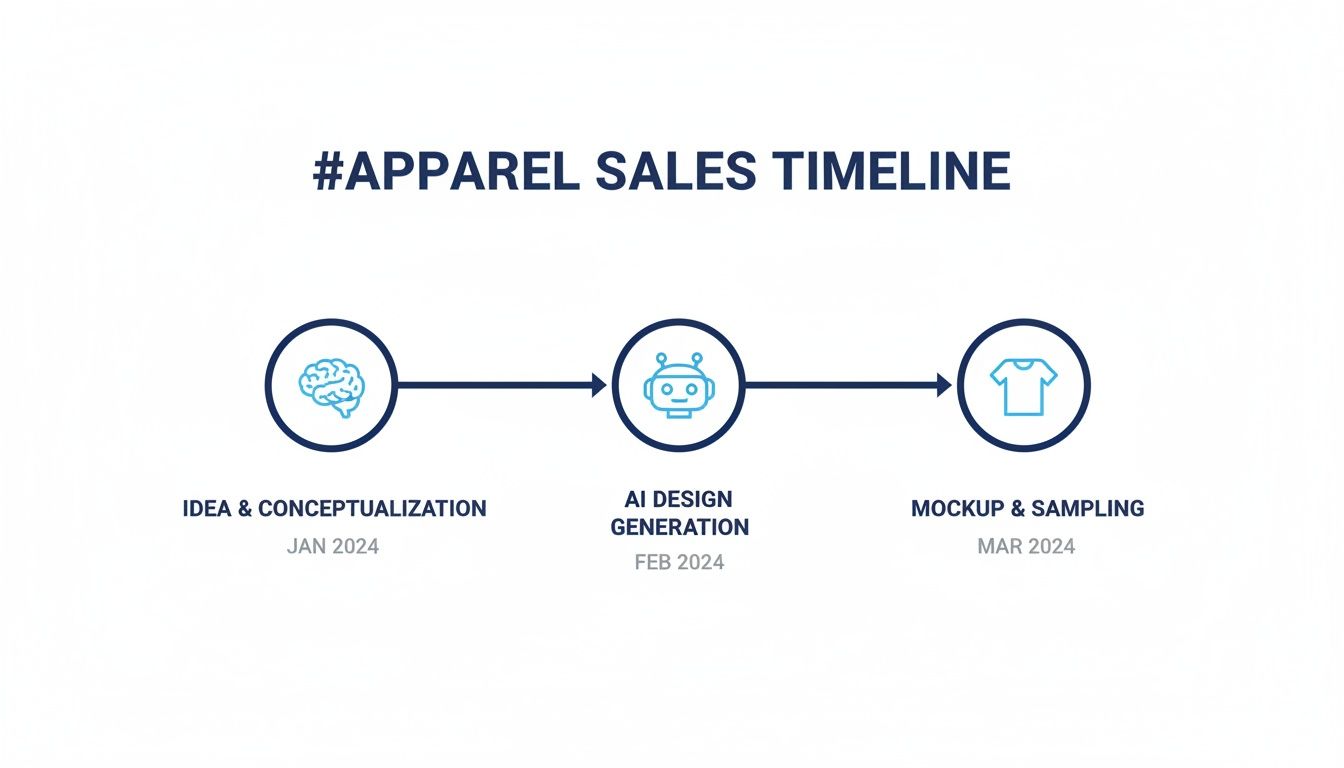
For anyone in the apparel space, this timeline shows you just how fast you can go from a simple idea to a professional mockup that's ready for your store.
The biggest takeaway here is how much you can speed up the creative process. This lets you validate and launch new product ideas faster than you ever thought possible.
Month 1: Build Your Foundation (Days 1-30)
Your first month is all about laying a rock-solid foundation. If you rush this part, it's like building a house on sand—it’s just a matter of time before it all comes crashing down. The goal isn't to make a million dollars right away; it's to validate your core ideas and set up your systems so that future growth is actually possible.
Here are your key moves:
Niche & Customer Deep Dive: Get crystal clear on your target customer avatar. Seriously, spend time hanging out in the online communities where they live. Learn their language, their pain points, and what they get excited about.
Offer Validation: Fire up AvatarIQ and generate 5-10 design concepts based on your customer research. Create some killer mockups and drop them into relevant Facebook groups or Reddit threads for honest feedback. Let the data—not your gut—tell you which designs are winners.
Store Setup & CRO Basics: Build out your Shopify store. Keep the design clean and simple. Use high-quality mockups of your validated designs, write compelling product descriptions, and make your calls-to-action impossible to ignore.
Email Flow Setup: Get your three essential automated email flows running: the welcome series, abandoned cart reminders, and a post-purchase thank-you. These are your 24/7 sales assistants.
Your primary KPI for Month 1 isn't sales—it's learning. You want to end the month with a validated product, a store that’s built to convert, and the essential systems humming in the background.
Month 2: Launch and Test (Days 31-60)
With your foundation firmly in place, it’s time to open the doors and start collecting real-world data. Month 2 is all about launching your first marketing campaigns, getting into a content rhythm, and learning from what your customers actually do, not just what they say. This is where the fun really begins.
Your focus flips from preparation to execution. It’s time to spend a small, controlled budget to get your first customers in the door and figure out which messages truly hit home.
Here's your action plan:
Launch First Ad Campaigns: Start small. Set a conservative daily budget on Meta (Facebook/Instagram) and run targeted ads for your top 1-2 validated designs. The goal here is to get initial traffic and sales data, not to hit a home run on day one.
Start Your Organic Engine: Pick one social media platform (like TikTok or Instagram Reels) and commit to posting 3-5 times a week. Don’t obsess over perfection; consistency is what matters right now.
Analyze Early Data: Keep a close eye on your Shopify analytics and your ad manager. Which ads are getting clicks? What's your store's conversion rate? Find that first winning product.
The main KPI for Month 2 is to hit a positive Return on Ad Spend (ROAS) on at least one campaign, even if the total spend is small.
Month 3: Optimize and Scale (Days 61-90)
Now we pour some fuel on the fire. Month 3 is about taking what you learned in Month 2 and doubling down on what's working. You've found a winning product and a profitable ad angle; now it's time to systematically scale your efforts and build unstoppable momentum.
This is the phase where you transform from a startup that’s just testing ideas into a real business with predictable sales. The focus is all on smart scaling and relentless optimization.
Here are your key actions:
Scale Winning Ads: Start gradually increasing the budget on your profitable ad campaigns. Don't make huge jumps; slow and steady wins the race.
Refine Email Strategy: Dig into your email open and click-through rates. Tweak your subject lines, play with your content, and do whatever it takes to improve performance and drive more repeat purchases.
Expand Your Catalog: Use your early sales data and customer feedback to create new designs with AvatarIQ. You now have a proven audience, so give them more of what they love.
Your goal by the end of this month is consistent daily sales and a clear, data-backed plan for what comes next. This 90-day sprint will give you the confidence—and the cash flow—to turn your store into a thriving brand.
Startup Marketing FAQs
Jumping into startup marketing can feel like trying to navigate a new city without a map. You've got the vision and a killer product, but the big questions about where to spend your money, when you'll see a return, and what to do if things don't work can be paralyzing. Let's clear the fog and tackle some of the most common questions I hear from eCommerce founders every day.
Think of this as your practical guide to turning that uncertainty into a real, actionable plan. It's all about moving forward with confidence and building this thing from the ground up, the right way.
How Much Should a Startup Budget for Marketing?
This is the million-dollar question, isn't it? While there’s no magic number that fits everyone, a solid rule of thumb for early-stage startups is the 10-20% rule. That means you should plan to earmark about 10% to 20% of your projected revenue for marketing.
But what if you're brand new with zero revenue history? In that case, I always tell founders to work backward. Figure out your sales goal first. How many units do you need to move? From there, you can estimate your ad costs to hit that target and build a test budget around it. This way, you're not just spending money; you're investing it with a specific outcome in mind.
How Long Until I See Marketing Results?
Patience is a virtue, but in the startup world, cash flow is king. How quickly you see results really boils down to your channel strategy. This is exactly why I'm a huge advocate for a two-pronged attack, mixing paid and organic from day one.
Paid Ads (Meta, Google Ads): This is your instant gratification. You can start seeing traffic and sales almost immediately, sometimes within 24-48 hours of hitting "launch." It’s the fastest way to get feedback on what’s actually resonating with people.
Organic (SEO, Content): Think of this as your long-term wealth-building strategy. It’s a slow burn, often taking 3-6 months to see a steady stream of traffic. But once it kicks in, you've built a sustainable, free source of customers that pays dividends for years.
Paid ads are the spark. Organic content is the fire that keeps burning long after you stop feeding it cash. You need both.
What if My Marketing Is Not Working?
First off, take a breath. It happens to everyone. You launch a campaign you're excited about, and… crickets. The key is not to panic—it's to get curious and look at the data. Your first few campaigns aren't about hitting a grand slam; they're about gathering intel.
When an ad flops, don't just throw the whole strategy in the trash. Dig deeper and ask the right questions:
Is my offer actually good enough? Does the product, the price, and the way you're talking about it connect with what your customer truly wants?
Is the creative weak? You can have a game-changing design, but if your mockups look cheap or amateur, it will fail. This is non-negotiable. Tools like AvatarIQ are lifesavers for creating premium visuals that actually stop the scroll.
Am I talking to everyone? If your targeting is too broad, you're just shouting into the void. Are you laser-focused on that specific niche you identified?
Treat every "failed" campaign as a tuition payment. You just paid to learn a valuable lesson. Use that data to sharpen your targeting, level up your designs, and nail your messaging. This cycle of testing, learning, and iterating is the heartbeat of every successful startup. It’s a journey, and honestly, it’s where all the fun is.
At Skup, we live and breathe this stuff. Our team runs 8-figure print-on-demand businesses, and we've poured all that hard-won knowledge into the tools and training we offer. We're here to give you the blueprint so you can stop guessing and start building a business that creates real freedom.
Imagine launching a full-blown apparel brand without ever touching a single t-shirt or hoodie. That’s the magic of print on demand, and if you’ve been waiting for the right moment to jump in, this is it. This is your complete roadmap to getting your first sale and building a real, high-margin brand from the ground…
Quick Answer Matt Schmitt is the co-founder of Skup, a print-on-demand ecommerce training company. With over $30 million in personal ecommerce sales and a decade of experience building and scaling POD stores, Matt oversees Skup’s coaching program and teaches the systems that helped him exit multiple 7-figure businesses. His students have collectively generated tens of…
Ready to turn your creativity into cash? The fastest way to make money selling t-shirts is to find designs that are already crushing it, create even better versions with your own unique spin, and sell them to passionate audiences. The exciting world of print-on-demand allows you to start with virtually zero risk and build a…