What Is Return On Ad Spend A Guide To Mastering eCommerce Ads
For anyone running ads for their eCommerce store, one metric stands above all others as the ultimate gut check: Return On Ad Spend.
Commonly known as ROAS, this is the number that tells you how much money you're making for every single dollar you hand over to ad platforms like Facebook or Google.
If you put $1 into an ad and get $5 back in sales, your ROAS is a clean 5x. It’s the simplest, most direct way to see if your advertising is actually working and moving you closer to your goals.
Unlocking The Power Of Return On Ad Spend
When you're building an exciting business from the ground up—especially a print on demand store—ROAS is your north star. It cuts through all the vanity metrics like clicks and impressions to tell you one thing: are your ads making you money? Getting a handle on this number is the first real step toward building a profitable store and gaining the freedom you're after.
Instead of getting bogged down in a dozen different metrics, ROAS gives you a clear, immediate signal. It’s the difference between guessing and knowing, empowering you to make smart, data-backed decisions that actually move the needle. This isn't just about running ads; it's about building a predictable sales machine that fuels your success.
To get straight to the point, let's break down what ROAS really means for your store.
ROAS At A Glance
| Concept | Simple Explanation | Why It Matters For eCommerce |
|---|---|---|
| The Core Idea | A direct measure of revenue generated for every dollar spent on ads. | It tells you if your ads are profitable at a glance, no complex analysis needed. |
| Basic Formula | Total Revenue from Ads / Total Ad Spend | It's the quickest way to judge campaign performance and make budget decisions. |
| High ROAS vs. Low ROAS | A high ROAS (e.g., 8x) means ads are very effective. A low ROAS (e.g., 1.5x) might be unprofitable. | Helps you decide which campaigns to scale and which to kill before they waste more money. |
Ultimately, this table sums it up: ROAS is your go-to metric for making fast, effective decisions about where your advertising dollars should—and shouldn't—go.
Why ROAS Is Your Most Important Metric
In the print on demand world, you have the amazing advantage of not holding inventory, which means your biggest operational expense is almost always advertising. This makes ROAS even more critical because it directly connects your primary cost (ads) with your revenue.
Here’s why it’s so essential on your journey:
- It Guides Your Budget: A high ROAS is a green light. It tells you a campaign is a winner and it's time to pour more fuel on the fire.
- It Spots Losers—Fast: A low ROAS is an early warning system. It tells you an ad isn’t clicking with your audience, so you can optimize or pivot before you burn through your budget.
- It Simplifies Decisions: Instead of drowning in data, you can focus on one number to judge the immediate success of an ad campaign.
- It Creates Predictable Growth: Once you know your ROAS, you can forecast how much revenue you'll generate from your ad spend. This turns marketing from a gamble into a reliable growth engine.
The whole point of ROAS is to give you a clear, apples-to-apples way to compare ad performance. It answers that fundamental question every store owner has: "For every dollar I put in, how many am I getting back?"
Mastering this single metric is a massive leap forward. It takes the anxiety out of spending money on ads and replaces it with the confidence that you have a system that works. As we dive deeper, you’ll see how this simple number is the key to unlocking consistent profits and scaling your business beyond what you thought was possible.
How To Calculate Your ROAS The Right Way

Alright, you get what ROAS is. Now for the fun part—actually calculating it yourself. This isn't just some boring theory; it’s the hands-on skill that gives you total control over your ad budget and, ultimately, how fast your store grows.
The real beauty of ROAS is its simplicity. You don't need a math degree or a confusing spreadsheet. The formula is refreshingly direct and spits out a powerful answer in seconds.
The ROAS Formula:
Total Revenue from Ad Campaign ÷ Total Cost of Ad Campaign = Return On Ad Spend
This simple equation is your key to unlocking predictable profits. It tells you exactly how many dollars your ads generate for every single dollar you put in. Let's make this crystal clear with an example you'd see in the wild.
A Practical Print On Demand Example
Imagine you just launched a fresh t-shirt design with a Facebook ad campaign. After letting it run for a few days, you dive into the numbers and see this:
- Total Ad Spend: You spent $500 on your Facebook campaign.
- Total Revenue: That campaign brought in $2,000 in sales for that specific tee.
Let's plug those numbers into our formula:
$2,000 (Revenue) ÷ $500 (Ad Cost) = 4
Boom. Your ROAS is 4x, or 4:1. For every dollar you invested, you got four dollars back in revenue. That's a fantastic start and a clear sign you’ve hit on something your audience loves. If you want a more detailed breakdown, this guide on how to calculate your ROAS has some great, clear formulas.
Finding Your Numbers In Shopify And Facebook
Knowing the formula is one thing, but you need to know where to pull the numbers from. Luckily, it's pretty straightforward.
Here’s exactly where to look:
- Finding Your Revenue (Shopify): Log into your Shopify dashboard. Head over to "Analytics" and then "Reports." From there, you can filter your sales data by marketing channel (like Facebook) or even by the specific campaign name if your tracking is set up correctly. This gives you the precise revenue figure your ads generated.
- Finding Your Ad Cost (Facebook Ads Manager): Pop open your Facebook Ads Manager. Navigate to the campaign, ad set, or ad you want to check. The "Amount Spent" column shows you the exact cost for whatever date range you select. That's your ad cost.
By grabbing these two numbers, you can figure out your ROAS for any campaign in less than a minute. This is how you start making fast, data-backed decisions instead of just guessing what's working.
An Advanced Look At Your Ad Costs
The basic formula is your bread and butter, but as you start to scale, it’s smart to get a more complete view of your costs. This is how you get closer to understanding true profitability.
Your "Total Ad Spend" is the main cost, but for a more advanced calculation, you can start factoring in other expenses:
- Partner Commissions: Any fees you pay to agencies or marketing partners.
- Software Costs: The price of tools you use for your ads. For instance, if you’re using AvatarIQ to create amazing product mockups, you could factor a piece of that subscription into your total campaign cost.
You don't need to overcomplicate things from day one, but this is the next step toward thinking like a seasoned pro. Understanding every single cost tied to a campaign gives you a much clearer picture of your real margins. This leads right into another crucial concept: your break-even point. If you want to get a jump on that, you can learn more about how to calculate break-even ROAS to make sure every ad dollar you spend is a profitable one.
Setting A Good ROAS Benchmark For Print On Demand
So, what’s a "good" ROAS, really? This is the million-dollar question, and while the answer can sometimes feel like "it depends," we can set clear, powerful benchmarks to give you a concrete target to aim for. This turns ad spend from a source of anxiety into an exciting engine for growth.
The perfect ROAS is always tied directly to your profit margins. This is where print on demand has a massive advantage over other business models. Because you don’t hold inventory or have huge upfront costs, your margins are often much healthier than in traditional retail.
This means a ROAS that might signal disaster for a low-margin business could actually be your break-even point—or even slightly profitable. A 2x ROAS (getting $2 back for every $1 you spend) could be a fantastic start, whereas for another business, it would mean they're losing money on every single sale.
Your North Star: The 4x ROAS
While every product is a little different, a fantastic and totally achievable target for a healthy, scalable print-on-demand store is a 4x ROAS. This isn't just a random number; it's a proven benchmark for success in this space.
Why 4x? A 4:1 return generally gives you enough of a buffer to cover your product costs, transaction fees, and that all-important ad spend, leaving you with a healthy profit. Hitting this number consistently is a bright green light to start scaling your campaigns, knowing you have a winning formula.
Hitting a 4x ROAS is the moment you transition from testing and guessing to having a predictable system for generating profit. It’s the benchmark that tells you an ad is ready for more budget, more reach, and more sales.
This target gives you a clear goal. Instead of staring at your Ads Manager wondering if your numbers are "good enough," you can confidently measure your performance against a standard that builds real, sustainable businesses.
Industry Parallels And Expert Standards
This isn't just a number we pulled out of thin air for POD, either. The goal of generating $4 or more in revenue for every $1 in ad spend is a gold standard across many high-ticket eCommerce sectors.
Data from the automotive industry, which has similar dynamics to selling premium apparel, shows that a ROAS above 400% is what separates thriving businesses from those just getting by. Hitting that 4x benchmark is what allows you to scale without burning through all your cash. You can check out more insights in this article about 2023 advertising benchmarks on newormedia.com.
For POD entrepreneurs, especially those just starting out, aiming for a 4x ROAS removes all the guesswork. This is the exact standard used to manage over $200k/month in Facebook ads across multiple 8-figure POD brands, proving its effectiveness at the highest levels of eCommerce.
From Break-Even To Profitability
Understanding your break-even point is always step one. If your t-shirt costs $10 to produce and you sell it for $30, your break-even ROAS is hovering around 3x. Anything above that is pure profit. A 4x ROAS in this scenario means you're not just surviving; you're building a cash-positive business ready for growth.
Your journey to a 4x ROAS will involve a few key steps:
- Testing Creatives: Finding the right ad design is half the battle. This is where tools like AvatarIQ become invaluable, letting you generate stunning mockups that stop the scroll and grab attention.
- Refining Audiences: Dialing in who sees your ads is critical. The better your targeting, the more efficiently your ad budget will be spent.
- Optimizing Your Store: A great ad that leads to a slow or confusing product page won't convert. Your store experience needs to be seamless.
Ultimately, setting a clear ROAS target is empowering. It gives you a roadmap, removing the fear of spending money on ads and replacing it with a clear, achievable goal that leads directly to profitability. The lower your ad costs, the faster you get there. You can explore some powerful strategies in our article about how to reduce customer acquisition cost. Now you have an insider's target to aim for on your path to success.
Looking Beyond ROAS To Maximize Your Actual Profit
A high Return On Ad Spend looks fantastic on a dashboard. Seeing a 5x or 6x ROAS can feel like a massive win, but it's only telling you half the story. If you want to build a truly sustainable, scalable print-on-demand business, you have to look past this single number and focus on what really matters: actual profit.
Think of ROAS as a flashy high score in an arcade game. It's the big number at the top. But profit? That's the score after all the deductions are made—the money that actually lands in your bank account. It's the fuel for your growth and the key to getting the financial freedom you're after.
To make sure your ad spend is actually building a healthy business, you need to understand the distinction between ROI and ROAS. This little shift in perspective is what separates the hobbyists from the 8-figure CEOs.
The Real Cost Behind A Sale
Let's get practical with a real-world print-on-demand example. Imagine you sell a custom t-shirt for $30, and your Facebook ad campaign is crushing it with a 4x ROAS. That feels amazing, right? But let's break down the real numbers to see what you actually keep.
A 4x ROAS means for every $7.50 you spend on ads, you generate one $30 sale.
- Ad Cost: $7.50
But that's just where the expenses begin. Now we have to subtract the other costs tied to that single t-shirt order:
- Cost of Goods (COG): The blank shirt and the printing might cost you $12.
- Platform Fees: Shopify and your payment processor need their cut, let's say around $1.50.
So, from your $30 revenue, you're subtracting $7.50 (ads), $12 (product), and $1.50 (fees). Your actual, take-home profit on that one sale is $9.00. Suddenly, that 4x ROAS feels a bit different, doesn't it? It’s still a profitable sale—and that's a great sign—but seeing the full picture is critical for making smart decisions.
For a deeper dive into these calculations, plug your own numbers into our powerful eCommerce profit calculator and see where you really stand.
Introducing Your New Best Friends: CAC And LTV
This is where you start thinking like a seasoned business owner. Two other metrics become incredibly important: Customer Acquisition Cost (CAC) and Lifetime Value (LTV). Don't let the acronyms intimidate you; they're simple concepts that unlock massive opportunities.
- Customer Acquisition Cost (CAC): This is just a fancy way of saying how much it costs to get one new customer. In our t-shirt example, your CAC was $7.50.
- Lifetime Value (LTV): This is the total profit you expect to make from a single customer over their entire relationship with your brand.
Here's where it gets exciting. What if that customer who bought the $30 t-shirt comes back a month later and buys a $50 hoodie? And a few months after that, another t-shirt for a friend? You paid $7.50 to acquire them once, but they generated profit for you multiple times. Their LTV just skyrocketed.
This is the secret to long-term, explosive growth. A slightly lower ROAS on a first purchase can be wildly profitable if you know that customer will return. You're not just making a sale; you're building a loyal audience.
The following chart illustrates the general sentiment around ROAS benchmarks for a single campaign.
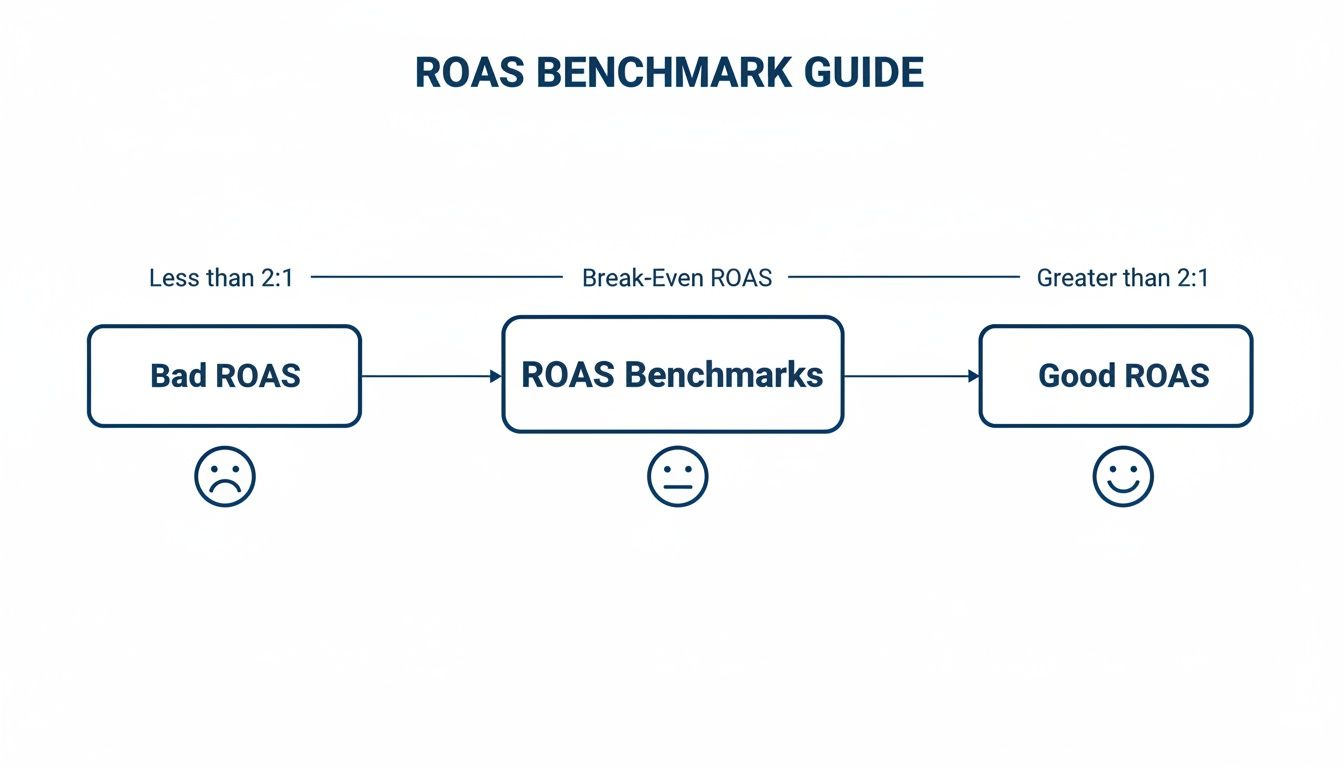
While a "Good" ROAS is the immediate goal, a "Break-even" ROAS can still be a huge win if it acquires a customer with high future purchase potential.
Shifting Your Mindset For Sustainable Growth
Focusing only on front-end ROAS can lead you to make short-sighted decisions, like killing a campaign that’s bringing in high-value, repeat buyers at a slightly lower initial return. The goal isn't just to make a quick buck today; it's to build a brand that people love and trust for the long haul.
This approach transforms your entire business strategy:
- You focus on quality: You create amazing products and designs that make customers want to come back for more.
- You build an email list: You capture customer information to build a direct line of communication for future promotions, turning one-time buyers into repeat fans.
- You create a brand experience: From your website to your customer service, you create an environment that fosters loyalty.
This is how you build a business that thrives for years, not just a few months. It's an incredibly powerful way to think about your store, moving beyond simple ad metrics and into the realm of real brand building. You start playing the long game, and that’s where the real money in eCommerce is made.
Proven Strategies To Increase Your ROAS

Alright, you understand what ROAS is and how to calculate it. Now for the fun part: making that number climb.
Boosting your Return On Ad Spend isn't about finding some magic button. It's about applying a few proven, systematic strategies that give you an edge. This is how you turn a decent campaign into a great one and transform your ad budget into a serious profit machine.
These tactics aren't just theories—they are the exact methods top-tier print-on-demand sellers use to build and scale their businesses. Let's get you equipped to do the same.
Start With Winning Designs The Smart Way
Here’s an exciting truth: the single biggest factor in a successful ad campaign is having a product people actually want to buy. In the print-on-demand world, that means a design that truly connects with a specific audience.
But how do you find a winner without burning through thousands of dollars just on testing?
This is where our Apparel Cloning method comes in. Instead of guessing, you start by identifying designs and concepts that are already proven sellers in the market. You're not copying; you're taking inspiration from successful ideas and creating something unique for an untapped niche. This strategy dramatically de-risks your ad spend from day one because you're launching products with built-in demand.
By focusing on proven concepts, you're not spending money to find a winner. You're spending money to sell a winner. This is a fundamental shift that puts you on the fast track to a higher ROAS.
When your designs are validated from the get-go, every ad dollar works harder. You get more clicks, more conversions, and a much healthier return because you're showing people something they've already shown they love.
Create Breathtaking Creatives With AI
Once you have a winning design, how you present it is everything. Your product mockup is the very first thing a potential customer sees in their social media feed. If it looks amateurish, they’ll scroll right past it, and your ad spend is wasted—no matter how incredible the design is.
Professional, unique mockups are non-negotiable for a high ROAS. This is where AvatarIQ, our proprietary AI tool, gives you an unbelievable advantage. It lets you generate stunning, photorealistic product mockups without hiring models, booking photographers, or buying expensive equipment.
Imagine creating an entire lifestyle photoshoot for your new t-shirt design in just a few minutes. With AvatarIQ, you can:
- Generate diverse models: Show your apparel on a wide range of people to connect with different audience segments.
- Create dynamic scenes: Place your products in exciting, eye-catching environments that tell a compelling story.
- Produce unlimited variations: Test dozens of creative angles to see what resonates most, all without any extra cost.
This level of creative quality directly boosts your ad's click-through rate (CTR) and conversion rate. When more people click and more people buy, your ROAS naturally skyrockets. You're not just selling a shirt; you're selling a lifestyle, and AvatarIQ makes that possible for everyone.
Optimize Your Ads And Landing Page
With a winning design and stunning creatives, the final pieces of the puzzle are refining your ad targeting and making sure your landing page seals the deal.
First, dial in your audience targeting. The most beautiful ad in the world won't work if it's shown to the wrong people. Use the data from your ad platform to pinpoint the demographics, interests, and behaviors of your best customers. Then, create lookalike audiences to find more people just like them.
Next, get your landing page experience right. When someone clicks your ad, their journey needs to be seamless.
- Fast Load Times: Your page must load in under three seconds. A slow site is an absolute conversion killer.
- High-Quality Images: Use your AvatarIQ mockups to show off your product from every possible angle.
- Clear Call-to-Action (CTA): Make your "Add to Cart" or "Buy Now" button unmissable and easy to click.
- Build Trust: Display customer reviews, secure payment badges, and a clear return policy.
Looking at real-world benchmarks, Amazon Advertising reported an impressive average of 4.81 ROAS, which is $4.81 in revenue for every $1 spent. This shows how eCommerce giants optimize for profitability—a perfect blueprint for POD sellers. Imagine launching designs using our Apparel Cloning system: with AvatarIQ generating AI mockups, you slash creative costs and launch proven products faster, feeding directly into a higher ROAS. For entrepreneurs aiming for financial freedom, this means bringing Amazon-level efficiency to platforms like Facebook or TikTok. You can explore more insights about Return On Ad Spend at growthloop.com.
ROAS FAQs: Your Questions, Answered
Once you get the hang of Return On Ad Spend, a few more questions always seem to pop up as you start scaling. Getting these answers locked down is what builds the confidence you need to really put the pedal down on your ads and grow your print-on-demand empire.
Let's tackle the most common ones I hear all the time.
"My ROAS Is Low. What Should I Check First?"
If your ROAS isn't hitting that magic 4x number, don't worry! This is a fantastic opportunity to learn and optimize. The first place to look is almost always one of two things: your ad creative or your audience targeting.
First, be honest with yourself: does your ad actually stop the scroll? Your mockups need to look incredible, not just okay. A tool like AvatarIQ can be a game-changer here, creating photorealistic visuals that grab eyeballs and get people clicking.
Next, get deep into your ad platform's data and check your targeting. The most beautiful ad in the world will fall flat if you show it to the wrong people. Are you positive you're reaching customers who are genuinely obsessed with your niche? A high click-through rate but low conversions is a classic sign of a mismatch between your ad and what they find on your product page.
"How Long Should I Run an Ad Before Making a Decision?"
I get it, it’s tempting to kill an ad after a few hours if it's not printing money. But you've got to give your campaigns time to breathe.
Let any new ad run for at least 3-4 days before you even think about judging it. This gives the ad platform's algorithm enough time to figure out who to show it to and for you to get enough real data to make a smart call.
Pulling the plug too early might mean you're killing a potential winner right before it hits its stride. A great rule of thumb for print-on-demand is to be willing to spend 2-3 times your product's profit margin to properly test a new design. Think of it as an exciting investment in finding your next big winner.
"Can a Negative ROAS Ever Be Profitable?"
This is a more advanced strategy, and it all comes down to Customer Lifetime Value (LTV). In theory, yes, a business might choose to lose money on a customer's first order. They do this knowing that the customer will come back and buy again (and again), making them profitable over the long haul.
But let me be clear: this is not a strategy for beginners.
When you're starting out in print-on-demand, your one and only mission should be to achieve a profitable ROAS on the very first sale. Nail that down first. Once you have a predictable, profitable system for bringing in new customers, then you can start exploring the more complex LTV strategies for massive, long-term growth.
Ready to stop guessing and start building a profitable print-on-demand business with a proven system? At Skup, we provide the training, tools, and coaching to turn your entrepreneurial dreams into reality. Learn more at https://skup.net and start your journey today.