Home » Blog » How to Start a Print on Demand Business from Scratch
Starting a print on demand business comes down to a simple formula: find a passionate group of people, create designs they can't resist, and set up a simple online store to sell them. The best part? You can do it all with zero inventory and ridiculously low startup costs. It's one of the most exciting and accessible ways to build a real brand from scratch.
Your Blueprint for a Profitable POD Business
So, you're ready to build a business that gives you real freedom and lets you ditch the 9-to-5? This is where your incredible journey begins. We're cutting through the noise to give you the exact foundational strategy to launch a profitable print on demand business, even if you've never done anything like this before.
This isn't just theory. It's the practical, repeatable plan our founders, Devin and Matt, have personally used to generate over $50 million in sales.
This is the very same model we've taught to thousands of beginners—many of them parents and working professionals—to help them build their own successful apparel brands. Forget the myth that you need to be a professional artist or a coding genius. The core pieces are way simpler than you think:
Find a hungry niche: Tap into an audience that's actively looking to buy products that reflect who they are.
Create designs that actually sell: You don't need art school. Tools like AvatarIQ can help you generate incredible, professional-quality designs in minutes.
Launch your online store: Get a slick, professional storefront live without touching a single line of code.
Get your first sales: Learn the marketing fundamentals to put your products right in front of eager buyers.
The Massive Opportunity in Print on Demand
Honestly, the timing couldn't be better. The global POD market is absolutely exploding. It's projected to rocket from around $10-13 billion in 2025 to a mind-blowing $103 billion by 2034. This growth is all fueled by people who are tired of generic junk and want unique products that shout their passions from the rooftops.
Unlike a traditional business, print on demand guts the biggest risks. No buying tons of inventory that might not sell. No warehousing fees. No packing boxes and running to the post office. You only pay for a product after a customer has already paid you for it.
If you want a deeper dive into the mechanics, check out our complete guide on what print on demand is. This model frees you up to focus on the only two things that actually matter: creating products people love and building a brand you're proud of.
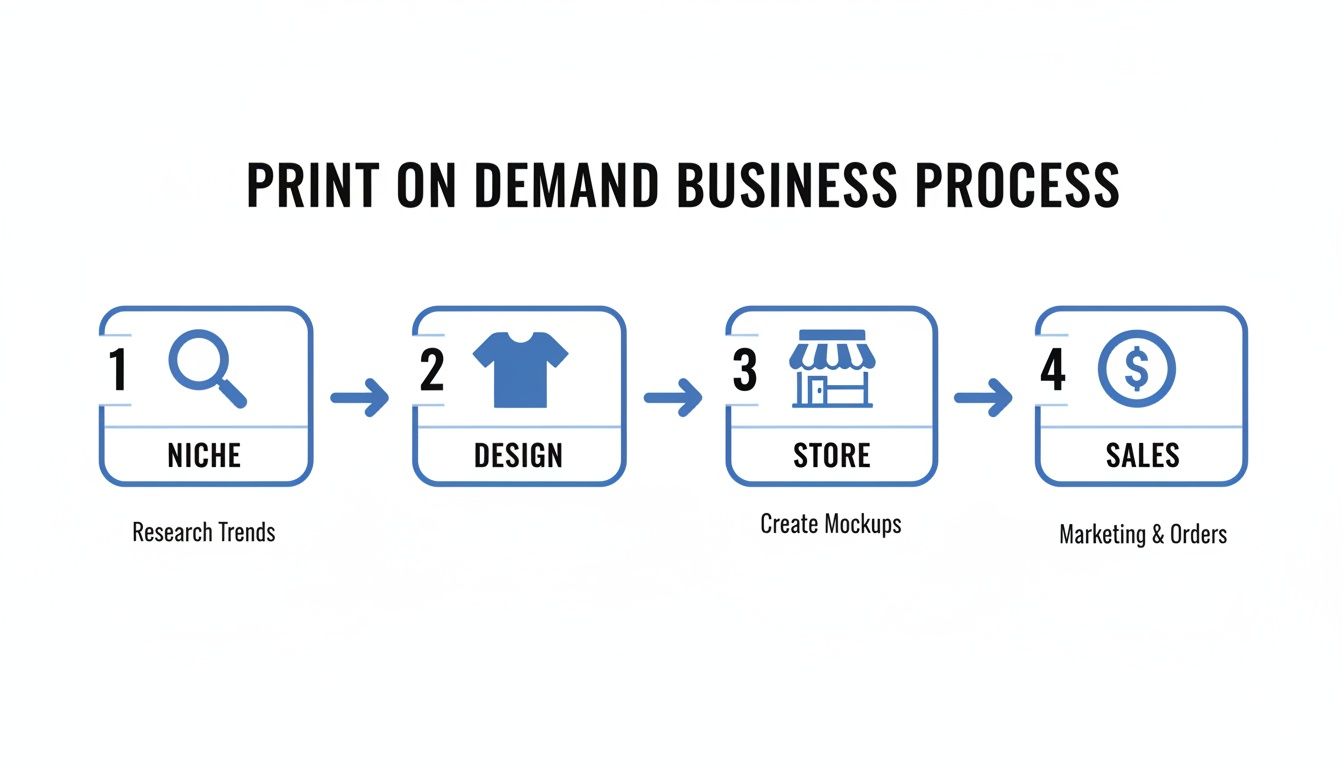
To put it all into perspective, we've broken down the entire journey into a simple, four-phase framework. This is the high-level map you'll follow to get from a simple idea to a running, profitable business.
Your 4-Step Launch Framework
Phase
Key Action
Primary Goal
Phase 1: Foundation
Niche & Audience Research
Find a profitable, passionate audience with proven demand.
Phase 2: Creation
Product & Design Workflow
Create compelling designs and mockups that resonate with your niche.
Phase 3: Setup
Store & Platform Configuration
Build your ecommerce store and connect your POD fulfillment partner.
Phase 4: Launch
Marketing & Sales
Drive targeted traffic to your store and generate your first sales.
This isn't rocket science. Success comes from executing these core steps effectively. This framework is your guide to building a profitable brand from the ground up.
As you can see, the flow is straightforward. It’s all about nailing these four phases to build a business that not only makes money but also gives you the freedom you're looking for.
Finding Your Winning Niche and Products
The secret to a powerhouse print-on-demand business isn’t having a thousand random designs. It’s finding a passionate group of people and becoming their go-to brand.
This is an opportunity for incredible creativity. So many people get paralyzed by too many choices, but you have the advantage of a proven system.
Forget guessing. We’re going to make smart, data-backed decisions from day one. This is the very core of our Apparel Cloning system—a proven method for sniffing out successful products and niches, taking the guesswork out of the equation so you can score wins right away.
Why Passion Equals Profit
The most profitable POD businesses are all built around tight-knit communities. Think about groups built around hobbies, professions, or just deep-seated passions. These are absolute goldmines.
Why? Because these people already have a strong sense of identity. They literally wear their interests on their sleeves and are actively looking for products that show the world who they are.
Instead of generic "funny t-shirts," get specific:
Hobbies: Think of dedicated communities like bass fishermen, quilting fanatics, or classic car restorers.
Professions: Tap into groups with a strong identity, like nurses, electricians, or teachers who live and breathe their work.
Passions: Find the die-hards. Corgi owners, sci-fi movie buffs, or vegan advocates are all great examples.
When you serve a dedicated niche, your marketing becomes ten times easier and way more effective. You're not just shouting into the void; you're speaking directly to a crowd that's already eager to listen. If you're drawing a blank, we've put together a deeper guide on how to find profitable niches for print on demand.
The Art of Smart Research
So, where do you find these killer ideas? Simple. You look for what’s already working.
The goal isn't to copy someone else's designs. It's about understanding the winning formula—the types of phrases, inside jokes, and design styles that are already getting sales.
Marketplaces like Etsy and social media are treasure troves for this kind of research. Hunt for t-shirts with hundreds or even thousands of positive reviews. Then, actually read the comments. What are customers saying? This is pure, direct feedback on what clicks with your potential audience.
This data-driven approach removes uncertainty from the equation. Before you spend a single second creating a design, you’ll have hard proof that a real demand already exists. This is how you build a business with 30-50% profit margins, not a hobby that barely breaks even.
The engine of this entire industry is apparel. Getting your POD business off the ground hinges on it, with personalized tees and hoodies dominating sales. The POD market exploded from $5.04 billion in 2023 to $6.25 billion in 2024 and is on track to hit nearly $20 billion by 2029, driven by consumers' desire for unique gifts and self-expression. Read the full market analysis of print on demand statistics on Scoop.market.us.
Validating Your Niche Idea
Once you've got a potential niche in your sights, it's time for a final check. A few quick questions will tell you if it has legs.
Is the Audience Passionate? Look for active Facebook groups, subreddits, popular blogs, or magazines dedicated to the topic. A buzzing, engaged community is a massive green flag.
Can You Easily Target Them? Put on your marketing hat. On platforms like Facebook, can you target users based on their interest in this specific niche? Specificity is key here.
Is There Room for You? Don't be scared of competition—it just proves there's money to be made. The real question is, can you bring a unique angle or a better design to the table?
Answering "yes" to these questions confirms you've found a solid foundation for your brand. This initial legwork is the most important step. It's what separates a sustainable, long-term business that generates life-changing income from one that makes a few random sales and fizzles out. You're not throwing spaghetti at the wall; you're building a brand with intention.
Creating Stunning Designs with AI
Let's be real for a second. This is the part of the journey where your creativity can truly shine. Some people believe you need to be a seasoned artist to make it in the apparel game.
This is exactly where you’re going to blow right past them.
The truth? Your success isn't about raw artistic talent. It’s about creating designs that resonate with your niche—designs that make people feel seen. And today, you can do that faster and better than ever before. This is where you finally get to turn all that research into real, sellable products.
Your Design Secret Weapon
Forget spending weeks trying to wrestle with complex software or shelling out hundreds of dollars for a freelance designer who doesn't really get your vision. That whole playbook is obsolete.
We built our own tool, AvatarIQ, to solve this exact problem for people just like you.
Think of AvatarIQ as your own in-house design team, on call 24/7. It lets you generate dozens of unique, high-quality apparel designs in minutes, even if your best work is a stick figure. This isn't about pumping out generic, soulless art. It's about giving you the power to bring your very specific, niche-driven ideas to life, instantly.
This one step completely removes the single biggest bottleneck in the print-on-demand model. Instead of grinding for a full day on one design, you can create and test ten. This speed lets you get products live in your store faster, see what’s actually selling, and find your winners in a fraction of the time.
You don't need to be a world-class artist to build a seven-figure apparel brand. You need a system that lets you translate great ideas into great products efficiently. Technology like AvatarIQ is that system, and it levels the playing field for everyone.
From Simple Idea to Sellable Design
You’re not starting from a blank canvas. Your best design ideas will come straight from the niche research you've already done. You’re starting with proven concepts, inside jokes, and styles your audience already loves.
The magic happens when you translate that research into a killer prompt for AvatarIQ. A great prompt is everything.
Let’s say you're targeting passionate cat owners who are also huge fans of vintage sci-fi movies. A lazy, weak prompt would be "cat in space." Yawn.
A powerful prompt that actually sells looks more like this:
"A photorealistic British Shorthair cat wearing a retro 1950s bubble space helmet, floating in space with Earth in the background, vintage comic book art style, detailed, vibrant colors."
See the difference? Specificity is king. The more detail you feed the AI, the closer it will get to creating a unique design that feels like it was made just for your audience.
Creating Mockups That Actually Convert
A killer design is only half the battle. How you present that design is just as critical. Nobody gets excited about a grainy, flat image of a t-shirt on a white background. You have to help your customers see themselves wearing your apparel.
This is another area where AvatarIQ gives you a massive leg up. It can generate professional lifestyle mockups that look like they're from a high-end photoshoot—all without hiring models or photographers.
You can create a whole set of cohesive images showing your designs on different people, in different settings, all matching the vibe of your brand. This simple step instantly makes your store look more professional and builds trust the second someone lands on your product page. A trustworthy, legit-looking brand is non-negotiable when you’re learning how to start a print on demand business that's built to last.
Building Your Store and Choosing a POD Partner
Alright, you've validated your niche and have a folder full of killer designs. Now it's time for the fun part: building your digital storefront. This is where your brand stops being an idea and starts becoming a real place where customers can find and buy your stuff.
This is the step that makes it all feel real. Let's give your vision a home.
Your Store Your Rules: Shopify vs. Etsy
When it comes to building your store, you've got a big choice to make right out of the gate. Do you build your own independent store on a platform like Shopify, or do you set up shop in a crowded marketplace like Etsy?
Let's break it down. Shopify gives you complete control. It’s your brand, your domain, and your rules. You get to customize every single pixel of the customer experience, which is absolutely essential if you're serious about building a long-term, sustainable brand that you actually own. This is the path we recommend for any serious entrepreneur.
Etsy, on the other hand, dangles the carrot of a built-in audience. Millions of buyers are already there, which sounds great in theory. But in reality, you're just renting space on someone else's property. You're stuck with their rules, their fees, and you’re jammed onto the same page as thousands of other sellers.
If you want to build a real asset, Shopify is the undisputed champ.
Selecting Your Print on Demand Fulfillment Partner
This is easily one of the most critical decisions you'll make. Your POD partner is the engine of your entire operation—they handle the printing, the packing, and the shipping. Their quality and reliability are a direct reflection of your brand.
When you're vetting potential partners, you need to put on your detective hat. Don't just glance at the prices and call it a day.
Here's what you need to dig into:
Product Catalog: Do they even have the high-quality apparel brands and specific products your niche will actually want to buy?
Print Quality: Your reputation is on the line with every single shirt. Always order samples. I can't stress this enough. See, feel, and wash the products yourself before you ever sell them to a customer.
Fulfillment Speed: How fast can they print an order and get it out the door? In a world of two-day shipping expectations, speed is a massive advantage.
Shipping Costs & Times: Are their shipping rates competitive? Are their delivery estimates reliable? This stuff directly impacts customer satisfaction and your bottom line.
Your fulfillment partner is a silent extension of your brand. A great partner makes your business feel effortless and keeps customers coming back. A bad one will bury you in logistical nightmares and kill your reputation before you even get off the ground. Choose wisely.
Pricing Your Products for Healthy Profit Margins
Here's a hard truth: profit isn't what you make, it's what you keep. The key to a POD business that actually lasts is setting your prices to lock in healthy profit margins from day one. You should be aiming for a 30-50% profit margin after all your costs are covered.
This means you have to know your numbers inside and out. Your total cost isn't just the base price of the t-shirt from your supplier. It's the base price plus the shipping cost.
Here’s a dead-simple formula to get started:
Retail Price = (Product Cost + Shipping Cost) x 2
Let's say a t-shirt costs you $12 from your supplier and shipping is $5. Your total cost is $17. Doubling that gives you a retail price of $34. This simple math ensures you cover your product costs, have a budget for marketing, and—most importantly—make a real profit on every single sale. This is the foundation of a business that actually thrives.
Getting Your First Sales: Time to Market Your POD Business
Look, you can have the most incredible designs and a pixel-perfect store, but none of it matters if nobody ever sees it. This is where the magic happens. Marketing is the engine that will turn your creative spark into actual, real-world sales.
We're about to break down the exact strategies our founders use to run 8-figure brands, simplified for someone just starting out.
This part might feel intimidating, but honestly, it’s one of the most exciting pieces of the puzzle. This is where you finally connect with your audience and see all your hard work start to pay off. It’s a feeling like no other when that first sale notification hits.
Don't Be Afraid of Paid Ads on Meta
Let's cut right to the chase. The fastest, most reliable way to get targeted traffic to your store is through paid advertising on platforms like Meta (that's Facebook and Instagram).
Forget crossing your fingers and hoping for random visitors. With paid ads, you can put your products directly in front of the exact people you spent time identifying during your niche research.
This isn't about gambling your money away; it's about making small, strategic investments to gather data. The best part is you can start with a tiny budget—think $10 to $20 a day—just to see what designs connect with your audience.
The print on demand market is projected to grow by an insane $25.36 billion between 2024 and 2029. A huge slice of that growth is powered by smart digital marketing. To get your piece of the pie, you need to be smart and targeted from day one.
Setting Up Your First Ad Campaign
Think of your first campaign as a science experiment, not a lottery ticket. The goal isn't to get rich overnight. It's to find out which of your designs makes people stop scrolling and click.
This is the simple framework our Apparel Cloning students use to nail down their first sales and build the data foundation they need to scale.
Here’s a simple game plan to start:
Pick Your Top Designs: Grab 3-5 of your absolute best designs—the ones you’re confident will hit home with your niche.
Create Killer Ad Creative: Use those professional lifestyle mockups you made with AvatarIQ. A clean, eye-catching image isn't optional; it's essential.
Define Your Audience: Jump into Meta Ads Manager and use the detailed interests you uncovered during your research. If your niche is "retired nurses who love gardening," you can literally target people with those exact interests.
Set a Small Daily Budget: Start small. Just $5-$10 per ad set is plenty to gather the initial data you need without risking much.
Your only job right now is to watch the numbers. Don't get emotionally attached to a design. Let the data tell you what people actually want.
Getting your first sale is a monumental moment. It proves the entire system works: you found a hungry audience, created a design they loved, and successfully put it in front of them. That first "cha-ching" is the proof of concept that can scale into a life-changing business.
Key Metrics to Watch from Day One
When you're starting out, it's easy to get lost in all the data inside Ads Manager. Ignore almost all of it. In the beginning, only a handful of metrics truly matter.
Cost Per Click (CPC): How much are you paying for each person who clicks your ad and lands on your store? A low CPC is a great sign that your ad creative is hitting the mark.
Click-Through Rate (CTR): What percentage of people who see your ad are actually clicking it? A higher CTR means your ad is effectively grabbing attention in a crowded feed.
Add to Carts (ATC): Are people who visit your store adding products to their cart? This tells you your product page and pricing are on the right track.
Purchases: This is the one that really counts. It's the ultimate proof that your entire funnel—from the ad to the product to the store—is working together perfectly.
Since POD products are so visual, social media is your best friend. For a deeper dive into one of the most important platforms for apparel, check out this comprehensive Instagram marketing guide for small businesses. Building a solid marketing plan from the get-go is a core part of learning how to start a print on demand business that lasts.
Scaling Your Business with the Apparel Cloning System
That feeling when you get your first few sales? It's incredible. But the real magic happens when you turn those first few wins into a predictable, life-changing income. This is the moment you stop being a hobbyist and start thinking like a serious business owner.
With a handful of sales, you now have the most valuable asset in eCommerce: data. Instead of throwing spaghetti at the wall to see what sticks next, you can look at what’s already working and just do more of it. This is the entire philosophy behind our Apparel Cloning course, and it's the key to growing your store without all the guesswork.
The method is dead simple but incredibly powerful. You find your winners—the designs getting clicks, add-to-carts, and ringing the cash register—and you go all in. I don't just mean running the same ad. I mean creating new, exciting variations of that winning design and aiming them at slightly different corners of your niche.
From Side Hustle to Full-Time Freedom
Look, the Apparel Cloning system isn't some get-rich-quick nonsense. It's a legitimate blueprint for building a real, sustainable brand that can stand the test of time. This requires a mental shift, moving away from chasing one-off hits and focusing on long-term, repeatable growth. To see how a system like this can supercharge your design workflow, you can explore the features of CopyCat247. This is how you build an actual asset that gives you true freedom.
Once your winning campaigns start spitting out consistent profit, you'll start scaling up your ad spend—but intelligently. You pour fuel on the fires that are already burning bright, letting the momentum build on its own. This is also the perfect time to start building another priceless asset: your email list.
Every person who buys from you is a potential repeat customer. When you get their email, you open a direct line to them. You can announce new products and run promotions without having to pay Meta another dime for ads. You're building a customer base you actually own.
The journey from a few sales to a full-time business is about replication, not reinvention. Find what works, create variations of it, and scale your marketing. This methodical process is how you turn a small side hustle into a predictable, income-generating machine.
Knowing When to Expand
As your store grows, the question of "what's next?" becomes a lot easier to answer. Your customers and your sales data will tell you exactly what they want.
If a specific t-shirt design becomes a runaway hit, that's your cue. Why not offer that same beloved design on a cozy hoodie, a coffee mug, or even a hat?
This systematic approach strips the emotion and guesswork out of the business. You’re no longer just starting a print-on-demand business; you're operating it like a pro, making data-backed decisions that lead to consistent growth and the financial independence you're working toward.
Your Top Questions About Starting a POD Business, Answered
Jumping into the world of e-commerce is a huge step, and it's totally normal to have a ton of questions swirling around. So, let's cut through the noise. Here are some straight-up answers to the most common things I hear from people just starting out with print-on-demand.
You'll quickly see that building a real, profitable online business is a lot more straightforward than you might think.
How Much Money Do I Really Need to Start?
This is the big one, right? And the answer is probably the best part about print-on-demand: the startup cost is incredibly low. You're not buying boxes of t-shirts to sit in your garage. That's the old way.
Your main costs are your e-commerce platform subscription (like Shopify), a solid design tool like AvatarIQ, and whatever you're comfortable putting into ads to get the ball rolling.
Honestly, you can start testing the waters with ads for as little as $10-$20 a day. This isn't a get-rich-quick scheme, but that low barrier to entry is exactly what makes this such a killer opportunity. It's how so many people start building their dream business on the side, while still holding down a 9-to-5.
Do I Need to Be a Designer or Artist to Pull This Off?
Absolutely not. Let's kill this myth right now, because it holds way too many people back.
Success in this game isn't about being the next Picasso. It's about having good ideas that connect with a specific group of people. It’s about understanding a niche, not your raw artistic talent.
Tools like AvatarIQ were literally built for non-designers. They use AI to help you crank out professional-looking designs that sell. Even better, our whole Apparel Cloning methodology is built on the idea that simple, proven concepts that resonate with an audience will outperform complex, artsy masterpieces every single time.
How Long Does It Take to Actually Make Money?
This is different for everyone, of course, but it's way faster than a traditional business. Since you have almost zero inventory costs, you can throw a new design up, run a small ad budget to it, and know pretty quickly if you've got a winner. We're talking weeks, not months or years.
Many of our students in the Apparel Cloning program see their first sales within the first week of launching ads. From there, it's about following the system. You reinvest your profits, scale up what's working, and kill what isn't.
Hitting consistent profitability within 30-90 days isn't just a possibility; it's a completely realistic goal if you take consistent action and let the data guide your decisions.
You launch your store, get your first sales, and finally feel like the machine is working. Then the email hits. A customer disputed a charge. The payment is frozen, the order might already be delivered, and now you're staring at a problem that feels way bigger than the sale itself. That first chargeback messes with…
Your phone shows sales. Orders are coming in. The store feels alive. Then you open your payouts, look at ad spend, check fulfillment costs, and realize revenue didn't answer the question that matters. What did each sale leave behind? That's where most POD sellers either get sharp or stay confused. They chase top-line numbers, celebrate…
Your shipping policy can tank conversion before your product ever gets a fair shot. In POD, customers are not just judging price and design. They are judging certainty. If your shipping page blurs production time with transit time, buyers fill in the gaps themselves, and they usually assume the fastest possible outcome. Sellfy notes that…