How to Print on Demand with Amazon: Build a Zero-Inventory Business
Picture this: an eCommerce business that lets you tap into a global marketplace of millions, all without ever buying a single piece of inventory. That's the real power behind learning how to print on demand with Amazon. This isn't just another side hustle—it's a full-blown, scalable business model that opens up incredible opportunities.
Why Amazon Print on Demand Is a Massive Opportunity
Print on demand (POD) is an incredible setup. You create designs for products like t-shirts, mugs, and hoodies, but the products are only physically made after a customer pays you for them. When you pair that with Amazon's colossal customer base, you get a perfect storm for success.
This model completely wipes out the need for inventory, warehousing, and fulfillment headaches. Seriously. You get to focus 100% on the fun stuff: creating killer designs and getting them in front of the right people. You're not just selling products; you're building a brand from scratch with almost zero financial risk. It's an exciting and empowering way to step into eCommerce.
The Numbers Behind the Excitement
This opportunity isn't just a hunch—it's backed by some explosive growth. The print on demand market is on a massive upward tear, making it one of the most exciting fields for anyone wanting to start their own thing.
Right now, the global POD industry is valued at around $12.96 billion. But get this: it's projected to absolutely skyrocket to $102.99 billion by 2034. That's a mind-boggling 26% compound annual growth rate (CAGR).
This isn't just a fad. It's a huge shift in how people shop and how businesses are built. Customers want unique, personalized stuff, and you can be the one to give it to them by plugging directly into Amazon's platform.
Key Benefits of Starting Today
The advantages of jumping into an Amazon POD business are crystal clear, especially if you're looking for a low-risk way into eCommerce.
- Zero Inventory Risk: You never have to buy products upfront. This completely kills the fear of getting stuck with boxes of unsold stock and losing a ton of money.
- Minimal Startup Costs: Your main investment is your time and creativity. You're not sinking cash into physical goods, which makes this one of the most accessible business models out there.
- Access to Amazon's Audience: You're tapping into a ready-made marketplace with millions of active buyers who are already there, credit cards in hand, ready to purchase.
- Creative Freedom: You can launch products for any niche you can dream up. From hobbies and passions to trending memes and holiday themes, the sky's the limit.
The beauty of print on demand with Amazon is that your success is only limited by your creativity and willingness to learn. You can test ideas quickly, find winning products, and build a real, sustainable income stream without the traditional retail headaches.
This guide is built to give you the exact steps to get started. By the time you're done, you'll have the knowledge you need to start building your own brand and feel genuinely excited about the freedom this path offers. If you want a quick primer first, you might want to check out our guide on what is print on demand.
Choosing Your Amazon POD Platform
When you're ready to jump into print on demand with Amazon, you've got two main roads you can take. Your choice isn't about which one is "better" across the board, but which one is the right launchpad for you and your specific goals right now.
Think of it like choosing between a fully guided tour and a self-guided adventure. Both get you to incredible places, but the journey and the level of control you have are completely different. Let's break down your options.
The Simplicity of Amazon Merch on Demand
For most people dipping their toes into the water, the first path is the ideal starting point: Amazon Merch on Demand.
This is Amazon’s own, fully integrated print on demand service, which makes getting started almost unbelievably straightforward. You simply upload a design, pick the products you want to sell it on (like t-shirts or hoodies), write a title and description, and Amazon handles literally everything else.
From there, Amazon creates the product listing, prints the item when someone buys it, ships it out, and even manages all the customer service. It’s a completely hands-off approach that frees you up to focus on what matters most in the beginning: creating great designs and figuring out what people want to buy.
Imagine you have a killer idea for a t-shirt aimed at coffee lovers. With Merch on Demand, you can go from design concept to a live product listing—available to millions of shoppers—in a matter of minutes. No supplier integrations, no shipping logistics, no return policies to worry about.
This streamlined process makes it the perfect sandbox to test ideas with zero financial risk. You can throw a dozen different designs at the wall to see what sticks, gathering real-world data on what customers are actually buying.
Key Takeaway: Amazon Merch on Demand is your fast track to selling. Its simplicity removes nearly every technical barrier, making it the perfect platform for beginners to get their first sales and build confidence.
This simplicity is amazing for getting started, but as you grow, you might want more control over your brand, a larger product catalog, or direct access to customer data. For ambitious sellers, those opportunities lead to the second path.
The Control of Seller Central with POD Integration
The other route involves opening an Amazon Seller Central account and integrating it with a third-party print on demand supplier.
This approach is like moving from renting an apartment to owning your own home. It requires more setup and management, but you get far greater freedom and control over your business.
Using Seller Central, you aren't just a designer; you're a full-fledged brand owner on the Amazon marketplace. You can build a branded storefront, offer a much wider range of products from your chosen supplier (think custom phone cases, canvases, blankets, and more), and gain access to valuable customer analytics.
Let's go back to that coffee-lover t-shirt. If it takes off on Merch on Demand, that's great. But with a Seller Central setup, you could immediately expand that winning design onto mugs, tote bags, and aprons from your supplier. You also unlock the ability to run more advanced marketing, like Amazon Ads, and build a brand that customers recognize and come back to.
For a deeper dive into potential partners, check out our guide on the best print on demand companies to see what’s possible.
This path gives you the power to create a more robust, long-term business asset. You have a more direct relationship with your customers and the flexibility to build a brand that extends far beyond just a few product types.
So, how do you decide which path is right for you? It really boils down to your experience and goals.
Merch on Demand vs. Seller Central: A Quick Comparison
To make the choice crystal clear, let's put the two options side-by-side.
| Feature | Amazon Merch on Demand | Seller Central with POD Integration |
|---|---|---|
| Ease of Use | Extremely simple. Upload design, add text, done. | Requires more setup, including supplier integration and listing creation. |
| Upfront Cost | $0. Completely free to get started. | Requires a $39.99/month Professional Seller account fee. |
| Product Catalog | Limited to Amazon's curated list of apparel, pop sockets, etc. | Vast. Access your POD supplier's entire catalog (hundreds of items). |
| Branding Control | Minimal. Your products are listed as "sold by Amazon." | Full control. Build a branded storefront, use custom packaging (sometimes). |
| Customer Data | None. Amazon owns the customer relationship entirely. | You get access to buyer information and can build a customer list. |
| Marketing Tools | Very limited. Relies on organic search and Amazon's algorithm. | Full access to Amazon Ads, promotions, and other marketing tools. |
| Best For | Beginners, designers testing ideas, those wanting a simple start. | Entrepreneurs building a long-term brand, experienced sellers. |
At the end of the day, both platforms offer incredible opportunities. Your decision just determines your starting point.
- Choose Amazon Merch on Demand if: You're a complete beginner who wants the simplest, fastest way to get started and test ideas without any technical hurdles or costs.
- Choose Seller Central with a POD partner if: You have some eCommerce experience or are committed to building a long-term brand with more product variety and marketing control from day one.
There's no wrong answer here. In fact, many successful sellers start with Merch on Demand to learn the ropes, find their winning niches, and then "graduate" to a full Seller Central store to scale their business. The amazing thing is that both paths lead to the same destination: a thriving, location-independent business fueled by your creativity.
Creating Designs That Actually Sell
This is where the magic happens. Many aspiring entrepreneurs feel this is a major hurdle, thinking, "I'm not a designer, how can I possibly compete?" Let's bust that myth right now.
You absolutely do not need to be a professional artist to create products that people are lining up to buy. Success with how to print on demand with Amazon is less about artistic genius and much more about having a smart strategy.
The secret isn't just making pretty pictures. It's about creating designs that connect with a specific group of people on an emotional level. You're giving them something that lets them express who they are, what they love, or what cracks them up.
Once you shift your mindset from "artist" to "marketer," you unlock a completely different, sales-first way of thinking.
The Apparel Cloning Method
Instead of guessing what might work, we teach a systematic approach called Apparel Cloning.
This isn't about copying other people's work—not even close. It’s a research-based strategy for pinpointing proven market demand before you ever create a single thing. The idea is to find designs that are already best-sellers, figure out why they're so successful, and then apply that winning formula to a new, untapped niche.
Think of it like this:
- Identify a Proven Concept: You spot a t-shirt with a funny slogan about knitting that's selling like crazy. The concept is simple: a witty phrase that resonates with a hobbyist group.
- Find an Untapped Niche: Now, you take that same concept to a different, less crowded niche. How about woodworking, container gardening, or restoring classic cars?
- Create Something Better: You don't just copy the idea; you improve it. You find a better font, write a more clever phrase, or use a more striking layout. You're creating a superior product for a hungry audience that's been overlooked.
This method completely removes the guesswork. You're not just hoping for the best; you're launching a product with built-in demand. That's a massive head start.
Unlocking Your Creativity with AvatarIQ
"Okay," you might be thinking, "I get the strategy, but I still can't physically create the design." This is the exact bottleneck our proprietary AI tool, AvatarIQ, was built to solve.
AvatarIQ is your personal design assistant, capable of generating unique, professional-quality concepts in a matter of minutes. No technical skills needed. You just feed it a prompt based on your research, and the AI gets to work, spitting out stunning visuals ready for a t-shirt, hoodie, or coffee mug.
This changes the entire game. The time it takes to go from a proven idea to a sellable product shrinks from days or weeks to mere minutes. You can test more ideas, jump into more niches, and scale your business faster than ever before.
But AvatarIQ does more than just generate designs. It also creates hyper-realistic product mockups. Instead of showing a flat, boring picture of a t-shirt, you can create lifestyle photoshoots with your apparel on models in real-world settings. This is absolutely crucial.
Customers don't just buy a design; they buy the feeling and identity that comes with it. High-quality mockups make your products look premium and desirable, which leads to higher click-through rates and, ultimately, more sales on a crowded Amazon results page.
Think Like a Buyer
To really master this, you need to get inside the head of your target customer. What makes them tick? What are their passions, their inside jokes, their biggest complaints? This is where research becomes your superpower.
Spend time where your audience hangs out online.
- Go through Facebook groups dedicated to their hobby.
- Browse subreddits and see what memes and phrases are trending.
- Check out what's popular on other marketplaces like Etsy.
What language do they use? What are the recurring themes you keep seeing? This isn't just about finding design ideas; it's about understanding the culture of your niche. A design that nails a niche-specific joke or a deeply held value will always crush a generic one. For more direct advice on this, you can dig into our full guide on how to design for print on demand.
When you combine the strategic approach of Apparel Cloning, the creative power of AvatarIQ, and a deep understanding of your customer, you build an unstoppable system for launching winners. You'll be making designs that don't just look good but connect, resonate, and—most importantly—sell.
Making Sure Customers Actually See Your Products
You could have the most incredible, jaw-dropping design in the world, but if nobody ever lays eyes on it, it might as well not exist. This is where we pivot from being creators to becoming smart marketers. If you want to succeed with print on demand on Amazon, you absolutely have to master the art of the product listing.
Getting your stuff noticed isn't about luck. It’s about methodically telling Amazon's algorithm exactly what your product is and who it's for. Nail this, and Amazon will start putting your design in front of thousands of people who are searching for something just like it.
Think of this as your crash course in Amazon SEO. We're going to dive into writing killer titles, bullet points, and descriptions—all packed with the keywords real customers are typing into that search bar. Let's make your products impossible to ignore.
Think Like Your Customer First
The biggest secret to a powerful listing is surprisingly simple: stop thinking about what you want to say and start focusing on what your customer wants to find. You have to speak their language.
Put yourself in their shoes for a minute. If you were looking for a t-shirt for your gardening-obsessed aunt, what would you type into Amazon? Maybe "gardening shirt," "plant lover gift," "funny garden t-shirt," or something specific like an "I'd rather be in my garden" tee?
Those aren't just words; they're valuable search queries. Each one is a direct line into your customer's brain. Your job is to capture these phrases and weave them into your listing so naturally that it feels like you're reading their mind.
Key Takeaway: Your product listing isn't just a block of text; it's a conversation with your potential buyer. When you use the exact words they're using, you build an instant connection that makes them want to click "Add to Cart."
Before you write a single word, just open a blank document and jot down a list of your main keywords and related phrases. Think about the niche, who you're selling to, the occasion (like a birthday or holiday), and the style of the design. This list is the foundation of your entire listing.
Crafting High-Impact Titles and Bullet Points
Your title and bullet points are the most valuable real estate on your entire Amazon product page. They carry the most weight with Amazon's search algorithm and are the very first things a customer scans.
Your Title Is Your Hook
The title needs to be crystal clear, descriptive, and loaded with your most important keywords right at the beginning. A simple formula works wonders:
- Main Keywords: "Funny Fishing Shirt"
- Target Audience: "for Men Dad"
- Occasion/Benefit: "Fathers Day Gift"
Put it all together, and you get something like: "Funny Fishing Shirt for Men Dad, Humorous Fathers Day Gift for Fisherman." In a single glance, this title tells both Amazon and the customer everything they need to know.
Bullet Points That Actually Sell
Right below the title, your bullet points are where you seal the deal. This is your chance to expand on the benefits and sprinkle in more of those secondary keywords you brainstormed earlier.
The key is to sell the feeling, not just list the features.
- Instead of writing "Made of cotton," try something like, "Perfect Gift for the Angler in Your Life: Whether it's for a birthday, Father's Day, or Christmas, this hilarious fishing tee is a guaranteed catch for any dad, grandpa, or husband who loves to fish."
- Instead of just "Classic fit," write "Comfortable and Durable for All-Day Wear: Made from soft, breathable fabric, this shirt is perfect for a long day on the boat or just relaxing at home. The classic fit ensures it looks great on any body type."
Each bullet point should paint a picture for the customer and get them excited about their purchase.
Pricing for Profit and Competitiveness
The final piece of the listing puzzle is setting your price. It's a delicate balance—you need to be competitive enough to attract buyers but profitable enough to actually build a business.
A good target to aim for is a healthy 30-50% profit margin. This gives you enough wiggle room to run ads later on if you want and still take home a solid profit from every sale.
Here’s how to break down pricing:
- Calculate Your Base Cost: This is the non-negotiable fee Amazon (or your POD partner) charges for the blank product and the printing.
- Determine Your Royalty: This is your profit. On Merch on Demand, Amazon makes this easy by showing you exactly what your royalty will be at different price points.
- Analyze the Competition: Do a quick search. What are similar quality shirts in your niche selling for? You don't always have to be the cheapest, but you need to be in the same ballpark.
For example, if the base cost of a t-shirt is $12 and you see similar designs selling for $19.99, your royalty would be around $7.99. That puts you at a fantastic 40% margin. For a business with zero inventory and zero risk, that's an incredible number—and it's totally achievable.
So, You're Live. Now What? Launching and Scaling Your POD Business
Your first products are up on Amazon, and you’re probably feeling that initial buzz of excitement. That's a fantastic first step. What you do next is what separates a flash-in-the-pan hobby from a real, scalable business. This is where you shift gears from just launching products to actually building a sustainable income stream.
It’s time to stop just uploading and start building momentum. Many new sellers wait for Amazon to work its magic. While the organic traffic is a huge piece of the puzzle, you can give the algorithm a serious nudge in the right direction.
Even a small, targeted Facebook Ad campaign can do wonders. Sending that strategic external traffic signals to Amazon that your product has potential. It's like giving your listing a little jetpack, helping it climb the organic search rankings much faster than it would on its own.
The Goldmine in Your Sales Data
Once those first sales start to trickle in, you’re no longer flying blind. You have data. And that data is the single most valuable asset you have for growing your business. It’s the market telling you exactly what it wants from you.
Think of every single sale as a vote. A real customer just raised their hand and said, “Yes, I like this design, in this niche, on this specific product.” Your job is to listen—really listen—and then give the people more of what they’re already buying.
This simple feedback loop completely changes how you approach how to print on demand with Amazon. Forget chasing a million new ideas. Start mining the gold you've already struck.
- Find Your Winners: Which designs are getting consistent sales? Even just one or two a day is a powerful signal. These are your top performers.
- Figure Out the 'Why': Why is that t-shirt selling? Is it the funny slogan? The specific dog breed? The art style? Break down what makes it successful.
- Double Down, Hard: Now, create variations. If a "Grumpy Cat Fisherman" shirt is a hit, make five more designs for fishing enthusiasts. Then, take that "Grumpy Cat" concept and apply it to other hobbies like golfing, knitting, or grilling.
This is the core of our strategy. Seriously. We've built 8-figure businesses by finding what's working and just doing more of it. It's a ridiculously simple concept that is shockingly powerful when you stay focused.
The fastest way to a six-figure POD business isn't about having a thousand different designs. It's about having a handful of proven concepts that you scale relentlessly across new products and related niches.
Building a Business That Runs Itself
Those first few sales are great, but the real magic happens when you build a system that generates sales day in and day out, whether you're at your desk or not. The fact that you can do this on a global scale with Amazon is just incredible.
Tapping into Amazon’s infrastructure is a massive advantage. Market forecasts show the print-on-demand world is set to explode, adding a staggering $25.36 billion in value between 2024 and 2029. That’s a 25.6% annual growth rate. North America is currently leading the charge with a 36% market share, but the opportunity is worldwide.
You're jumping into a rising tide, backed by Amazon’s direct access to over 300 million Prime users. You can dig into the numbers in Technavio’s full market research report.
The process for capturing this demand is straightforward, as you can see below.
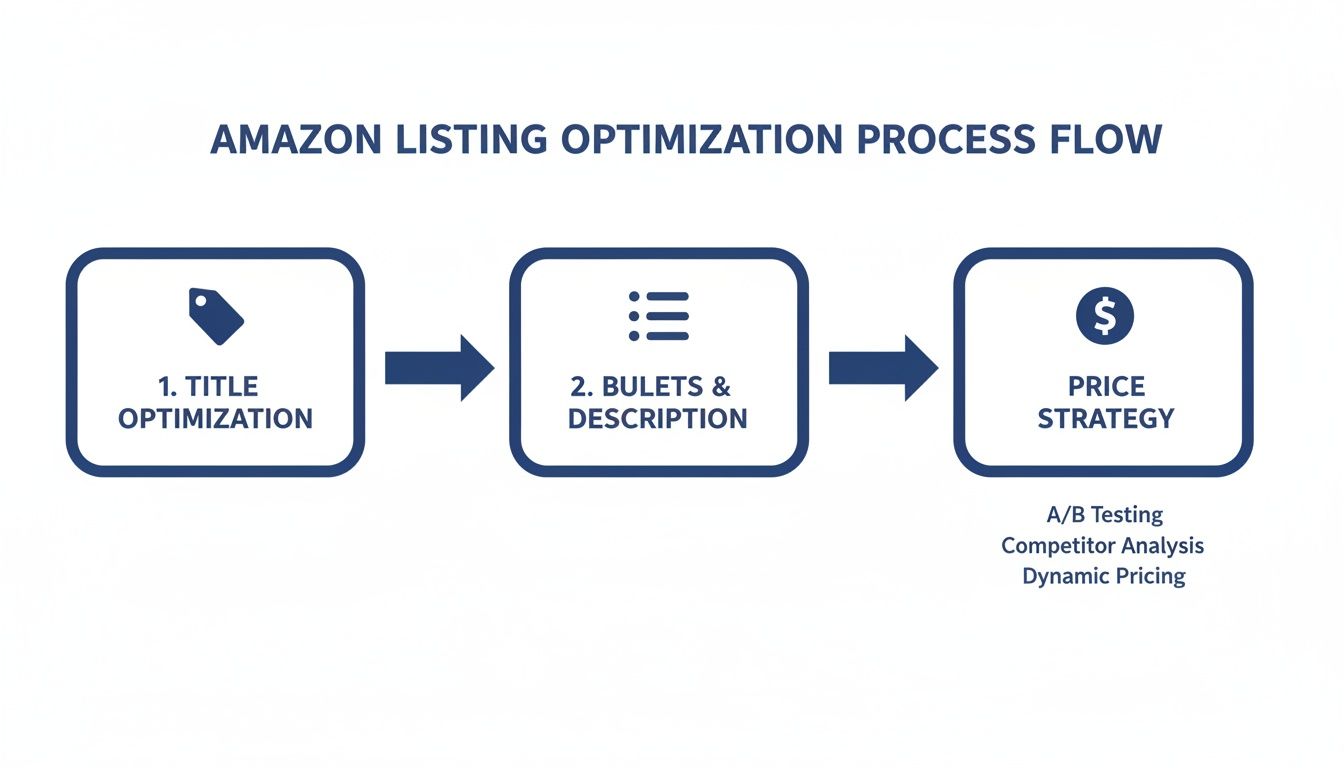
It all boils down to mastering three key parts of your Amazon listing: your title, your bullet points, and your pricing strategy.
Ready to Get Serious About Scaling?
Once you have a few winning designs and a consistent flow of sales, you’ll hit a fork in the road. You can keep things ticking along as they are, or you can decide to turn this into a business that could genuinely change your life. For those who are ready to pour some fuel on the fire, we’ve laid out a proven path.
Our Apparel Cloning course is the training we built to take you from those first exciting sales to a reliable income. It’s a complete system for finding winning designs and scaling them without all the guesswork. It's the perfect next move for anyone who's had a taste of success and is ready for the main course.
The road from your first sale to a full-time business is an exciting one. By focusing on your data, hammering your winners, and following a proven system, you can build something truly amazing. The opportunity is right there for the taking.
A Few Common Questions About Selling POD on Amazon
As you get ready to jump into your print-on-demand business, it's totally normal to have some last-minute questions buzzing around. This is a genuinely exciting path, and getting those final doubts cleared up is the last thing standing between you and building something awesome. Let's run through some of the most common questions I hear from people just starting out.
How Much Money Do I Really Need to Start?
This is, hands down, one of the best parts of the POD model. The barrier to entry is just incredibly low. You're not buying any inventory upfront, which is the single biggest cost that holds people back from traditional retail.
Honestly, your main expenses are pretty minimal. You might opt for an Amazon Professional Seller account, which runs $39.99/month, and a subscription to a solid design tool like AvatarIQ. A powerful tool like this pays for itself almost immediately by slashing the time it takes to get your creative ideas ready to sell.
While you can genuinely get started on a shoestring budget, it’s a smart move to have a little extra cash set aside for some initial ads. This isn't mandatory, but it helps you collect crucial data way faster and land those first few sales that signal to Amazon's algorithm that your product is worth showing to more people. From there, you just reinvest your profits to grow. It's one of the most accessible business opportunities out there today.
Who Handles Customer Service and Returns?
Here's another huge weight lifted right off your shoulders. The short answer is: Amazon handles almost all of it. This frees you up to focus on the things that actually grow your business.
If you're selling through Amazon Merch on Demand, the entire process is 100% hands-off for you. Amazon takes care of all the production, shipping, customer questions, and any returns. If a buyer has an issue, they're dealing with Amazon's world-class customer service, not you.
When you use a Seller Central account with a POD partner, your partner is on the hook for production and print quality. But even then, Amazon still manages the entire customer-facing experience. They handle the service chats, the return process, and all the logistics. This system is designed to let you pour your energy into the high-value tasks: finding new niches, creating killer designs, and marketing your products.
Is the Amazon POD Market Too Saturated?
This is a common question, but it’s usually based on a misunderstanding of how this market actually works. If you've got the right strategy, this concern is completely unfounded.
Look, if you're trying to launch yet another "funny cat shirt," you're going to have a bad time. That's a red ocean. But for every one of those massive, oversaturated categories, there are literally thousands of untapped sub-niches packed with passionate buyers who are desperate for a product that speaks to them.
Success here isn't about competing with everyone. It's about finding a concept that's already working in one niche and applying it to a new, overlooked audience. Our entire Apparel Cloning system is built on this exact principle. The market is projected to keep growing, and new trends pop up every single day. There is more than enough room for sellers who think strategically. The opportunity is immense.
The real question isn't whether the market is too crowded. It's whether you have a smart system to find the open water. With the right research, you can carve out a profitable space that feels like it was made just for you.
What Sells Well Besides T-Shirts?
Apparel is a fantastic foundation for any POD business, but diversifying your product catalog is where you can build some serious long-term, stable income. Expanding beyond t-shirts is a powerful way to create multiple revenue streams from a single design.
Books and notebooks sold through Amazon KDP, for example, can be absolute game-changers. I’ve seen a simple, well-designed handwriting practice book for kids or a planner for a specific hobby generate consistent, passive sales month after month, often with zero ad spend once it gets traction.
Other high-potential categories to explore include:
- Home Decor: Think throw pillows and custom blankets. People love personalizing their living spaces.
- Accessories: Tote bags and mugs are evergreen best-sellers and make for fantastic, easy-to-buy gifts.
- Stationery: Niche-specific journals, notebooks, and planners can become incredibly steady sellers.
No matter the product, the core strategy is the same. Find a passionate audience, figure out what they want, and create a unique product that serves them perfectly.
You have the strategy, the tools, and the roadmap. The only thing left to do is take that first step. At Skup, we've built our entire company around helping entrepreneurs just like you build profitable, sustainable businesses from the ground up.
If you're ready to stop dreaming and start building, explore our proven systems and tools at https://skup.net.